Coursera vs Udemy for AI & ML (2026): Which Platform Is Better?
This page compares Coursera and Udemy specifically for learners pursuing Artificial Intelligence and Machine Learning courses in 2026. Whether you are a beginner exploring AI for the first time, a working professional upskilling for a career pivot, or a student targeting employer-recognized credentials, this Coursera vs Udemy comparison covers pricing, course quality, certificates, learning experience, and career outcomes to help you choose the right platform.
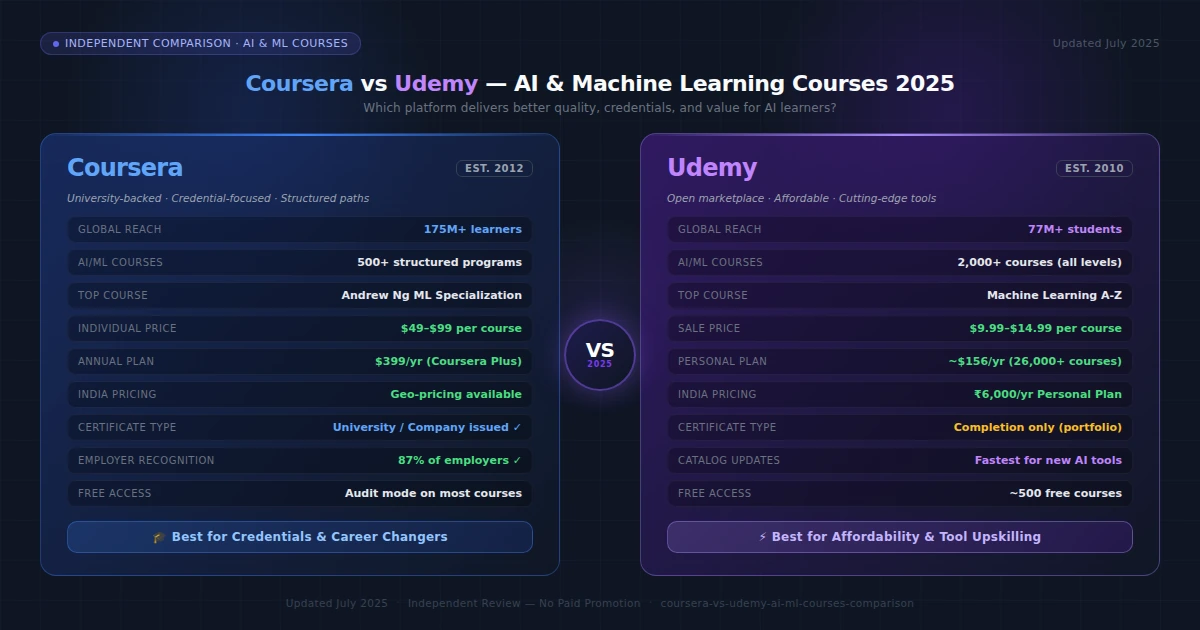
Coursera vs Udemy for AI & Machine Learning (2026)
Coursera
Coursera was founded in 2012 by Stanford University professors Andrew Ng and Daphne Koller with the mission of providing universal access to world-class education. Headquartered in California, USA, the platform has grown to serve over 175 million registered learners globally as of 2026 and partners with more than 350 universities and organizations — including Stanford, Yale, Google, IBM, Meta, and DeepLearning.AI. Coursera operates primarily as a curated academic platform, offering individual courses, Specializations, Professional Certificates, MasterTrack Certificates, and fully accredited online degrees. Its primary user base includes career changers, working professionals seeking employer-recognized credentials, and learners in higher education. Coursera introduced geo-pricing in mid-2026 to make courses more affordable in lower-income countries, including India.
Udemy
Udemy was founded in 2010 and is headquartered in San Francisco, USA. It operates as an open online learning marketplace where independent instructors publish courses, resulting in a catalog of over 250,000 courses across virtually every topic. As of 2026, Udemy reports more than 77 million students on its platform. Unlike Coursera's institutional model, Udemy allows any qualified professional to create and sell courses, which produces enormous variety but also variable quality. The platform is particularly popular for practical, skill-specific learning in technology, data science, AI, programming, business, and design. Udemy offers both individual course purchases with lifetime access and a subscription-based Personal Plan. Its primary user base includes self-taught learners, working professionals, hobbyists, and budget-conscious students looking to build specific technical skills quickly.
Coursera vs Udemy: Full Feature Comparison
Feature | Coursera | Udemy |
Founded | 2012 | 2010 |
Primary Market | Global; strong in USA, India, Europe | Global; popular in USA, India, UK |
AI & ML Courses | 500+ structured AI/ML programs | 2,000+ AI/ML courses (all levels) |
Subjects Covered | AI, ML, Data Science, Business, Health, Engineering, Humanities | AI, ML, Coding, Design, Business, Photography, Personal Dev |
Course Quality Control | Curated; only universities & vetted companies publish | Open marketplace; quality varies widely |
Top AI/ML Instructors | Andrew Ng (DeepLearning.AI), Google, IBM, Stanford | Jose Portilla, Kirill Eremenko, independent AI engineers |
Learning Structure | Structured paths with deadlines, peer review, graded assignments | Self-paced; no deadlines; optional quizzes |
Pricing Model | Subscription (Coursera Plus) or per-course/certificate | Per-course (lifetime access) or Personal Plan subscription |
Individual Course Price | $49–$99 per course | $9.99–$199.99 (frequent sales at $9.99–$14.99) |
Subscription Price | $59/month or $399/year (Coursera Plus) | ~$20/month or ~$156/year (Personal Plan) |
India Pricing | Geo-pricing available from mid-2026 | ₹780/month or ~₹6,000/year (Personal Plan) |
Free Content | Audit mode (no certificate); 300+ fully free courses | ~500 free courses (mostly introductory) |
Financial Aid | Yes — full access including certificate, apply per course | 30-day refund guarantee; no formal aid program |
Certificate Type | University/company-issued, verified, LinkedIn shareable | Certificate of Completion (not institution-issued) |
Employer Recognition | High — Google, IBM, Meta certs recognized by 87% of employers (per Coursera 2026 Impact Report) | Moderate — good for portfolio; less weight with HR teams |
Accredited Degrees | Yes — full degrees from Imperial College, UT Austin, etc. | No |
Mobile App | 4.8/5 iOS, 4.5/5 Android; offline downloads | App available; user-reported stability issues on some devices |
Community & Support | Forums, peer review, 24/7 customer support | Q&A per course; instructor response varies |
AI Learning Features | Coursera Coach AI tutor; ML-translated content in 26 languages | Udemy AI Assistant; AI Role Play simulations |
Best For | Career changers, credential seekers, structured learners | Budget learners, rapid upskilling, tool-specific AI courses |
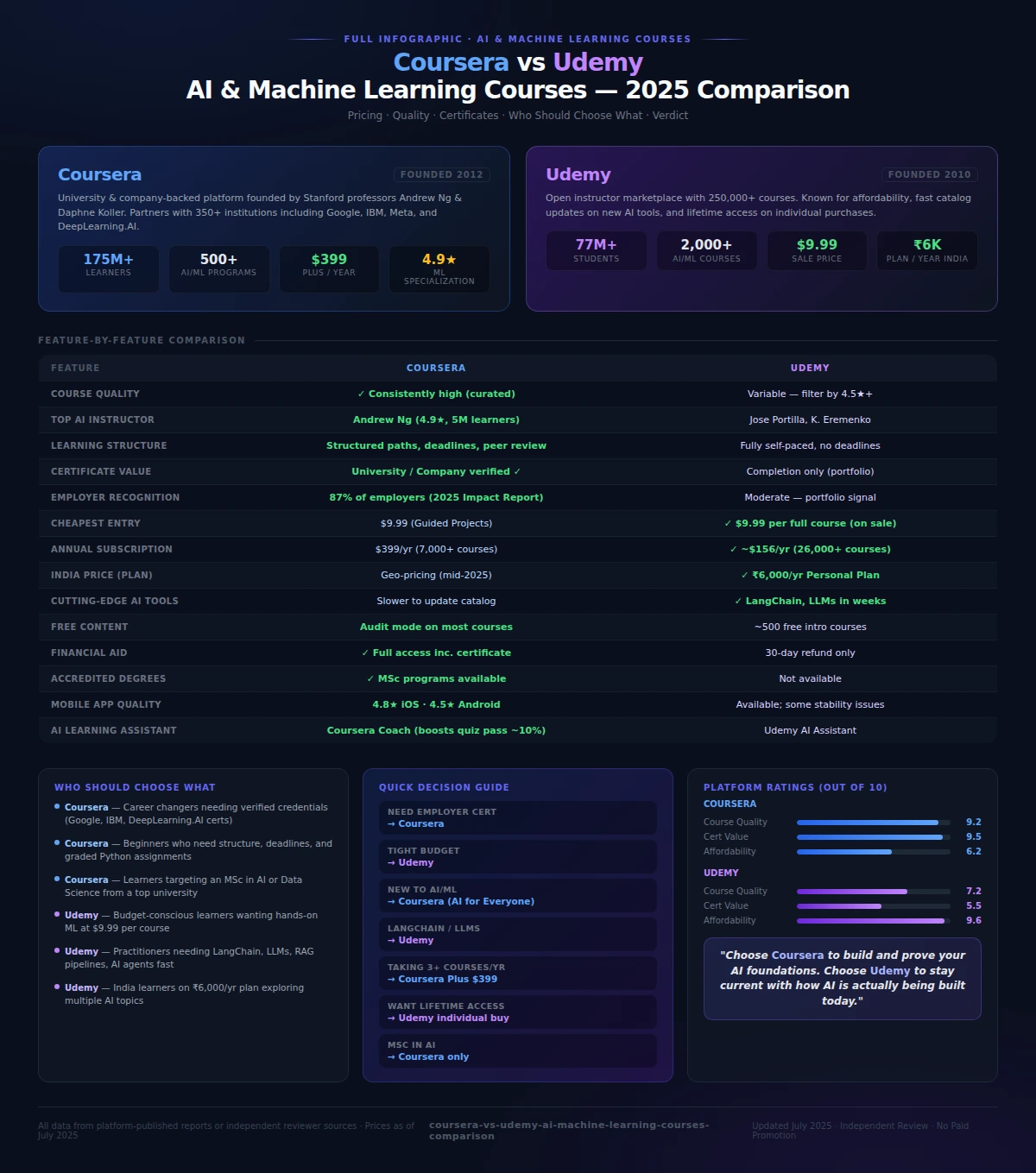
Table Summary: The most important difference between Coursera and Udemy for AI and ML learners is credential value — Coursera issues certificates from recognized universities and companies that carry measurable career weight, while Udemy certificates are completion records that serve as portfolio evidence. For pricing, Udemy wins decisively on individual course cost during promotions, but Coursera Plus offers better value for learners taking multiple programs over a year.
Course Pricing & Value: What Do You Actually Pay?
Pricing is one of the most commonly misunderstood aspects of both platforms. Coursera appears expensive at list price but offers geo-pricing (from mid-2026), financial aid, and free audit options that significantly lower the effective cost. Udemy appears very cheap — often $9.99 per course during frequent sales — but the actual list price can reach $199.99, and the Personal Plan subscription gives access only to a curated subset of 26,000 courses from its 250,000+ catalog. Here is a direct comparison of the main pricing tiers relevant to AI and ML learners.
Pricing Tier | Coursera | Udemy |
Free Access | Audit mode on most courses (no certificate) | ~500 free introductory courses |
Cheapest Paid Entry | $9.99 (Guided Projects) | $9.99 per course (during frequent sales) |
Individual AI/ML Course | $49–$99 per course | $9.99–$199.99 (typically $9.99–$14.99 on sale) |
Specialization / Path | $39–$79/month (e.g., ML Specialization) | Must purchase individual courses separately |
Subscription — Monthly | $59/month (Coursera Plus, 7,000+ courses) | ~$20/month (Personal Plan, 26,000 curated courses) |
Subscription — Annual | $399/year (Coursera Plus) | ~$156/year (Personal Plan) |
India Subscription Price | Geo-pricing (check Coursera for current INR rate) | ₹780/month or ~₹6,000/year |
Degrees / Advanced | $9,000–$50,000 (accredited degrees) | Not available |
Financial Aid | Yes — free full access including certificate | No formal program; 30-day refund policy |
Free Trial | 7-day free trial (monthly plan) | 7-day free trial (Personal Plan) |
Refund Policy | 14-day for subscriptions; per-course varies | 30-day money-back guarantee |
Pricing Verdict: For a single AI or ML course, Udemy is the clear winner on cost — especially during its frequent promotions. For learners planning to take three or more courses or earn a Professional Certificate, Coursera Plus at $399/year often delivers better value than purchasing Udemy courses individually. Indian learners should check both platforms' current geo-pricing, as Coursera introduced localized pricing in 2026.
How to Get Started: Step-by-Step Guide
Starting on Coursera — Step-by-Step
1. Create a free account at coursera.org.
Tip: Use your LinkedIn profile photo and professional email — your Coursera profile links to your earned certificates on LinkedIn automatically.
2. Search for an AI or ML program that matches your level.
Tip: For absolute beginners, start with AI for Everyone (Andrew Ng, DeepLearning.AI) — it is non-technical and free to audit. For technical learners, the Machine Learning Specialization by Andrew Ng is the gold standard.
3. Use Audit Mode first to evaluate course quality before paying.
Tip: Audit gives access to video lectures and reading materials. You only need to pay to access graded assignments and receive a certificate.
4. Apply for financial aid if the course fee is a barrier.
Tip: Financial aid applications typically take 2–3 weeks to process and, when approved, grant full access including graded work and the verified certificate at no cost.
5. Subscribe to Coursera Plus if you plan to take more than one program.
Tip: The annual plan at $399 breaks even after approximately 5–7 individual course purchases, making it cost-effective for serious learners.
6. Complete graded assignments and submit peer-reviewed projects.
Tip: Coursera's graded programming assignments — many in Python using Jupyter Notebooks — are the primary quality signal that separates Coursera's ML training from passive video platforms.
7. Download your verified certificate and add it to LinkedIn.
Tip: Certificates issued by Google, IBM, Stanford, and DeepLearning.AI on Coursera are widely shared by hiring managers and are verifiable via a unique URL.
8. Progress into a Professional Certificate or Specialization for maximum career impact.
Tip: According to Coursera's 2026 Learner Outcomes Report, nearly half of surveyed learners who completed a Professional Certificate reported a salary increase or promotion within six months.
Starting on Udemy — Step-by-Step
1. Create a free account at udemy.com.
Tip: No credit card required for a free account. Browse the full catalog before deciding whether to buy individually or subscribe.
2. Search for your specific AI or ML topic and filter by rating (4.5+) and recent update date.
Tip: Because Udemy is an open marketplace, quality varies significantly. Filter courses by 4.5 stars or higher, a recent update (2024 or 2026), and a minimum of a few thousand reviews to avoid low-quality content.
3. Preview course content using the free preview lectures before purchasing.
Tip: Most Udemy courses offer several free preview lectures. Use these to assess the instructor's teaching style and audio/video quality before spending money.
4. Wait for a Udemy promotional sale — courses regularly drop to $9.99–$14.99.
Tip: Udemy runs site-wide sales multiple times a month. If a course is at full price today, it will almost certainly be on sale within days. Do not pay list price.
5. Consider the Personal Plan subscription if you plan to explore multiple AI and ML topics.
Tip: The Personal Plan at approximately $20/month (or ₹780/month in India) gives access to 26,000+ curated courses including top AI and ML bestsellers, making it cost-effective for active multi-topic learners.
6. Complete hands-on coding exercises and projects within the course.
Tip: Unlike Coursera, Udemy does not require assignment submission to receive a certificate. Actively complete the coding exercises anyway — they are essential for genuine skill development.
7. Request a refund within 30 days if the course does not meet expectations.
Tip: Udemy's 30-day money-back guarantee is easy to access. If a course is not what you expected, requesting a refund is straightforward through account settings.
Learning Experience: Course Quality, Depth & Completion
On Coursera
Course quality is consistently high because only accredited universities and vetted organizations such as Google, IBM, Stanford, and DeepLearning.AI can publish content — there is no open marketplace dynamic.
Structured learning paths with deadlines, peer-reviewed assignments, and graded programming work in Python help learners complete courses at significantly higher rates than fully unguided platforms. Coursera reports higher completion rates among Coursera Plus subscribers.
The Coursera Coach AI tutor, launched in 2026, is integrated across most courses and has been shown to improve quiz pass rates by nearly 10 percent, providing contextual help without replacing human instruction.
The academic pace of Coursera — particularly in Specializations — can feel slow for experienced learners who want rapid, tool-specific skill acquisition rather than deep theoretical grounding.
Offline access via the mobile app is reliable, with a 4.8/5 iOS rating and 4.5/5 Android rating (as of 2026), supporting learning during commutes.
On Udemy
The breadth of AI and ML content on Udemy is unmatched — with over 2,000 courses covering everything from foundational machine learning to specialized tools like LangChain, LlamaIndex, RAG pipelines, and AI agent engineering. New courses on emerging tools often appear within weeks of a technology release.
Quality varies widely because any instructor can publish. Learners must filter carefully using star ratings (4.5+), recency of last update, and volume of honest reviews to find genuinely strong courses.
The learning structure is fully self-paced with no deadlines, which suits working professionals with irregular schedules but contributes to lower average completion rates across the platform — Udemy's fully self-directed format reports completion rates of approximately 12–15 percent on average (user-reported figures).
Udemy's Personal Plan and AI Assistant features, including AI Role Play simulations and coding exercises, have improved the interactivity of the platform since 2024, though the experience still lags behind Coursera's structured pedagogy.
Some users report app stability issues on certain Android devices, though individual course purchases provide lifetime browser-based access regardless of app performance.
Overall Learning Experience: Coursera delivers a more consistent, structured, and pedagogically rigorous learning experience for AI and ML — particularly for beginners who benefit from guided paths and mandatory assignments. Udemy's strength lies in its speed-to-market for new AI tools and its flexibility for experienced learners who know what they need and learn effectively without structure. For deep foundational AI education, Coursera leads; for cutting-edge tool coverage and cost efficiency, Udemy is hard to beat.
Which Platform Should YOU Choose?
The right platform depends on who you are, what you need to learn, and how you plan to use that learning. Use this table to find your match.
Your Situation | Choose Coursera | Choose Udemy |
Complete beginner in AI/ML | AI for Everyone → ML Specialization guided path | Try free intro courses first; upgrade if you stay engaged |
Career pivot into AI/Data Science | Professional Certificates from Google, IBM, DeepLearning.AI | Use as supplement for hands-on project courses |
Need employer-recognized certificate | Clear choice — university & company certs verified and shareable | Udemy certificates are not employer-verified; use for portfolio only |
Budget-conscious learner | Audit for free; apply for financial aid | Sale prices ($9.99–$14.99) or Personal Plan (~₹780/mo India) |
Rapid upskilling on specific AI tools | Slower to update; limited niche tool coverage | Best choice — LangChain, LLM apps, prompt engineering updated fast |
Deep learning theory & foundations | Andrew Ng's Deep Learning Specialization is the industry gold standard | Machine Learning A-Z covers fundamentals at lower depth |
Structured learning with deadlines | Yes — peer review, graded assignments, guided schedules | No structure; entirely self-directed |
Taking multiple courses in a year | Coursera Plus at $399/year covers 7,000+ programs | Personal Plan at ~$156/year covers 26,000+ curated courses |
Indian learner on a budget | Geo-pricing available (mid-2026); financial aid available | ₹780/month Personal Plan; individual courses ~₹449–₹599 on sale |
Targeting a master's degree in AI | Yes — MSc programs from Imperial College, UT Austin available | Not available |
Honest Pros and Cons
Coursera — Pros & Cons
PROS:
University and company-backed certificates that carry genuine weight with employers — 87 percent of employers surveyed in Coursera's 2026 Impact Report have hired at least one candidate with a micro-credential, and verified credentials show a 6–11 percent hiring advantage in Stanford research.
Andrew Ng's Machine Learning Specialization and Deep Learning Specialization are considered the global gold standard for foundational AI education, with the ML Specialization attracting nearly 5 million learners and a 4.9/5 rating.
Structured learning with graded programming assignments, peer review, and AI coaching (Coursera Coach) produces demonstrably higher comprehension and completion than passive video platforms.
Free audit mode and financial aid make world-class AI education accessible to learners who cannot afford course fees, including in lower-income countries.
Full accredited degree programs in AI and Machine Learning available from institutions including Imperial College London and the University of Illinois.
CONS:
Subscription or per-course pricing is significantly higher than Udemy at list price, and the academic pace can feel slow for experienced professionals who want rapid skill acquisition.
Coverage of cutting-edge, fast-moving AI tools and frameworks (LangChain, LangGraph, LlamaIndex, advanced LLM engineering) lags behind Udemy due to the time required for curated course development.
Some user reviews on Trustpilot note outdated course materials in select programs and occasional issues with grading tools — quality is high overall but not perfectly consistent.
Subscription-only access means learners do not own course content — canceling Coursera Plus ends access to all enrolled programs.
Udemy — Pros & Cons
PROS:
The most affordable entry point for AI and ML learning — individual courses frequently sell for $9.99 to $14.99 during promotional periods, giving lifetime access to course content.
The fastest-updating catalog for cutting-edge AI topics — courses on LangChain, LangGraph, RAG pipelines, AI agents, and new LLM frameworks typically appear on Udemy within weeks of new tool releases, well ahead of Coursera.
Enormous course variety covering both foundational ML and highly specific tools, with multiple instructor options for every topic, allowing learners to find a teaching style that suits them.
Lifetime access on individual purchases means courses remain available career-long for reference — a significant advantage over subscription models where access ends when payment stops.
The 30-day money-back guarantee is easy to use and makes trying new courses effectively risk-free.
CONS:
Course quality is highly variable because the open marketplace model allows any instructor to publish — learners must invest time vetting courses through reviews, ratings, and update dates before purchasing.
Udemy certificates are not institution-issued or employer-verified. They serve as portfolio evidence but carry limited weight in formal hiring processes compared to Coursera's verified credentials.
Udemy's frequent site-wide sales — discounting courses to $9.99 regardless of set price — reduce instructor earnings significantly and have contributed to some quality creators leaving the platform.
No structured learning paths, deadlines, or peer-graded assignments, which contributes to low average completion rates and requires strong self-discipline from the learner.
Final Verdict: Coursera or Udemy?
For AI and Machine Learning specifically, these two platforms serve genuinely different learner needs rather than competing as direct substitutes. Coursera is the stronger platform for learners who need structured, deep, credential-carrying AI education — particularly those pursuing career changes into data science, AI engineering, or ML roles where a verified certificate from Google, IBM, or a top university provides measurable hiring advantages. The Andrew Ng programs on Coursera remain the most respected free and paid ML courses available anywhere online.
Udemy is the better platform for experienced practitioners who want to stay current with rapidly evolving AI tools, for budget-conscious learners who need hands-on project practice without formal certification, and for anyone targeting a specific framework — LangChain, LLM applications, computer vision libraries — that Coursera's curated catalog has not yet caught up with.
For students and professionals in India, Udemy's Personal Plan at approximately ₹6,000 per year and Coursera's geo-pricing introduced in 2026 both make serious AI learning accessible. The hybrid strategy that most working AI engineers use — Coursera for foundational theory and credentials, Udemy for rapid upskilling on specific tools as the field evolves — is the most effective long-term approach for anyone serious about an AI career.
People Also Search For AI & Machine Learning Courses
Navigating the expanding landscape of artificial intelligence requires matching your current career stage with targeted educational tracks. Global tech organizations now prioritize skills in deep learning, neural networks, and modern agentic engineering. Explore these trending curriculum pathways to unlock elite certifications, flexible training, and structured machine learning frameworks without financial constraints.
1. AI Courses Online Free
High-quality education is accessible globally through premium open-source platforms. Elite resources like Elements of AI, Harvard's CS50AI, and DeepLearning.AI provide foundational training modules completely free. These foundational digital pathways break down complex statistical concepts, multi-layer artificial neural networks, and prompt engineering parameters without upfront financial commitments.
2. Artificial Intelligence Free Course with Certificate
Earning free credentials from premium tech leaders significantly validates your resume. Google Cloud’s Introduction to Generative AI and IBM's Generative AI Fundamentals offer verified digital badges upon completion on Coursera. These highly interactive courses teach enterprise cloud basics, responsible model deployment, and natural language processing pipelines entirely free.
3. Best AI Courses for Beginners
Starting a career in automation requires an intuitive, code-light introduction to concepts. Andrew Ng’s AI For Everyone on Coursera serves as the gold standard for non-technical professionals. Additionally, introductory tracks from Microsoft Learn and Udemy build core comprehension regarding predictive modeling, computer vision, and machine learning ethics.
4. Artificial Intelligence Course with Certificate
Structured professional certifications offer massive career advantages in highly competitive global engineering markets. The comprehensive Google AI Professional Certificate and the IBM AI Engineering Professional Certificate on Coursera provide comprehensive, hands-on learning paths. These programs feature multi-project capstones, architectural portfolio reviews, and recognized corporate graduation credentials.
5. Free AI Courses for Beginners
Aspiring developers can master early predictive engineering using completely subsidized introductory paths. Kaggle Learn offers highly interactive, short modules covering introductory Python, foundational data visualization, and beginner-friendly machine learning algorithms. Simultaneously, freeCodeCamp provides multi-hour video tutorials detailing basic neural network programming and data pre-processing workflows.
6. Google Artificial Intelligence Course Online Free with Certificate
Google provides elite, industry-vetted training targeting modern, highly scalable developer workflows. The freshly updated Google AI Essentials and specialized cloud development courses hosted on Great Learning or Coursera can be completed entirely free. These programs issue direct employer-recognized certificates covering Google Gemini interfaces, prompt execution, and Python application integration.
7. Artificial Intelligence Courses in India
India boasts cutting-edge specialized academic paths matching rigorous domestic industry needs. Elite educational partnerships like the IIT Madras Advanced Certification or programs via IISc Bangalore offer top-tier structural learning. Furthermore, advanced platforms like upGrad and Great Learning deliver hybrid deep-learning models integrated with corporate mentorship.
8. AI Courses Online with Certificate
Flexible digital credentials help working professionals upskill efficiently without leaving their current roles. Premium tracks including the Professional Certificate in Computer Science for AI by Harvard via edX establish immense technical authority. These structured courses combine advanced Python programming with intensive, real-world algorithmic engineering validation.
FindMyGuru Conclusion Section
Navigating the vast ecosystem of modern technology education requires reliable clarity and data-driven direction. As a premier digital academic guide, Find Tutors Near Me systematically streamlines your educational decisions by allowing you to easily browse, evaluate, and choose high-impact learning programs. Whether you want to unlock free google artificial intelligence course online free with certificate options, build an elite portfolio using agentic ai, or locate the best artificial intelligence courses in india, FindMyGuru curates verified reviews and fee details, helping you explore the Top 10 universities for Data Science in India. Rely on FindMyGuru to discover industry-vetted courses that match your long-term career aspirations.
User Also Search For FAQ's AI & Machine Learning
1.Best AI/ML course for learning from beginner to advanced in 2026?
A.The Machine Learning Zoomcamp by DataTalks.Club combined with the DeepLearning.AI TensorFlow Developer Professional Certificate represents the best end-to-end framework. It systematically transitions learners from fundamental linear algebra and Python data pipelines up to advanced deep learning architectures and production-level MLOps deployment models.
2.What Are the MOST Valuable AI/ML & Agentic AI Courses Right Now for Building a Serious Portfolio?
A.The most valuable options are the IBM RAG and Agentic AI Professional Certificate on Coursera and IITM Pravartak’s Agentic AI Systems & Design. These programs focus heavily on LangGraph workflows, multi-agent orchestration via CrewAI, Model Context Protocol (MCP) tool integration, and building autonomous, corporate-grade production systems.
3.Best AI/ML course for Beginners to advanced, recommendations?
A.We highly recommend initiating your roadmap with the Machine Learning Specialization by Andrew Ng (Stanford/DeepLearning.AI) to firmly master algorithmic math. Immediately follow this with the AI Engineer Production Track on Udemy to acquire advanced expertise in deploying Large Language Models and building functional, stateful AI systems.
4.Whats the best way/course to take to become good at ML and AI?
A.The absolute best way is combining rigorous theoretical study with relentless open-source construction. Complete the DeepLearning.AI core specializations, then pivot immediately to building individual systems. Write clean, custom neural networks, publish functional code on GitHub, compete inside Kaggle environments, and deploy live end-to-end applications to cloud servers.
5.AI/ML Engineers: If you had to start from scratch in 2026, what roadmap would you follow?
A.Start by mastering advanced Python scripting, SQL, and linear algebra. Next, learn Scikit-Learn for traditional machine learning before transitioning to PyTorch for building neural networks. Finally, master Agentic AI engineering using LangGraph, Vector Databases, and Retrieval-Augmented Generation (RAG) while deploying systems via robust MLOps practices.
6.Best AI/ML course for working professionals?
A.The Executive PG Programme in Machine Learning by IIIT Bangalore (via upGrad) or the Advanced Programme in AI for Business by IIM Calcutta are exceptional choices. These structures offer flexible, weekend-friendly pacing, real-world corporate case studies, elite university alumni status, and comprehensive networking avenues.
Frequently Asked Questions
