Find My Guru logo
  • Top Skills
    • Python Programming
    • Yoga
    • Dance
    • Music
    • Guitar
    • Hindi Speaking
    • Drawing
    • Painting
    • Chess
    • Digital Marketing
    • View All Skills
  • Top Locations
    • Online
    • Hyderabad
      • Ameerpet
      • Kukatpally
      • Dilsukhnagar
      • Madhapur
      • Gachibowli
    • Bangalore
      • Whitefield
      • Marathahalli
      • HSR Layout
      • Koramangala
      • Indiranagar
    • Mumbai
      • Andheri West
      • Mira Road East
      • Kandivali West
      • Kandivali East
      • Malad West
    • New Delhi
      • Dwarka
      • Rohini
      • Hauz Khas
      • Mukherjee Nagar
      • Laxmi Nagar
    • Chennai
      • Anna Nagar
      • Madipakkam
      • Adyar
      • Mylapore
      • Velachery
    • Pune
      • Hinjewadi
      • Wakad
      • Baner
      • Pimple Saudagar
      • Balewadi
    • Gurgaon
      • DLF Phase 5
      • Golf Course Road
      • Sector 31
      • Sector 56
      • Palam Vihar
    • Noida
      • Sector 125/126 Amity University
      • Sector 137 Expressway
      • Sector 18-15
      • Sector 27 (Atta Market)
      • Bisrakh
    • Kolkata
      • Newtown
      • Bidhannagar
      • Garia
      • Behala
      • Jadavpur
    • Ahmedabad
      • Satellite
      • Bopal / South Bopal
      • Navrangpura
      • Prahlad Nagar
      • Vastrapur
    • View All Locations
  • Pricing Plans
  • Tutor Login
  1. Blog/
  2. Academics/
  3. JNU Admission 2026: Complete Guide to Eligibility, Dates, Exam & Process
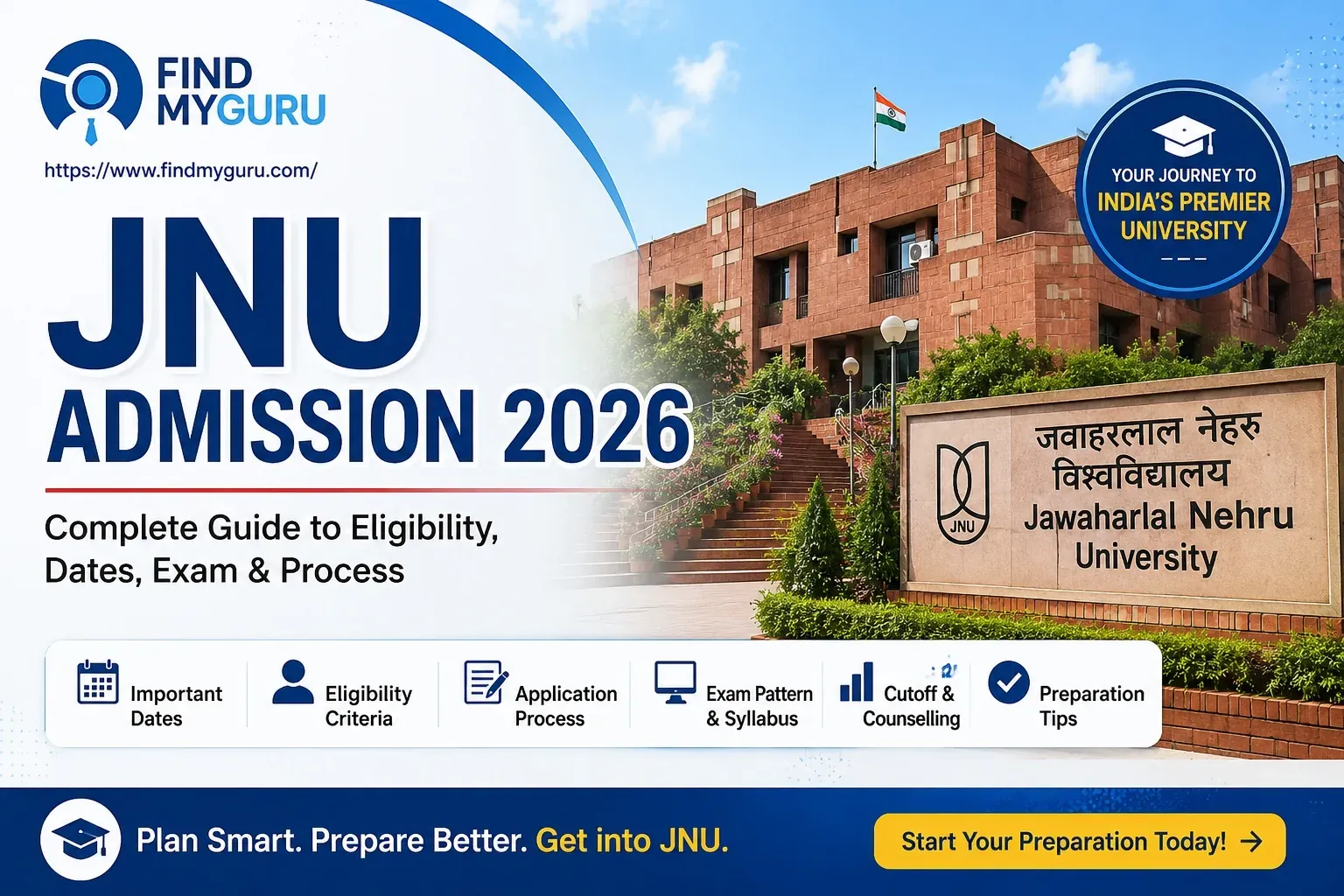
JNU Admission 2026: Complete Guide to Eligibility, Dates, Exam & Process

JNU Admission 2026: Complete Guide to Eligibility, Dates, Exam & Process

JNU Admission 2026 is around the corner, and if you have been eyeing one of India's most prestigious central universities, this guide will walk you through everything you need to know. Whether you are a Class 12 student aiming for a BA Honours programme, a graduate aspiring to one of JNU's renowned MA or M.Sc courses, or a researcher targeting a PhD in social sciences, life sciences, or international studies, the admission process can feel overwhelming the first time you encounter it. Students preparing for competitive university admissions often seek academic guidance, and many search online for resources such as Online Economics Tutors Needed to strengthen their understanding of economics and related subjects.

The good news is that JNU's process is structured, merit-based, and navigable once you understand its components. This article covers the full roadmap: why JNU, key dates, eligibility criteria, application process, entrance exam pattern, syllabus, cutoff trends, counselling, and tips to strengthen your preparation. By the time you finish reading, you will know exactly what you are getting into and what you need to do next.

Why JNU? A Quick Look at Jawaharlal Nehru University

Established in 1969, Jawaharlal Nehru University (JNU) is a central university located in New Delhi and consistently ranked among India's top universities in the National Institutional Ranking Framework (NIRF). It regularly appears in the top five in the University category and has earned a reputation for academic rigour, research output, and intellectual culture that is genuinely difficult to replicate. For students motivated by education quotes to inspire learning and personal growth, JNU represents an environment that encourages curiosity, critical thinking, and lifelong learning, making it one of the most respected institutions in the country.

JNU's strength lies in disciplines that most Indian universities underserve: social sciences, humanities, international studies, language and literature, life sciences, environmental sciences, and biotechnology. It attracts students from across the country — and internationally — who want deep, research-oriented education rather than purely professional credentials.

Two facts stand out for Indian students comparing JNU against private universities. First, hostel fees at JNU have historically been among the most subsidised in the country — making quality residential higher education accessible to students from all economic backgrounds. Second, JNU's academic culture encourages independent thinking, debate, and interdisciplinary learning in a way that prepares graduates exceptionally well for research, civil services, academia, and policy careers.

Jawaharlal Nehru University admission 2026 is competitive, but the competition is against peers who share your academic seriousness — which makes the process worth engaging with fully.

JNU Admission 2026 — Important Dates to Mark on Your Calendar

Specific dates for JNU Admission 2026 will be officially released by NTA (National Testing Agency) on the JNU website (jnu.ac.in) and the NTA portal (nta.ac.in). Always verify dates from these official sources before planning your preparation or travel.

That said, based on the typical annual cycle for JNU admissions, here is the expected timeline for 2026:

Application Form Release: JNU's application forms are typically released in the first quarter of the year — usually between January and March. The JNUEE (JNU Entrance Examination) notification is published simultaneously on the official portal.

Last Date to Apply: The application window typically remains open for four to six weeks after release. Students are strongly advised to apply in the first half of this window to avoid technical issues near the deadline.

Admit Card Release: Admit cards are usually available for download approximately two to three weeks before the examination date. They are issued through the NTA portal using the application number and date of birth.

Entrance Examination Window: JNU's entrance examination is conducted by NTA, typically between May and June, as a Computer-Based Test (CBT) at centres across India.

Result Declaration: Results are generally declared within three to four weeks of the examination, with scorecards available on the NTA and JNU portals.

Counselling Rounds: JNU conducts multiple rounds of counselling — typically two to three — between July and August. Seat allotments are based on entrance rank, category reservation, and programme-specific merit lists.

Commencement of Classes: The academic session at JNU typically begins in late July or August, following the completion of counselling and document verification.

Bookmark jnu.ac.in and nta.ac.in and check them regularly from October 2025 onwards for the official JNU Admission 2026 notification.

JNU Eligibility Criteria 2026

JNU eligibility criteria vary by programme level. Here is a clear breakdown across UG, PG, and PhD categories.

Undergraduate Programmes (BA Honours)

JNU offers a limited number of undergraduate programmes, primarily through its School of Language, Literature and Culture Studies and the School of International Studies.

  • Minimum qualification: Class 12 (10+2) or equivalent from a recognised board

  • Minimum marks: Generally 45–50% aggregate (varies by school and category — SC/ST candidates receive relaxation as per UGC norms)

  • Age limit: No upper age limit for most programmes

  • Admission basis: JNU Entrance Examination (JNUEE) score

Postgraduate Programmes (MA, M.Sc, M.Tech, MBA)

This is where the majority of JNU's competitive admissions are concentrated.

  • Minimum qualification: Bachelor's degree in a relevant discipline from a recognised university

  • Minimum marks: 55% aggregate (50% for SC/ST/PwD candidates) in the qualifying degree — specific requirements vary by school and programme

  • Final year students: Candidates appearing in their final year examination are eligible to apply provisionally, subject to meeting the minimum percentage criteria upon result declaration

  • Admission basis: JNUEE score, with some programmes also considering academic record

MPhil and PhD Programmes

JNU is one of India's leading research universities, and its PhD programmes are among the most sought-after in humanities, social sciences, and life sciences.

  • Minimum qualification: Master's degree in a relevant discipline with at least 55% marks (50% for SC/ST/PwD)

  • NET/JRF: Candidates with UGC-NET/JRF, CSIR-NET/JRF, or equivalent national fellowship are given preference or direct consideration in many schools

  • Admission basis: JNUEE score, followed by a research proposal and/or interview for shortlisted candidates

JNU Application Form 2026 — How to Apply

The JNU application form is submitted entirely online through the official portal. Here is a step-by-step overview of the process.

Step 1 — Registration: Visit the official NTA-JNU admission portal. Create an account using a valid email ID and mobile number. You will receive login credentials for the application portal.

Step 2 — Fill in the Application Form: Log in and complete the application form with personal details, academic qualifications, programme preferences (you can apply for multiple programmes in a single application), and category information (General / OBC-NCL / SC / ST / EWS / PwD).

Step 3 — Upload Documents: Upload scanned copies of your photograph (passport size, recent), signature, Class 10 certificate (for age verification), and relevant academic marksheets. Ensure all files meet the specified size and format requirements.

Step 4 — Pay the Application Fee: The application fee is paid online via net banking, credit card, debit card, or UPI. Fee amounts vary by category — General and OBC candidates pay a higher fee than SC/ST/PwD candidates. Exact fee amounts for 2026 will be specified in the official notification.

Step 5 — Submit and Save Confirmation: After submission, download and save your application confirmation page. Note your application number — it will be required for all future correspondence, admit card download, and result checking.

Important: JNU does not accept offline applications. Ensure a stable internet connection and complete all steps in one session if possible to avoid partial submission issues.

JNU Entrance Exam 2026 — Pattern and Structure

The JNUEE (Jawaharlal Nehru University Entrance Examination) is conducted by NTA as a Computer-Based Test. The pattern varies slightly across programme levels and schools, but the general structure is as follows.

Mode: Computer-Based Test (CBT) at NTA examination centres across India

Duration: Typically 1.5 to 3 hours depending on the programme

Question Type: Multiple Choice Questions (MCQ) for most programmes; some programmes include Short Answer Questions (SAQ) or descriptive components in a second phase

Marking Scheme: +4 for correct answers, -1 for incorrect answers (negative marking applies — do not guess randomly)

Medium: English and Hindi for most programmes; language programmes tested in the respective language

Sections: Questions are drawn from the core subject area of the programme applied for. There is no common general aptitude section — the examination is discipline-specific.

For PhD programmes, shortlisted candidates are typically called for a second round comprising a research proposal presentation and/or viva voce interview, which carries significant weight in the final selection.

JNU Syllabus 2026 — What to Prepare

The JNU entrance exam syllabus is programme-specific and broadly aligned with the undergraduate or postgraduate curriculum of the relevant discipline. There is no single unified syllabus — each school and programme has its own content area.

For Humanities and Social Sciences (MA programmes): Questions typically test conceptual understanding of the core discipline — political theory, historical periods, sociological frameworks, economic concepts, international relations theory — along with current affairs relevant to the subject. Standard textbooks from the BA Honours curriculum of major central universities form the preparation base.

For Life Sciences and Environmental Sciences (M.Sc / PhD): Questions test fundamental concepts in biology, biochemistry, molecular biology, ecology, and related areas. The syllabus broadly aligns with UGC-CSIR NET Life Sciences content, making simultaneous NET preparation highly efficient.

For Language Programmes: Literature, grammar, linguistic theory, and translation components are tested. The specific language's literature — both classical and modern — forms the core preparation area.

For MBA: Covers management concepts, quantitative aptitude, logical reasoning, English language proficiency, and general awareness.

Recommended preparation approach: Download the previous year's JNUEE question papers (available on jnu.ac.in) and use them as your primary benchmark for difficulty level, question distribution, and topical emphasis. Supplement with standard textbooks from your discipline and, where relevant, UGC-NET preparation material.

JNU Cutoff 2026 — What to Expect

The JNU cutoff is not a single score — it is programme-specific, category-specific, and varies year on year based on the number of seats, number of applicants, and examination difficulty. There is no official cutoff published in advance; cutoffs emerge from the counselling process as seat allotments are made. Students preparing for JNU entrance examinations often seek additional academic support, and many begin searching for the Best Home Private Tutors Needed Near Me in Chennai to strengthen their subject knowledge, improve exam performance, and enhance their chances of securing admission to their preferred programme.

General trends from recent years:

For popular MA programmes in social sciences and humanities — Political Science, Economics, History, Sociology, International Relations — the competition is intense. General category candidates typically require scores in the 60th to 80th percentile range or above to receive counselling calls, with top programmes requiring even higher.

For M.Sc programmes in life sciences and related fields, the cutoff is highly competitive among candidates who have also prepared for CSIR-NET, as there is significant overlap in the applicant pool.

For PhD programmes, shortlisting for interviews is based on entrance scores combined with research area fit and, in many schools, NET/JRF status.

Category-wise relaxation: SC/ST/PwD candidates receive reservation as per central government norms — 15% for SC, 7.5% for ST, 5% for PwD — and correspondingly lower effective cutoffs within reserved category seats.

The most reliable way to calibrate your preparation is to review the previous year's rank versus seat data, published by JNU after counselling completion.

JNU Counselling Process 2026

JNU counselling is conducted online and comprises the following steps.

Round 1 — Rank List and Seat Matrix Publication: JNU publishes the merit list (entrance exam rank) alongside the available seat matrix for each programme and category. Candidates check their rank against the seat matrix to assess their probability of admission.

Seat Allotment: Based on rank, programme preference, and category, JNU issues provisional seat allotment letters to candidates in each counselling round.

Document Verification: Allotted candidates must report for document verification — either in person at JNU or through an online document submission portal, depending on the mode specified for 2026. Required documents typically include: original marksheets (Class 10, 12, and qualifying degree), category certificate (if applicable), migration certificate, and character certificate.

Fee Payment and Seat Confirmation: After document verification, candidates pay the admission fee online to confirm their seat. Failure to pay within the specified window results in cancellation of the allotted seat.

Subsequent Rounds: Seats vacated by candidates who did not confirm or who withdrew are released in subsequent counselling rounds, giving lower-ranked candidates another opportunity. JNU typically conducts two to three rounds.

Reporting for Classes: Final admitted students report to their respective schools for orientation and commencement of classes as per the academic calendar.

How to Get Admission in JNU — Preparation Tips

How to get admission in JNU is ultimately about three things: depth of subject knowledge, familiarity with the examination format, and strategic preparation. Here are the most effective practices from successful candidates.

Solve previous year papers exhaustively: JNU entrance questions have recognisable patterns within each discipline. Five to seven years of previous papers will reveal the most frequently tested concepts and the depth of knowledge expected.

Read standard textbooks, not shortcuts: JNU examinations reward conceptual clarity and the ability to reason within a discipline. Coaching shortcuts that focus on eliminating wrong answers tend to underserve JNU preparation. Build genuine understanding of your discipline's foundational texts.

Prepare for negative marking: With -1 for incorrect answers, selective answering outperforms random guessing. Track your accuracy by subject area in mock tests and avoid attempting questions you are genuinely uncertain about.

For PhD aspirants — develop your research proposal early: If you are applying for a PhD, your research statement and the ability to articulate your research question, methodology, and contribution clearly in an interview can compensate for a lower entrance rank in schools where interviews carry significant weight.

Stay updated with current affairs in your discipline: Many JNU entrance papers — particularly in political science, economics, and international studies — include questions that require connecting theoretical frameworks with recent developments. Reading a quality newspaper daily and following academic journals in your field helps significantly.

Comparison: JNU Admission by Programme Level

Programme Level

Qualification Required

Admission Basis

Typical Intake Period

BA Honours (UG)

Class 12 (10+2), 45–50%

JNUEE Score

July–August

MA / M.Sc / MBA (PG)

Bachelor's degree, 55% (50% SC/ST)

JNUEE Score

July–August

MPhil / PhD

Master's degree, 55% (50% SC/ST)

JNUEE Score + Interview

July–August

Certificate / Diploma

Varies by programme

Varies

Varies

Key Takeaways

  • JNU Admission 2026 follows a structured, NTA-conducted entrance examination process — JNUEE — for all major UG, PG, and PhD programmes.

  • Applications are submitted entirely online through the NTA-JNU portal; watch jnu.ac.in from late 2025 for the official notification.

  • JNU eligibility criteria require Class 12 for UG, a relevant bachelor's degree with 55% for PG, and a relevant master's degree with 55% for PhD (50% for SC/ST/PwD across all levels).

  • The JNU entrance exam is discipline-specific, computer-based, and carries negative marking — accurate, selective answering is more effective than attempting every question.

  • JNU cutoff varies by programme and category; previous year rank data is the most reliable benchmark for preparation calibration.

  • JNU counselling comprises multiple online rounds with document verification and fee confirmation — respond to allotment letters within the specified window to secure your seat.

  • The most effective preparation combines previous year papers, standard discipline textbooks, and consistent subject reading — JNU rewards genuine understanding over rote shortcuts.

Frequently Asked Questions

Q: When will JNU Admission 2026 applications open?
A: The official notification for JNU Admission 2026 will be released by NTA on jnu.ac.in and nta.ac.in. Based on the typical annual cycle, applications are expected to open between January and March 2026. Students should bookmark both portals and check regularly from October 2025 for the first official announcement.

Q: Is there a single entrance exam for all JNU programmes?
A: Yes — JNU conducts the Jawaharlal Nehru University Entrance Examination (JNUEE) for admission to UG, PG, and PhD programmes. The exam is administered by NTA as a Computer-Based Test. However, the question paper is discipline-specific for each programme, and PhD admissions also include an interview stage for shortlisted candidates.

Q: What is the JNU application fee for 2026?
A: The exact fee for JNU Admission 2026 will be specified in the official notification. In recent years, General and OBC-NCL candidates have paid a higher application fee than SC/ST/PwD candidates. Check jnu.ac.in for the official and current fee structure before applying.

Q: Can final year students apply for JNU admission?
A: Yes. Students appearing in their final year of the qualifying examination (Class 12 for UG; bachelor's degree for PG; master's degree for PhD) are eligible to apply provisionally. Admission is confirmed only upon submission of final marksheets showing the required minimum percentage.

Q: What is the hostel fee at JNU?
A: JNU is well-known for its heavily subsidised hostel accommodation. Hostel fees have historically been among the lowest at any central university in India, making residential education accessible across economic backgrounds. Exact fee structures for 2026 will be available through the JNU administration upon admission.

Q: How competitive is JNU admission for MA programmes?
A: JNU's MA programmes — particularly in Political Science, Economics, History, Sociology, and International Relations — are among the most competitive at any Indian university. Thousands of applicants compete for a few hundred seats in each programme. Thorough preparation using previous year papers, standard textbooks, and strong current affairs reading is essential for General category candidates targeting top-ranked seats.

Final Thoughts

JNU is not just a university — for many Indian students, it represents a genuine opportunity to pursue knowledge-intensive, research-oriented education at world-class depth, at a cost that does not require taking on lifetime debt. That combination is rare, and it makes JNU Admission 2026 worth pursuing seriously.

The process is demanding, but it is also transparent and merit-based. Start early, prepare thoroughly within your discipline, use official resources, and approach the application with the same seriousness you would bring to the academic work that follows admission. Students can also benefit from connecting with experienced Tutors by Location to receive personalized guidance, targeted preparation, and academic support throughout their admission journey.

Your preparation starts now. JNU's doors open to those who come genuinely ready.

Find My Guru

Find My Guru Editorial Team

This article is produced by the Find My Guru Editorial Team, which includes education writers and subject specialists experienced in academic guidance, tutoring, and skill-based learning. Content is researched using reliable sources and reviewed internally to ensure accuracy, clarity, and relevance for students, parents, and tutors.

All content is created in line with Find My Guru’s Editorial Policy and quality standards.

  1. Blog/
  2. Academics/
  3. JNU Admission 2026: Complete Guide to Eligibility, Dates, Exam & Process

JNU Admission 2026: Complete Guide to Eligibility, Dates, Exam & Process

JNU Admission 2026: Complete Guide to Eligibility, Dates, Exam & Process

JNU Admission 2026 is around the corner, and if you have been eyeing one of India's most prestigious central universities, this guide will walk you through everything you need to know. Whether you are a Class 12 student aiming for a BA Honours programme, a graduate aspiring to one of JNU's renowned MA or M.Sc courses, or a researcher targeting a PhD in social sciences, life sciences, or international studies, the admission process can feel overwhelming the first time you encounter it. Students preparing for competitive university admissions often seek academic guidance, and many search online for resources such as Online Economics Tutors Needed to strengthen their understanding of economics and related subjects.

The good news is that JNU's process is structured, merit-based, and navigable once you understand its components. This article covers the full roadmap: why JNU, key dates, eligibility criteria, application process, entrance exam pattern, syllabus, cutoff trends, counselling, and tips to strengthen your preparation. By the time you finish reading, you will know exactly what you are getting into and what you need to do next.

Why JNU? A Quick Look at Jawaharlal Nehru University

Established in 1969, Jawaharlal Nehru University (JNU) is a central university located in New Delhi and consistently ranked among India's top universities in the National Institutional Ranking Framework (NIRF). It regularly appears in the top five in the University category and has earned a reputation for academic rigour, research output, and intellectual culture that is genuinely difficult to replicate. For students motivated by education quotes to inspire learning and personal growth, JNU represents an environment that encourages curiosity, critical thinking, and lifelong learning, making it one of the most respected institutions in the country.

JNU's strength lies in disciplines that most Indian universities underserve: social sciences, humanities, international studies, language and literature, life sciences, environmental sciences, and biotechnology. It attracts students from across the country — and internationally — who want deep, research-oriented education rather than purely professional credentials.

Two facts stand out for Indian students comparing JNU against private universities. First, hostel fees at JNU have historically been among the most subsidised in the country — making quality residential higher education accessible to students from all economic backgrounds. Second, JNU's academic culture encourages independent thinking, debate, and interdisciplinary learning in a way that prepares graduates exceptionally well for research, civil services, academia, and policy careers.

Jawaharlal Nehru University admission 2026 is competitive, but the competition is against peers who share your academic seriousness — which makes the process worth engaging with fully.

JNU Admission 2026 — Important Dates to Mark on Your Calendar

Specific dates for JNU Admission 2026 will be officially released by NTA (National Testing Agency) on the JNU website (jnu.ac.in) and the NTA portal (nta.ac.in). Always verify dates from these official sources before planning your preparation or travel.

That said, based on the typical annual cycle for JNU admissions, here is the expected timeline for 2026:

Application Form Release: JNU's application forms are typically released in the first quarter of the year — usually between January and March. The JNUEE (JNU Entrance Examination) notification is published simultaneously on the official portal.

Last Date to Apply: The application window typically remains open for four to six weeks after release. Students are strongly advised to apply in the first half of this window to avoid technical issues near the deadline.

Admit Card Release: Admit cards are usually available for download approximately two to three weeks before the examination date. They are issued through the NTA portal using the application number and date of birth.

Entrance Examination Window: JNU's entrance examination is conducted by NTA, typically between May and June, as a Computer-Based Test (CBT) at centres across India.

Result Declaration: Results are generally declared within three to four weeks of the examination, with scorecards available on the NTA and JNU portals.

Counselling Rounds: JNU conducts multiple rounds of counselling — typically two to three — between July and August. Seat allotments are based on entrance rank, category reservation, and programme-specific merit lists.

Commencement of Classes: The academic session at JNU typically begins in late July or August, following the completion of counselling and document verification.

Bookmark jnu.ac.in and nta.ac.in and check them regularly from October 2025 onwards for the official JNU Admission 2026 notification.

JNU Eligibility Criteria 2026

JNU eligibility criteria vary by programme level. Here is a clear breakdown across UG, PG, and PhD categories.

Undergraduate Programmes (BA Honours)

JNU offers a limited number of undergraduate programmes, primarily through its School of Language, Literature and Culture Studies and the School of International Studies.

  • Minimum qualification: Class 12 (10+2) or equivalent from a recognised board

  • Minimum marks: Generally 45–50% aggregate (varies by school and category — SC/ST candidates receive relaxation as per UGC norms)

  • Age limit: No upper age limit for most programmes

  • Admission basis: JNU Entrance Examination (JNUEE) score

Postgraduate Programmes (MA, M.Sc, M.Tech, MBA)

This is where the majority of JNU's competitive admissions are concentrated.

  • Minimum qualification: Bachelor's degree in a relevant discipline from a recognised university

  • Minimum marks: 55% aggregate (50% for SC/ST/PwD candidates) in the qualifying degree — specific requirements vary by school and programme

  • Final year students: Candidates appearing in their final year examination are eligible to apply provisionally, subject to meeting the minimum percentage criteria upon result declaration

  • Admission basis: JNUEE score, with some programmes also considering academic record

MPhil and PhD Programmes

JNU is one of India's leading research universities, and its PhD programmes are among the most sought-after in humanities, social sciences, and life sciences.

  • Minimum qualification: Master's degree in a relevant discipline with at least 55% marks (50% for SC/ST/PwD)

  • NET/JRF: Candidates with UGC-NET/JRF, CSIR-NET/JRF, or equivalent national fellowship are given preference or direct consideration in many schools

  • Admission basis: JNUEE score, followed by a research proposal and/or interview for shortlisted candidates

JNU Application Form 2026 — How to Apply

The JNU application form is submitted entirely online through the official portal. Here is a step-by-step overview of the process.

Step 1 — Registration: Visit the official NTA-JNU admission portal. Create an account using a valid email ID and mobile number. You will receive login credentials for the application portal.

Step 2 — Fill in the Application Form: Log in and complete the application form with personal details, academic qualifications, programme preferences (you can apply for multiple programmes in a single application), and category information (General / OBC-NCL / SC / ST / EWS / PwD).

Step 3 — Upload Documents: Upload scanned copies of your photograph (passport size, recent), signature, Class 10 certificate (for age verification), and relevant academic marksheets. Ensure all files meet the specified size and format requirements.

Step 4 — Pay the Application Fee: The application fee is paid online via net banking, credit card, debit card, or UPI. Fee amounts vary by category — General and OBC candidates pay a higher fee than SC/ST/PwD candidates. Exact fee amounts for 2026 will be specified in the official notification.

Step 5 — Submit and Save Confirmation: After submission, download and save your application confirmation page. Note your application number — it will be required for all future correspondence, admit card download, and result checking.

Important: JNU does not accept offline applications. Ensure a stable internet connection and complete all steps in one session if possible to avoid partial submission issues.

JNU Entrance Exam 2026 — Pattern and Structure

The JNUEE (Jawaharlal Nehru University Entrance Examination) is conducted by NTA as a Computer-Based Test. The pattern varies slightly across programme levels and schools, but the general structure is as follows.

Mode: Computer-Based Test (CBT) at NTA examination centres across India

Duration: Typically 1.5 to 3 hours depending on the programme

Question Type: Multiple Choice Questions (MCQ) for most programmes; some programmes include Short Answer Questions (SAQ) or descriptive components in a second phase

Marking Scheme: +4 for correct answers, -1 for incorrect answers (negative marking applies — do not guess randomly)

Medium: English and Hindi for most programmes; language programmes tested in the respective language

Sections: Questions are drawn from the core subject area of the programme applied for. There is no common general aptitude section — the examination is discipline-specific.

For PhD programmes, shortlisted candidates are typically called for a second round comprising a research proposal presentation and/or viva voce interview, which carries significant weight in the final selection.

JNU Syllabus 2026 — What to Prepare

The JNU entrance exam syllabus is programme-specific and broadly aligned with the undergraduate or postgraduate curriculum of the relevant discipline. There is no single unified syllabus — each school and programme has its own content area.

For Humanities and Social Sciences (MA programmes): Questions typically test conceptual understanding of the core discipline — political theory, historical periods, sociological frameworks, economic concepts, international relations theory — along with current affairs relevant to the subject. Standard textbooks from the BA Honours curriculum of major central universities form the preparation base.

For Life Sciences and Environmental Sciences (M.Sc / PhD): Questions test fundamental concepts in biology, biochemistry, molecular biology, ecology, and related areas. The syllabus broadly aligns with UGC-CSIR NET Life Sciences content, making simultaneous NET preparation highly efficient.

For Language Programmes: Literature, grammar, linguistic theory, and translation components are tested. The specific language's literature — both classical and modern — forms the core preparation area.

For MBA: Covers management concepts, quantitative aptitude, logical reasoning, English language proficiency, and general awareness.

Recommended preparation approach: Download the previous year's JNUEE question papers (available on jnu.ac.in) and use them as your primary benchmark for difficulty level, question distribution, and topical emphasis. Supplement with standard textbooks from your discipline and, where relevant, UGC-NET preparation material.

JNU Cutoff 2026 — What to Expect

The JNU cutoff is not a single score — it is programme-specific, category-specific, and varies year on year based on the number of seats, number of applicants, and examination difficulty. There is no official cutoff published in advance; cutoffs emerge from the counselling process as seat allotments are made. Students preparing for JNU entrance examinations often seek additional academic support, and many begin searching for the Best Home Private Tutors Needed Near Me in Chennai to strengthen their subject knowledge, improve exam performance, and enhance their chances of securing admission to their preferred programme.

General trends from recent years:

For popular MA programmes in social sciences and humanities — Political Science, Economics, History, Sociology, International Relations — the competition is intense. General category candidates typically require scores in the 60th to 80th percentile range or above to receive counselling calls, with top programmes requiring even higher.

For M.Sc programmes in life sciences and related fields, the cutoff is highly competitive among candidates who have also prepared for CSIR-NET, as there is significant overlap in the applicant pool.

For PhD programmes, shortlisting for interviews is based on entrance scores combined with research area fit and, in many schools, NET/JRF status.

Category-wise relaxation: SC/ST/PwD candidates receive reservation as per central government norms — 15% for SC, 7.5% for ST, 5% for PwD — and correspondingly lower effective cutoffs within reserved category seats.

The most reliable way to calibrate your preparation is to review the previous year's rank versus seat data, published by JNU after counselling completion.

JNU Counselling Process 2026

JNU counselling is conducted online and comprises the following steps.

Round 1 — Rank List and Seat Matrix Publication: JNU publishes the merit list (entrance exam rank) alongside the available seat matrix for each programme and category. Candidates check their rank against the seat matrix to assess their probability of admission.

Seat Allotment: Based on rank, programme preference, and category, JNU issues provisional seat allotment letters to candidates in each counselling round.

Document Verification: Allotted candidates must report for document verification — either in person at JNU or through an online document submission portal, depending on the mode specified for 2026. Required documents typically include: original marksheets (Class 10, 12, and qualifying degree), category certificate (if applicable), migration certificate, and character certificate.

Fee Payment and Seat Confirmation: After document verification, candidates pay the admission fee online to confirm their seat. Failure to pay within the specified window results in cancellation of the allotted seat.

Subsequent Rounds: Seats vacated by candidates who did not confirm or who withdrew are released in subsequent counselling rounds, giving lower-ranked candidates another opportunity. JNU typically conducts two to three rounds.

Reporting for Classes: Final admitted students report to their respective schools for orientation and commencement of classes as per the academic calendar.

How to Get Admission in JNU — Preparation Tips

How to get admission in JNU is ultimately about three things: depth of subject knowledge, familiarity with the examination format, and strategic preparation. Here are the most effective practices from successful candidates.

Solve previous year papers exhaustively: JNU entrance questions have recognisable patterns within each discipline. Five to seven years of previous papers will reveal the most frequently tested concepts and the depth of knowledge expected.

Read standard textbooks, not shortcuts: JNU examinations reward conceptual clarity and the ability to reason within a discipline. Coaching shortcuts that focus on eliminating wrong answers tend to underserve JNU preparation. Build genuine understanding of your discipline's foundational texts.

Prepare for negative marking: With -1 for incorrect answers, selective answering outperforms random guessing. Track your accuracy by subject area in mock tests and avoid attempting questions you are genuinely uncertain about.

For PhD aspirants — develop your research proposal early: If you are applying for a PhD, your research statement and the ability to articulate your research question, methodology, and contribution clearly in an interview can compensate for a lower entrance rank in schools where interviews carry significant weight.

Stay updated with current affairs in your discipline: Many JNU entrance papers — particularly in political science, economics, and international studies — include questions that require connecting theoretical frameworks with recent developments. Reading a quality newspaper daily and following academic journals in your field helps significantly.

Comparison: JNU Admission by Programme Level

Programme Level

Qualification Required

Admission Basis

Typical Intake Period

BA Honours (UG)

Class 12 (10+2), 45–50%

JNUEE Score

July–August

MA / M.Sc / MBA (PG)

Bachelor's degree, 55% (50% SC/ST)

JNUEE Score

July–August

MPhil / PhD

Master's degree, 55% (50% SC/ST)

JNUEE Score + Interview

July–August

Certificate / Diploma

Varies by programme

Varies

Varies

Key Takeaways

  • JNU Admission 2026 follows a structured, NTA-conducted entrance examination process — JNUEE — for all major UG, PG, and PhD programmes.

  • Applications are submitted entirely online through the NTA-JNU portal; watch jnu.ac.in from late 2025 for the official notification.

  • JNU eligibility criteria require Class 12 for UG, a relevant bachelor's degree with 55% for PG, and a relevant master's degree with 55% for PhD (50% for SC/ST/PwD across all levels).

  • The JNU entrance exam is discipline-specific, computer-based, and carries negative marking — accurate, selective answering is more effective than attempting every question.

  • JNU cutoff varies by programme and category; previous year rank data is the most reliable benchmark for preparation calibration.

  • JNU counselling comprises multiple online rounds with document verification and fee confirmation — respond to allotment letters within the specified window to secure your seat.

  • The most effective preparation combines previous year papers, standard discipline textbooks, and consistent subject reading — JNU rewards genuine understanding over rote shortcuts.

Frequently Asked Questions

Q: When will JNU Admission 2026 applications open?
A: The official notification for JNU Admission 2026 will be released by NTA on jnu.ac.in and nta.ac.in. Based on the typical annual cycle, applications are expected to open between January and March 2026. Students should bookmark both portals and check regularly from October 2025 for the first official announcement.

Q: Is there a single entrance exam for all JNU programmes?
A: Yes — JNU conducts the Jawaharlal Nehru University Entrance Examination (JNUEE) for admission to UG, PG, and PhD programmes. The exam is administered by NTA as a Computer-Based Test. However, the question paper is discipline-specific for each programme, and PhD admissions also include an interview stage for shortlisted candidates.

Q: What is the JNU application fee for 2026?
A: The exact fee for JNU Admission 2026 will be specified in the official notification. In recent years, General and OBC-NCL candidates have paid a higher application fee than SC/ST/PwD candidates. Check jnu.ac.in for the official and current fee structure before applying.

Q: Can final year students apply for JNU admission?
A: Yes. Students appearing in their final year of the qualifying examination (Class 12 for UG; bachelor's degree for PG; master's degree for PhD) are eligible to apply provisionally. Admission is confirmed only upon submission of final marksheets showing the required minimum percentage.

Q: What is the hostel fee at JNU?
A: JNU is well-known for its heavily subsidised hostel accommodation. Hostel fees have historically been among the lowest at any central university in India, making residential education accessible across economic backgrounds. Exact fee structures for 2026 will be available through the JNU administration upon admission.

Q: How competitive is JNU admission for MA programmes?
A: JNU's MA programmes — particularly in Political Science, Economics, History, Sociology, and International Relations — are among the most competitive at any Indian university. Thousands of applicants compete for a few hundred seats in each programme. Thorough preparation using previous year papers, standard textbooks, and strong current affairs reading is essential for General category candidates targeting top-ranked seats.

Final Thoughts

JNU is not just a university — for many Indian students, it represents a genuine opportunity to pursue knowledge-intensive, research-oriented education at world-class depth, at a cost that does not require taking on lifetime debt. That combination is rare, and it makes JNU Admission 2026 worth pursuing seriously.

The process is demanding, but it is also transparent and merit-based. Start early, prepare thoroughly within your discipline, use official resources, and approach the application with the same seriousness you would bring to the academic work that follows admission. Students can also benefit from connecting with experienced Tutors by Location to receive personalized guidance, targeted preparation, and academic support throughout their admission journey.

Your preparation starts now. JNU's doors open to those who come genuinely ready.

Find My Guru

Find My Guru Editorial Team

This article is produced by the Find My Guru Editorial Team, which includes education writers and subject specialists experienced in academic guidance, tutoring, and skill-based learning. Content is researched using reliable sources and reviewed internally to ensure accuracy, clarity, and relevance for students, parents, and tutors.

All content is created in line with Find My Guru’s Editorial Policy and quality standards.

Start Your Teaching Journey Today

Join thousands of tutors who are sharing their knowledge and helping students succeed.

Start getting Students

Explore Tutors by Location and Skills

Find Expert tutors across India for Popular Subjects, Skills and Cities

Popular courses

    Popular Locations

      Popular Searches

          Start Your Teaching Journey Today

          Join thousands of tutors who are sharing their knowledge and helping students succeed.

          Start getting Students

          Explore Tutors by Location and Skills

          Find Expert tutors across India for Popular Subjects, Skills and Cities

          Popular courses

          • Online Biology coaching classes
          • Spoken Spoken English teacher near me
          • Mathematics teachers
          • Python Programming tutors near me
          • Online Class 12 Biology coaching classes
          • Online English coaching classes
          • Private Class 11 Biology teachers
          • Private A and As Biology teachers
          • NEET Biology tutors near me
          • Chemistry teachers

          Popular Locations

          • Private tutoring in Hyderabad
          • Bangalore classes
          • Chennai training institutes
          • Home tutors in New Delhi
          • Pune training institutes
          • Kolkata classes
          • Mumbai teachers
          • Coimbatore tutors
          • Private tutoring in Lucknow
          • Home tutors in Gurgaon

          Popular Searches

          • Best Tamil teachers in Chennai
          • Spoken Tamil classes in Chennai
          • Best Kannada teachers in Bangalore
          • Best Mathematics teachers in Hyderabad
          • Online Spoken English classes in Bangalore
          • Maths (Grades 6 to 10) classes in Hyderabad
          • Online Communication Skills classes in Hyderabad
          • Best Tamil Ilakkanam teachers in Chennai
          • Online Academic Kannada classes in Bangalore
          • English classes in Bangalore
          Find My Guru logo
          • facebook
          • instagram
          • linkedin
          • X
          • youtube

          Quick Links

          • Home
          • About Us
          • Contact Us

          Legal & Policies

          • Terms & Conditions
          • Privacy Policy
          • Editorial Policy

          Support

          • FAQs for Students
          • Online Tutors
          • Investor Connect

          Discover

          • All Tutors
          • All Institutes
          • India Tutors
          Disclaimer: All the course names, logos, and certification titles we use are their respective owners' property. The firm, service, or product names on the website are solely for identification purposes. We do not own, endorse or have the copyright of any brand/logo/name in any manner. Few graphics on our website are freely available on public domains.

          ©️ 2026 Findmyguru.com | All Rights Reserved. A Brand of TutorKhoj Private Limited

          Write a Review onTrustpilot
          Find My Guru logo
          • Top Skills
            • Python Programming
            • Yoga
            • Dance
            • Music
            • Guitar
            • Hindi Speaking
            • Drawing
            • Painting
            • Chess
            • Digital Marketing
            • View All Skills
          • Top Locations
            • Online
            • Hyderabad
              • Ameerpet
              • Kukatpally
              • Dilsukhnagar
              • Madhapur
              • Gachibowli
            • Bangalore
              • Whitefield
              • Marathahalli
              • HSR Layout
              • Koramangala
              • Indiranagar
            • Mumbai
              • Andheri West
              • Mira Road East
              • Kandivali West
              • Kandivali East
              • Malad West
            • New Delhi
              • Dwarka
              • Rohini
              • Hauz Khas
              • Mukherjee Nagar
              • Laxmi Nagar
            • Chennai
              • Anna Nagar
              • Madipakkam
              • Adyar
              • Mylapore
              • Velachery
            • Pune
              • Hinjewadi
              • Wakad
              • Baner
              • Pimple Saudagar
              • Balewadi
            • Gurgaon
              • DLF Phase 5
              • Golf Course Road
              • Sector 31
              • Sector 56
              • Palam Vihar
            • Noida
              • Sector 125/126 Amity University
              • Sector 137 Expressway
              • Sector 18-15
              • Sector 27 (Atta Market)
              • Bisrakh
            • Kolkata
              • Newtown
              • Bidhannagar
              • Garia
              • Behala
              • Jadavpur
            • Ahmedabad
              • Satellite
              • Bopal / South Bopal
              • Navrangpura
              • Prahlad Nagar
              • Vastrapur
            • View All Locations
          • List Your Profile
          • FAQ
          • Blogs
          • Pricing Plans
          • Tutor Login