Find My Guru logo
  • Top Skills
    • Python Programming
    • Yoga
    • Dance
    • Music
    • Guitar
    • Hindi Speaking
    • Drawing
    • Painting
    • Chess
    • Digital Marketing
    • View All Skills
  • Top Locations
    • Online
    • Hyderabad
      • Ameerpet
      • Kukatpally
      • Dilsukhnagar
      • Madhapur
      • Gachibowli
    • Bangalore
      • Whitefield
      • Marathahalli
      • HSR Layout
      • Koramangala
      • Indiranagar
    • Mumbai
      • Andheri West
      • Mira Road East
      • Kandivali West
      • Kandivali East
      • Malad West
    • New Delhi
      • Dwarka
      • Rohini
      • Hauz Khas
      • Mukherjee Nagar
      • Laxmi Nagar
    • Chennai
      • Anna Nagar
      • Madipakkam
      • Adyar
      • Mylapore
      • Velachery
    • Pune
      • Hinjewadi
      • Wakad
      • Baner
      • Pimple Saudagar
      • Balewadi
    • Gurgaon
      • DLF Phase 5
      • Golf Course Road
      • Sector 31
      • Sector 56
      • Palam Vihar
    • Noida
      • Sector 125/126 Amity University
      • Sector 137 Expressway
      • Sector 18-15
      • Sector 27 (Atta Market)
      • Bisrakh
    • Kolkata
      • Newtown
      • Bidhannagar
      • Garia
      • Behala
      • Jadavpur
    • Ahmedabad
      • Satellite
      • Bopal / South Bopal
      • Navrangpura
      • Prahlad Nagar
      • Vastrapur
    • View All Locations
  • Pricing Plans
  • Tutor Login
  1. Blog/
  2. IT Courses/
  3. Flutter vs React Native India: Which Should You Choose in 2026?
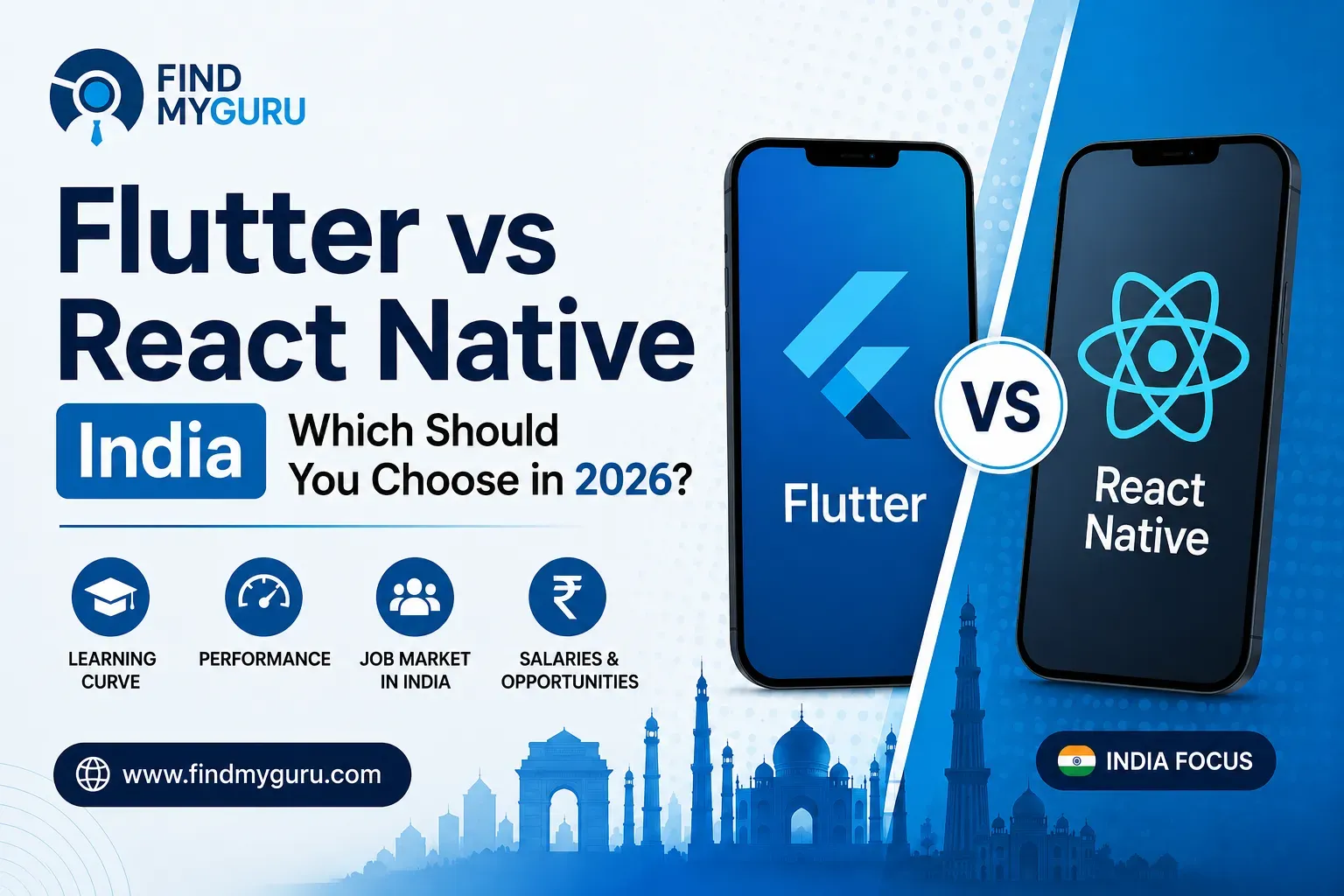
Flutter vs React Native India: Which Should You Choose in 2026?

Flutter vs React Native India: Which Should You Choose in 2026?

You have just decided to learn mobile app development. Smart move — India's startup ecosystem is producing thousands of app-first products every year, from fintech platforms in Mumbai to agritech apps targeting farmers in UP. You open your browser, search for where to start, and immediately land in the middle of a fierce debate: Flutter or React Native? If you're looking to strengthen your React skills, Online React Tutors Needed is a common search among learners seeking expert guidance before choosing a mobile development framework.

Both have passionate supporters. Both are used in production apps you have probably used today. Both will get you employed. So how do you choose? For Indian developers and students specifically, the Flutter vs React Native India decision is not just a technical question — it is a career question, shaped by local job market demand, available training resources, freelance opportunities, and the types of products the Indian startup economy actually needs.

This article gives you the complete picture: what each framework is, how they compare across five key dimensions, what jobs and salaries look like in India, which mobile app development course in India is worth your time, and — ultimately — a clear, honest recommendation based on your background and goal.

What Are Flutter and React Native?

Before comparing them, it helps to understand exactly what each framework is — in plain language.

Flutter is Google's open-source UI toolkit, first released publicly in 2018. It uses a programming language called Dart (also built by Google) and lets developers build apps for Android, iOS, web, and desktop from a single codebase. The defining characteristic of Flutter is that it renders its own UI components directly — it does not rely on native platform widgets, which means Flutter apps look and behave consistently across devices. For learners searching for the Best Home Private React Tutors Needed Near Me in Chennai, understanding modern frameworks and cross-platform technologies like Flutter can be highly beneficial. Indian apps you almost certainly know that are built with Flutter: Google Pay India, Dream11, and Groww. Flutter's adoption in India's fintech and consumer app space has been particularly strong.

React Native is Meta's (formerly Facebook's) open-source framework, released in 2015. It uses JavaScript and React — the same language and library that power most of India's web frontends — allowing developers to build native-feeling mobile apps. React Native bridges JavaScript code to native platform components, which means apps feel more "native" to each operating system but can sometimes behave differently across platforms. Indian apps built with React Native at various stages include Myntra, ShareChat, and OYO. Because it uses JavaScript, React Native benefits from one of the largest developer communities in the world.

Both frameworks solve the same fundamental problem: building apps for multiple platforms without writing completely separate codebases for Android and iOS. They just take different philosophical approaches to it — and those differences have real implications for your career path.

Flutter vs React Native India — Head-to-Head Comparison

1. Programming Language and Learning Curve

Flutter uses Dart, which most developers come to fresh — there is no prior knowledge shortcut unless you have already used it. The good news is that Dart is considered one of the easier languages to pick up; its syntax is clean, its documentation is excellent, and Google has invested heavily in beginner resources. For learners exploring the Top Skills to Learn in 2026 for High Salary in India, Flutter and Dart offer a strong career pathway. Most Indian learners with a basic programming background report getting comfortable with Dart within four to six weeks of focused study.

React Native uses JavaScript, which is already the most widely known programming language among Indian web developers and CS students. If you have done any web development — even basic HTML/CSS/JS — React Native's learning curve is significantly gentler. This is its single biggest practical advantage in the Indian learning context, where JavaScript already dominates web development curricula at colleges and bootcamps.

Verdict: React Native wins on learning curve for existing JavaScript developers. Flutter has a steeper entry but Dart is genuinely learnable. For complete beginners, the difference is smaller than it looks.

2. Performance

Flutter's rendering approach — using its own Skia (now Impeller) graphics engine rather than bridging to native components — means it delivers consistently high performance across devices. Animations are smooth, frame rates are stable, and complex UIs do not degrade. This is why Flutter is particularly popular for apps with heavy UI requirements like Dream11's live game interface.

React Native's JavaScript bridge architecture means there is a communication overhead between JavaScript code and native device components. For most standard apps, this is imperceptible. For high-performance use cases — complex animations, real-time data rendering, games — this overhead can become noticeable. The newer Fabric and JSI (JavaScript Interface) architecture in React Native has reduced this gap significantly, but Flutter still has a performance edge for demanding UI work.

Verdict: Flutter wins on raw performance, especially for animation-heavy and graphically demanding apps. For standard business apps and content-based products, the difference is minimal.

3. Community and Ecosystem

React Native has been around since 2015 — three years longer than Flutter's stable release — and benefits from one of the largest open-source ecosystems in mobile development. The npm package ecosystem is vast, and the overlap with the JavaScript/React web community means solutions to most problems are findable within minutes on Stack Overflow, GitHub, or Indian developer forums.

Flutter's community has grown remarkably fast since 2018 and now has strong representation in India specifically. The Flutter India community on Discord, pub.dev's package ecosystem, and active Google Developer Groups (GDGs) in Bengaluru, Hyderabad, Mumbai, and Delhi mean that Indian Flutter developers have solid local support networks. Flutter's documentation quality is consistently rated higher than React Native's.

Verdict: React Native edges ahead on raw community size and package availability. Flutter closes the gap with superior documentation and a rapidly growing Indian developer community.

4. Cross-Platform Scope

Flutter's cross-platform story is genuinely broader: a single codebase can target Android, iOS, web, desktop (Windows, macOS, Linux), and even embedded devices. For Indian startups building products that need to run across multiple surfaces — a mobile app plus a web dashboard plus a desktop tool — Flutter's single-codebase approach is increasingly compelling.

React Native's strength has traditionally been mobile (Android and iOS), with web support through React Native Web, though the integration is less seamless than Flutter's native multi-platform approach. For mobile-first products — which describes the majority of Indian consumer startups — this distinction matters less.

Verdict: Flutter wins on cross-platform breadth. For pure mobile development, both are comparable.

5. Job Market in India — Flutter vs React Native

This is where the Flutter vs React Native India comparison gets most practically relevant for job seekers.

Searching Naukri and LinkedIn India in 2026, React Native consistently shows more job listings than Flutter — partly because of its longer history and partly because JavaScript proficiency is already widespread, making React Native easier for companies to hire and onboard for. Startups and mid-size product companies in Bengaluru, Pune, and Hyderabad list React Native most frequently in mobile developer job descriptions.

Flutter's job listings are growing rapidly, particularly at companies building new consumer apps and at Google's own ecosystem of partners. The key distinction: React Native has more total jobs right now, but Flutter jobs are growing faster and face a smaller pool of qualified candidates — meaning Flutter specialists often have stronger negotiating leverage per role.

Freelance platforms including Fiverr, Upwork, and Indian-focused platforms show strong demand for both, with Flutter gaining ground for newer projects and React Native dominant in established codebase maintenance and updates.

Verdict: React Native wins on raw job volume in India today. Flutter is catching up fast and may have more favourable supply-demand dynamics for skilled candidates.

Salary Comparison: Flutter vs React Native Developers in India

Based on current Indian job market data from Naukri, LinkedIn, and AmbitionBox:

Role

Experience

Flutter Salary (LPA)

React Native Salary (LPA)

Junior Developer

0–2 years

₹4–7

₹4–8

Mid-Level Developer

2–5 years

₹9–18

₹10–20

Senior Developer

5+ years

₹18–35

₹20–38

Lead / Architect

7+ years

₹30–55

₹32–55

The salary difference between Flutter and React Native specialists is not dramatic at any level. What moves the needle more than framework choice is overall app development portfolio quality, system design knowledge, and — at senior levels — leadership and architecture experience. Both frameworks command meaningful salaries at senior levels, and both are well above India's general software development average.

Flutter Courses in India — Best Options

If Flutter is your choice, here are the most credible learning paths available to Indian learners:

The Complete Flutter Development Bootcamp with Dart (Udemy — Angela Yu / App Brewery) — The most reviewed and recommended Flutter course globally, consistently on sale at ₹399–₹649 on Udemy. Builds a dozen apps from scratch and covers Dart thoroughly. Ideal first course for most beginners.

Flutter & Dart — The Complete Guide (Udemy — Maximilian Schwarzmüller, Academind) — More comprehensive, slightly more advanced. Good complement to Angela Yu's course or as a standalone for learners with some programming background.

Google's Flutter documentation and codelabs — Flutter's official documentation at flutter.dev is genuinely excellent, and the free codelabs at codelabs.developers.google.com cover everything from setup to advanced state management. Free, always up to date.

NPTEL / SWAYAM — Some Indian university courses now include Flutter in their mobile development curriculum. Check SWAYAM for currently offered courses with IIT faculty involvement.

Flutter India community (FlutterIndia on Discord and GitHub) — Peer learning and project collaboration with Indian developers is one of the fastest ways to progress beyond basics. Free, and the community is active and helpful.

React Native Courses in India — Best Options

The Complete React Native + Hooks Course (Udemy — Stephen Grider) — One of the most-reviewed React Native courses available, covering hooks, navigation, state management, and API integration. Sale price ₹399–₹649.

React Native — The Practical Guide (Udemy — Maximilian Schwarzmüller) — Comprehensive, up to date with the latest React Native architecture. Covers Expo workflow and bare React Native.

Meta's React Native documentation and official tutorials — react.dev and reactnative.dev provide extensive free documentation. Meta has also partnered with Coursera for structured learning programmes.

Simplilearn and Great Learning React Native courses — Structured instructor-led options for learners who prefer a guided format with certification. Costs vary from ₹5,000–₹30,000 depending on depth and mode.

freeCodeCamp's JavaScript curriculum — If you are new to JavaScript entirely, completing freeCodeCamp's JavaScript Algorithms and Data Structures certification (free) before starting React Native saves significant frustration.

For either framework, a mobile app development course in India is most valuable when it culminates in three to five real apps in your portfolio — not just certificates. Recruiters want to see what you built, not just what you studied.

Pros and Cons Summary

Factor

Flutter

React Native

Language

Dart (new for most)

JavaScript (widely known)

Performance

Excellent — own renderer

Good — improved with new arch

Learning curve

Moderate

Lower for JS developers

Job market India

Growing fast, less competition

More listings, more competition

Cross-platform

Android, iOS, web, desktop

Android, iOS (web via RNW)

Community

Rapidly growing, strong India GDG

Larger globally, vast npm ecosystem

Documentation

Excellent

Good, improving

Backing

Google

Meta

Best for

UI-heavy apps, new projects, fintech

JS teams, existing React knowledge

Freelance demand

Growing

Strong, established

Which Should You Choose? The Honest Recommendation

Here is the honest, direct answer to the Flutter vs React Native India question:

Choose Flutter if:

  • You are starting fresh with no strong programming language preference

  • You want to build visually sophisticated, performance-intensive apps

  • You are targeting fintech, gaming-adjacent, or consumer apps where UI polish matters most

  • You are willing to learn Dart and want the advantage of a growing specialisation with strong Google backing

  • You are interested in cross-platform development beyond just mobile (web + desktop)

Choose React Native if:

  • You already know JavaScript or have a web development background

  • You want the fastest route to employability given the higher volume of current job listings

  • You are joining an existing product team that has already chosen React Native

  • You want to leverage the vast JavaScript/npm ecosystem and React component knowledge

  • You are targeting large-scale content or commerce apps where team JavaScript fluency matters

The nuanced truth: If you are a complete beginner in India today, Flutter is arguably the slightly better long-term bet — Google's investment, growing Indian adoption, and the advantage of being in a less saturated talent pool all point in its direction. If you have JavaScript background, React Native is the more immediately practical choice with the lower learning overhead.

Either way — the most important variable is not which framework you choose. It is whether you build real apps, document them, and put them on GitHub. A portfolio of three solid apps in either framework will get you interviews. A certificate in both without a portfolio will not. Similarly, when searching for the Best Tuition Classes Needed Near Me in Lucknow, practical learning outcomes and consistent skill development matter more than simply enrolling in multiple courses.

Key Takeaways

  • Flutter vs React Native in India is a genuinely competitive choice — both are production-proven, well-supported, and lead to strong careers.

  • Flutter uses Dart, offers superior performance and cross-platform reach, and is growing fast in India's fintech and consumer app space.

  • React Native uses JavaScript, has a larger current job market in India, and benefits enormously from existing JavaScript developer knowledge.

  • Salary differences between Flutter and React Native specialists are not dramatic — both frameworks lead to ₹4–55 LPA+ depending on experience.

  • The best mobile app development course in India for either framework is one that prioritises building real apps over collecting certificates.

  • For beginners: choose Flutter for long-term positioning or React Native for faster employability if you know JavaScript.

  • For team/project context: use whichever framework the team or existing codebase has chosen — framework agnosticism is itself a valuable skill.

Frequently Asked Questions

Q: Is Flutter or React Native better for jobs in India in 2026?

A: React Native currently has more job listings on Naukri and LinkedIn India, but Flutter listings are growing faster and face less competition per role. Both frameworks lead to strong employment outcomes. React Native is the pragmatic choice if you already know JavaScript and want immediate job market access; Flutter is the stronger long-term bet for those building from scratch.

Q: Which is easier to learn — Flutter or React Native?

A: For complete beginners, Flutter and React Native have roughly comparable learning curves. For developers who already know JavaScript, React Native is significantly easier since Dart is an additional language to learn. Flutter compensates with superior documentation and structured codelabs that many learners find easier to follow.

Q: What is the salary for a Flutter developer in India?

A: Flutter developers in India earn ₹4–7 LPA at entry level (0–2 years), ₹9–18 LPA at mid-level (2–5 years), and ₹18–35 LPA at senior level (5+ years). Flutter architect and lead roles at product companies earn ₹30–55 LPA. Salaries are comparable to React Native at every level, with slight variation by company type and city.

Q: Where can I take a Flutter course in India?

A: The most recommended Flutter courses for Indian learners are Angela Yu's Complete Flutter Bootcamp on Udemy (₹399–₹649 during sales), Maximilian Schwarzmüller's Flutter & Dart course on Udemy, and Google's free official Flutter codelabs at codelabs.developers.google.com. The FlutterIndia community on Discord is also a valuable free learning resource with active Indian developer participation.

Q: Can I build a career in mobile app development in India with React Native?

A: Yes — React Native is one of the most in-demand mobile development skills in India's startup and product company ecosystem. Companies across fintech, e-commerce, edtech, and healthcare actively hire React Native developers. A React Native developer with 2–3 years of experience and a strong portfolio typically earns ₹10–20 LPA at Indian product companies.

Q: Is Flutter used in India by major companies?

A: Yes. Several prominent Indian consumer apps are built with Flutter, including Google Pay India (the most prominent example), Dream11, and Groww. Flutter adoption has been particularly strong in Indian fintech, where Google Pay's success has influenced other companies in the ecosystem to adopt the same framework.

Final Thoughts

The Flutter vs React Native India debate does not have one right answer — it has one right answer for you, based on your current skills, your target role, and how you learn best.

What both frameworks share is more important than what divides them: they are both paths into one of India's most active and well-paying technical specialisations. The Indian mobile app market — serving 900 million internet users, tens of thousands of startups, and a consumer economy that runs on smartphones — will need Flutter and React Native developers for years to come. This growing digital landscape also reflects the increasing demand for Indian Tutors Needed across various technical and educational domains.

Find My Guru

Find My Guru Editorial Team

This article is produced by the Find My Guru Editorial Team, which includes education writers and subject specialists experienced in academic guidance, tutoring, and skill-based learning. Content is researched using reliable sources and reviewed internally to ensure accuracy, clarity, and relevance for students, parents, and tutors.

All content is created in line with Find My Guru’s Editorial Policy and quality standards.

  1. Blog/
  2. IT Courses/
  3. Flutter vs React Native India: Which Should You Choose in 2026?

Flutter vs React Native India: Which Should You Choose in 2026?

Flutter vs React Native India: Which Should You Choose in 2026?

You have just decided to learn mobile app development. Smart move — India's startup ecosystem is producing thousands of app-first products every year, from fintech platforms in Mumbai to agritech apps targeting farmers in UP. You open your browser, search for where to start, and immediately land in the middle of a fierce debate: Flutter or React Native? If you're looking to strengthen your React skills, Online React Tutors Needed is a common search among learners seeking expert guidance before choosing a mobile development framework.

Both have passionate supporters. Both are used in production apps you have probably used today. Both will get you employed. So how do you choose? For Indian developers and students specifically, the Flutter vs React Native India decision is not just a technical question — it is a career question, shaped by local job market demand, available training resources, freelance opportunities, and the types of products the Indian startup economy actually needs.

This article gives you the complete picture: what each framework is, how they compare across five key dimensions, what jobs and salaries look like in India, which mobile app development course in India is worth your time, and — ultimately — a clear, honest recommendation based on your background and goal.

What Are Flutter and React Native?

Before comparing them, it helps to understand exactly what each framework is — in plain language.

Flutter is Google's open-source UI toolkit, first released publicly in 2018. It uses a programming language called Dart (also built by Google) and lets developers build apps for Android, iOS, web, and desktop from a single codebase. The defining characteristic of Flutter is that it renders its own UI components directly — it does not rely on native platform widgets, which means Flutter apps look and behave consistently across devices. For learners searching for the Best Home Private React Tutors Needed Near Me in Chennai, understanding modern frameworks and cross-platform technologies like Flutter can be highly beneficial. Indian apps you almost certainly know that are built with Flutter: Google Pay India, Dream11, and Groww. Flutter's adoption in India's fintech and consumer app space has been particularly strong.

React Native is Meta's (formerly Facebook's) open-source framework, released in 2015. It uses JavaScript and React — the same language and library that power most of India's web frontends — allowing developers to build native-feeling mobile apps. React Native bridges JavaScript code to native platform components, which means apps feel more "native" to each operating system but can sometimes behave differently across platforms. Indian apps built with React Native at various stages include Myntra, ShareChat, and OYO. Because it uses JavaScript, React Native benefits from one of the largest developer communities in the world.

Both frameworks solve the same fundamental problem: building apps for multiple platforms without writing completely separate codebases for Android and iOS. They just take different philosophical approaches to it — and those differences have real implications for your career path.

Flutter vs React Native India — Head-to-Head Comparison

1. Programming Language and Learning Curve

Flutter uses Dart, which most developers come to fresh — there is no prior knowledge shortcut unless you have already used it. The good news is that Dart is considered one of the easier languages to pick up; its syntax is clean, its documentation is excellent, and Google has invested heavily in beginner resources. For learners exploring the Top Skills to Learn in 2026 for High Salary in India, Flutter and Dart offer a strong career pathway. Most Indian learners with a basic programming background report getting comfortable with Dart within four to six weeks of focused study.

React Native uses JavaScript, which is already the most widely known programming language among Indian web developers and CS students. If you have done any web development — even basic HTML/CSS/JS — React Native's learning curve is significantly gentler. This is its single biggest practical advantage in the Indian learning context, where JavaScript already dominates web development curricula at colleges and bootcamps.

Verdict: React Native wins on learning curve for existing JavaScript developers. Flutter has a steeper entry but Dart is genuinely learnable. For complete beginners, the difference is smaller than it looks.

2. Performance

Flutter's rendering approach — using its own Skia (now Impeller) graphics engine rather than bridging to native components — means it delivers consistently high performance across devices. Animations are smooth, frame rates are stable, and complex UIs do not degrade. This is why Flutter is particularly popular for apps with heavy UI requirements like Dream11's live game interface.

React Native's JavaScript bridge architecture means there is a communication overhead between JavaScript code and native device components. For most standard apps, this is imperceptible. For high-performance use cases — complex animations, real-time data rendering, games — this overhead can become noticeable. The newer Fabric and JSI (JavaScript Interface) architecture in React Native has reduced this gap significantly, but Flutter still has a performance edge for demanding UI work.

Verdict: Flutter wins on raw performance, especially for animation-heavy and graphically demanding apps. For standard business apps and content-based products, the difference is minimal.

3. Community and Ecosystem

React Native has been around since 2015 — three years longer than Flutter's stable release — and benefits from one of the largest open-source ecosystems in mobile development. The npm package ecosystem is vast, and the overlap with the JavaScript/React web community means solutions to most problems are findable within minutes on Stack Overflow, GitHub, or Indian developer forums.

Flutter's community has grown remarkably fast since 2018 and now has strong representation in India specifically. The Flutter India community on Discord, pub.dev's package ecosystem, and active Google Developer Groups (GDGs) in Bengaluru, Hyderabad, Mumbai, and Delhi mean that Indian Flutter developers have solid local support networks. Flutter's documentation quality is consistently rated higher than React Native's.

Verdict: React Native edges ahead on raw community size and package availability. Flutter closes the gap with superior documentation and a rapidly growing Indian developer community.

4. Cross-Platform Scope

Flutter's cross-platform story is genuinely broader: a single codebase can target Android, iOS, web, desktop (Windows, macOS, Linux), and even embedded devices. For Indian startups building products that need to run across multiple surfaces — a mobile app plus a web dashboard plus a desktop tool — Flutter's single-codebase approach is increasingly compelling.

React Native's strength has traditionally been mobile (Android and iOS), with web support through React Native Web, though the integration is less seamless than Flutter's native multi-platform approach. For mobile-first products — which describes the majority of Indian consumer startups — this distinction matters less.

Verdict: Flutter wins on cross-platform breadth. For pure mobile development, both are comparable.

5. Job Market in India — Flutter vs React Native

This is where the Flutter vs React Native India comparison gets most practically relevant for job seekers.

Searching Naukri and LinkedIn India in 2026, React Native consistently shows more job listings than Flutter — partly because of its longer history and partly because JavaScript proficiency is already widespread, making React Native easier for companies to hire and onboard for. Startups and mid-size product companies in Bengaluru, Pune, and Hyderabad list React Native most frequently in mobile developer job descriptions.

Flutter's job listings are growing rapidly, particularly at companies building new consumer apps and at Google's own ecosystem of partners. The key distinction: React Native has more total jobs right now, but Flutter jobs are growing faster and face a smaller pool of qualified candidates — meaning Flutter specialists often have stronger negotiating leverage per role.

Freelance platforms including Fiverr, Upwork, and Indian-focused platforms show strong demand for both, with Flutter gaining ground for newer projects and React Native dominant in established codebase maintenance and updates.

Verdict: React Native wins on raw job volume in India today. Flutter is catching up fast and may have more favourable supply-demand dynamics for skilled candidates.

Salary Comparison: Flutter vs React Native Developers in India

Based on current Indian job market data from Naukri, LinkedIn, and AmbitionBox:

Role

Experience

Flutter Salary (LPA)

React Native Salary (LPA)

Junior Developer

0–2 years

₹4–7

₹4–8

Mid-Level Developer

2–5 years

₹9–18

₹10–20

Senior Developer

5+ years

₹18–35

₹20–38

Lead / Architect

7+ years

₹30–55

₹32–55

The salary difference between Flutter and React Native specialists is not dramatic at any level. What moves the needle more than framework choice is overall app development portfolio quality, system design knowledge, and — at senior levels — leadership and architecture experience. Both frameworks command meaningful salaries at senior levels, and both are well above India's general software development average.

Flutter Courses in India — Best Options

If Flutter is your choice, here are the most credible learning paths available to Indian learners:

The Complete Flutter Development Bootcamp with Dart (Udemy — Angela Yu / App Brewery) — The most reviewed and recommended Flutter course globally, consistently on sale at ₹399–₹649 on Udemy. Builds a dozen apps from scratch and covers Dart thoroughly. Ideal first course for most beginners.

Flutter & Dart — The Complete Guide (Udemy — Maximilian Schwarzmüller, Academind) — More comprehensive, slightly more advanced. Good complement to Angela Yu's course or as a standalone for learners with some programming background.

Google's Flutter documentation and codelabs — Flutter's official documentation at flutter.dev is genuinely excellent, and the free codelabs at codelabs.developers.google.com cover everything from setup to advanced state management. Free, always up to date.

NPTEL / SWAYAM — Some Indian university courses now include Flutter in their mobile development curriculum. Check SWAYAM for currently offered courses with IIT faculty involvement.

Flutter India community (FlutterIndia on Discord and GitHub) — Peer learning and project collaboration with Indian developers is one of the fastest ways to progress beyond basics. Free, and the community is active and helpful.

React Native Courses in India — Best Options

The Complete React Native + Hooks Course (Udemy — Stephen Grider) — One of the most-reviewed React Native courses available, covering hooks, navigation, state management, and API integration. Sale price ₹399–₹649.

React Native — The Practical Guide (Udemy — Maximilian Schwarzmüller) — Comprehensive, up to date with the latest React Native architecture. Covers Expo workflow and bare React Native.

Meta's React Native documentation and official tutorials — react.dev and reactnative.dev provide extensive free documentation. Meta has also partnered with Coursera for structured learning programmes.

Simplilearn and Great Learning React Native courses — Structured instructor-led options for learners who prefer a guided format with certification. Costs vary from ₹5,000–₹30,000 depending on depth and mode.

freeCodeCamp's JavaScript curriculum — If you are new to JavaScript entirely, completing freeCodeCamp's JavaScript Algorithms and Data Structures certification (free) before starting React Native saves significant frustration.

For either framework, a mobile app development course in India is most valuable when it culminates in three to five real apps in your portfolio — not just certificates. Recruiters want to see what you built, not just what you studied.

Pros and Cons Summary

Factor

Flutter

React Native

Language

Dart (new for most)

JavaScript (widely known)

Performance

Excellent — own renderer

Good — improved with new arch

Learning curve

Moderate

Lower for JS developers

Job market India

Growing fast, less competition

More listings, more competition

Cross-platform

Android, iOS, web, desktop

Android, iOS (web via RNW)

Community

Rapidly growing, strong India GDG

Larger globally, vast npm ecosystem

Documentation

Excellent

Good, improving

Backing

Google

Meta

Best for

UI-heavy apps, new projects, fintech

JS teams, existing React knowledge

Freelance demand

Growing

Strong, established

Which Should You Choose? The Honest Recommendation

Here is the honest, direct answer to the Flutter vs React Native India question:

Choose Flutter if:

  • You are starting fresh with no strong programming language preference

  • You want to build visually sophisticated, performance-intensive apps

  • You are targeting fintech, gaming-adjacent, or consumer apps where UI polish matters most

  • You are willing to learn Dart and want the advantage of a growing specialisation with strong Google backing

  • You are interested in cross-platform development beyond just mobile (web + desktop)

Choose React Native if:

  • You already know JavaScript or have a web development background

  • You want the fastest route to employability given the higher volume of current job listings

  • You are joining an existing product team that has already chosen React Native

  • You want to leverage the vast JavaScript/npm ecosystem and React component knowledge

  • You are targeting large-scale content or commerce apps where team JavaScript fluency matters

The nuanced truth: If you are a complete beginner in India today, Flutter is arguably the slightly better long-term bet — Google's investment, growing Indian adoption, and the advantage of being in a less saturated talent pool all point in its direction. If you have JavaScript background, React Native is the more immediately practical choice with the lower learning overhead.

Either way — the most important variable is not which framework you choose. It is whether you build real apps, document them, and put them on GitHub. A portfolio of three solid apps in either framework will get you interviews. A certificate in both without a portfolio will not. Similarly, when searching for the Best Tuition Classes Needed Near Me in Lucknow, practical learning outcomes and consistent skill development matter more than simply enrolling in multiple courses.

Key Takeaways

  • Flutter vs React Native in India is a genuinely competitive choice — both are production-proven, well-supported, and lead to strong careers.

  • Flutter uses Dart, offers superior performance and cross-platform reach, and is growing fast in India's fintech and consumer app space.

  • React Native uses JavaScript, has a larger current job market in India, and benefits enormously from existing JavaScript developer knowledge.

  • Salary differences between Flutter and React Native specialists are not dramatic — both frameworks lead to ₹4–55 LPA+ depending on experience.

  • The best mobile app development course in India for either framework is one that prioritises building real apps over collecting certificates.

  • For beginners: choose Flutter for long-term positioning or React Native for faster employability if you know JavaScript.

  • For team/project context: use whichever framework the team or existing codebase has chosen — framework agnosticism is itself a valuable skill.

Frequently Asked Questions

Q: Is Flutter or React Native better for jobs in India in 2026?

A: React Native currently has more job listings on Naukri and LinkedIn India, but Flutter listings are growing faster and face less competition per role. Both frameworks lead to strong employment outcomes. React Native is the pragmatic choice if you already know JavaScript and want immediate job market access; Flutter is the stronger long-term bet for those building from scratch.

Q: Which is easier to learn — Flutter or React Native?

A: For complete beginners, Flutter and React Native have roughly comparable learning curves. For developers who already know JavaScript, React Native is significantly easier since Dart is an additional language to learn. Flutter compensates with superior documentation and structured codelabs that many learners find easier to follow.

Q: What is the salary for a Flutter developer in India?

A: Flutter developers in India earn ₹4–7 LPA at entry level (0–2 years), ₹9–18 LPA at mid-level (2–5 years), and ₹18–35 LPA at senior level (5+ years). Flutter architect and lead roles at product companies earn ₹30–55 LPA. Salaries are comparable to React Native at every level, with slight variation by company type and city.

Q: Where can I take a Flutter course in India?

A: The most recommended Flutter courses for Indian learners are Angela Yu's Complete Flutter Bootcamp on Udemy (₹399–₹649 during sales), Maximilian Schwarzmüller's Flutter & Dart course on Udemy, and Google's free official Flutter codelabs at codelabs.developers.google.com. The FlutterIndia community on Discord is also a valuable free learning resource with active Indian developer participation.

Q: Can I build a career in mobile app development in India with React Native?

A: Yes — React Native is one of the most in-demand mobile development skills in India's startup and product company ecosystem. Companies across fintech, e-commerce, edtech, and healthcare actively hire React Native developers. A React Native developer with 2–3 years of experience and a strong portfolio typically earns ₹10–20 LPA at Indian product companies.

Q: Is Flutter used in India by major companies?

A: Yes. Several prominent Indian consumer apps are built with Flutter, including Google Pay India (the most prominent example), Dream11, and Groww. Flutter adoption has been particularly strong in Indian fintech, where Google Pay's success has influenced other companies in the ecosystem to adopt the same framework.

Final Thoughts

The Flutter vs React Native India debate does not have one right answer — it has one right answer for you, based on your current skills, your target role, and how you learn best.

What both frameworks share is more important than what divides them: they are both paths into one of India's most active and well-paying technical specialisations. The Indian mobile app market — serving 900 million internet users, tens of thousands of startups, and a consumer economy that runs on smartphones — will need Flutter and React Native developers for years to come. This growing digital landscape also reflects the increasing demand for Indian Tutors Needed across various technical and educational domains.

Find My Guru

Find My Guru Editorial Team

This article is produced by the Find My Guru Editorial Team, which includes education writers and subject specialists experienced in academic guidance, tutoring, and skill-based learning. Content is researched using reliable sources and reviewed internally to ensure accuracy, clarity, and relevance for students, parents, and tutors.

All content is created in line with Find My Guru’s Editorial Policy and quality standards.

Start Your Teaching Journey Today

Join thousands of tutors who are sharing their knowledge and helping students succeed.

Start getting Students

Explore Tutors by Location and Skills

Find Expert tutors across India for Popular Subjects, Skills and Cities

Popular courses

    Popular Locations

      Popular Searches

          Start Your Teaching Journey Today

          Join thousands of tutors who are sharing their knowledge and helping students succeed.

          Start getting Students

          Explore Tutors by Location and Skills

          Find Expert tutors across India for Popular Subjects, Skills and Cities

          Popular courses

          • Private Biology teachers
          • Online Spoken English language teachers
          • Private Mathematics teachers
          • Python Programming training
          • Online Class 12 Biology coaching classes
          • Online English coaching classes
          • Class 11 Biology teachers
          • A and As Biology teachers
          • NEET Biology tutors near me
          • Online Chemistry coaching classes

          Popular Locations

          • Home tutors in Hyderabad
          • Best Bangalore tutors near me
          • Best Chennai tutors near me
          • New Delhi teachers
          • Kolkata tutors
          • Best Pune tutors near me
          • Mumbai training institutes
          • Coimbatore classes
          • Home tutors in Lucknow
          • Gurgaon training institutes

          Popular Searches

          • Tamil training in Chennai
          • Spoken Tamil training in Chennai
          • Kannada classes in Bangalore
          • Mathematics tutors in Hyderabad
          • Online Spoken English classes in Bangalore
          • Online Maths (Grades 6 to 10) classes in Hyderabad
          • Best Tamil Ilakkanam teachers in Chennai
          • Best Academic Kannada teachers in Bangalore
          • Python Programming tutors in Hyderabad
          • Online English classes in Bangalore
          Find My Guru logo
          • facebook
          • instagram
          • linkedin
          • X
          • youtube

          Quick Links

          • Home
          • About Us
          • Contact Us

          Legal & Policies

          • Terms & Conditions
          • Privacy Policy
          • Editorial Policy

          Support

          • FAQs for Students
          • Online Tutors
          • Investor Connect

          Discover

          • All Tutors
          • All Institutes
          • India Tutors
          Disclaimer: All the course names, logos, and certification titles we use are their respective owners' property. The firm, service, or product names on the website are solely for identification purposes. We do not own, endorse or have the copyright of any brand/logo/name in any manner. Few graphics on our website are freely available on public domains.

          ©️ 2026 Findmyguru.com | All Rights Reserved. A Brand of TutorKhoj Private Limited

          Write a Review onTrustpilot
          Find My Guru logo
          • Top Skills
            • Python Programming
            • Yoga
            • Dance
            • Music
            • Guitar
            • Hindi Speaking
            • Drawing
            • Painting
            • Chess
            • Digital Marketing
            • View All Skills
          • Top Locations
            • Online
            • Hyderabad
              • Ameerpet
              • Kukatpally
              • Dilsukhnagar
              • Madhapur
              • Gachibowli
            • Bangalore
              • Whitefield
              • Marathahalli
              • HSR Layout
              • Koramangala
              • Indiranagar
            • Mumbai
              • Andheri West
              • Mira Road East
              • Kandivali West
              • Kandivali East
              • Malad West
            • New Delhi
              • Dwarka
              • Rohini
              • Hauz Khas
              • Mukherjee Nagar
              • Laxmi Nagar
            • Chennai
              • Anna Nagar
              • Madipakkam
              • Adyar
              • Mylapore
              • Velachery
            • Pune
              • Hinjewadi
              • Wakad
              • Baner
              • Pimple Saudagar
              • Balewadi
            • Gurgaon
              • DLF Phase 5
              • Golf Course Road
              • Sector 31
              • Sector 56
              • Palam Vihar
            • Noida
              • Sector 125/126 Amity University
              • Sector 137 Expressway
              • Sector 18-15
              • Sector 27 (Atta Market)
              • Bisrakh
            • Kolkata
              • Newtown
              • Bidhannagar
              • Garia
              • Behala
              • Jadavpur
            • Ahmedabad
              • Satellite
              • Bopal / South Bopal
              • Navrangpura
              • Prahlad Nagar
              • Vastrapur
            • View All Locations
          • List Your Profile
          • FAQ
          • Blogs
          • Pricing Plans
          • Tutor Login