BODMAS Rule Explained: What It Is, How It Works, and Why It Matters
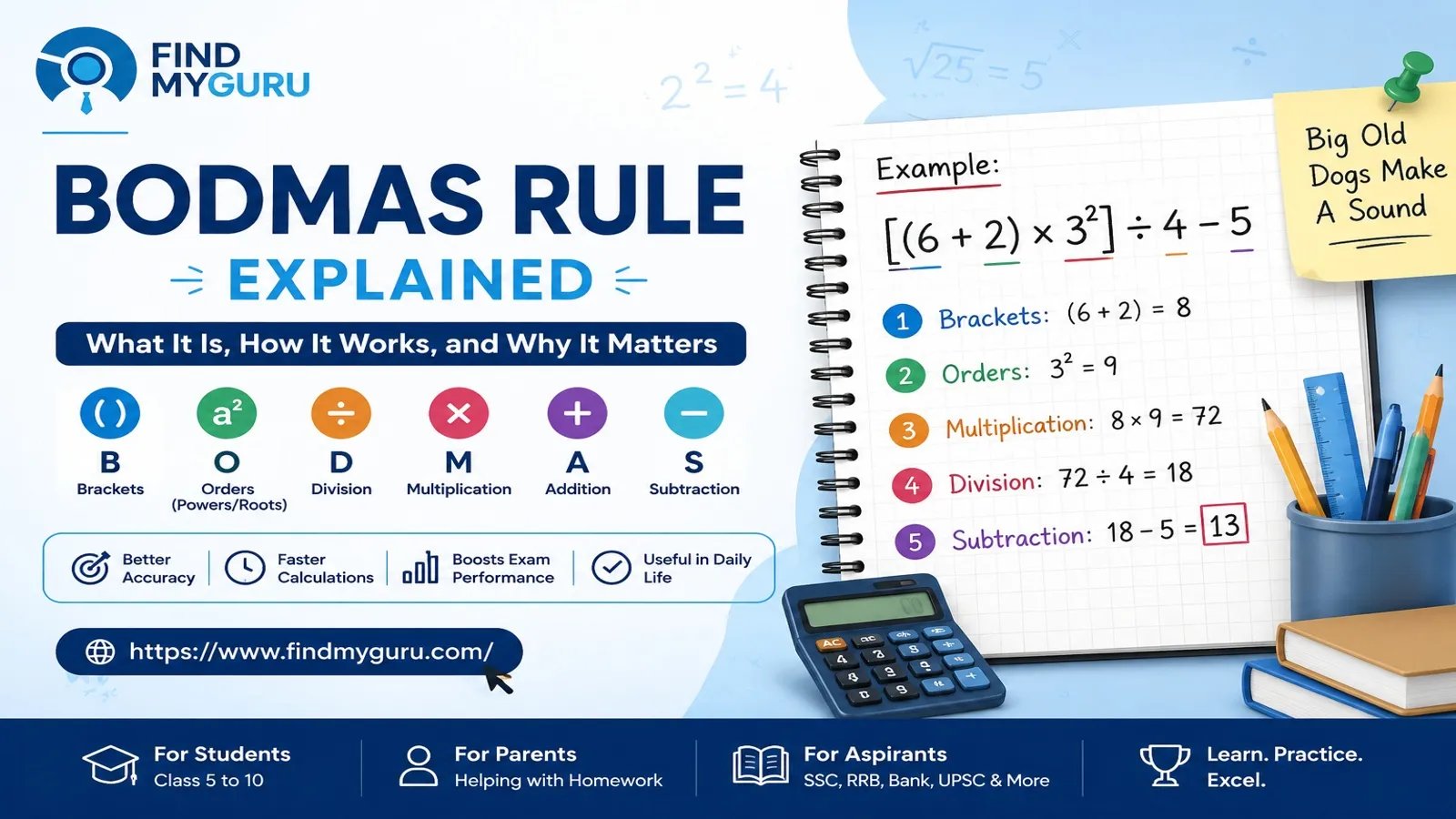
You are at a shop in the market and the owner tells you: "Take 3 packets of biscuits at ₹10 each, plus one packet of namkeen for ₹20, and I'll give you a ₹5 discount." Simple enough — but if you write that as a calculation and solve it left to right without any rules, you get a completely wrong answer. This is exactly why the BODMAS rule is important in mathematics. Whether you are learning basic arithmetic or preparing for competitive exams with the help of Online Mathematics Tutors Needed for personalized guidance, understanding the correct order of operations helps you solve calculations accurately and avoid common mistakes. This is exactly the problem that the BODMAS Rule solves. It tells you the correct order in which to perform mathematical operations so that every person solving the same expression gets the same right answer.
The BODMAS Rule in Mathematics is one of the most important foundational concepts you will encounter in school — from Class 5 all the way through competitive examinations like SSC CGL, RRB NTPC, and SBI PO, where simplification questions appear in almost every paper. Whether you are a Class 7 student working through NCERT exercises, a parent helping with homework, or an aspirant preparing for a bank exam, understanding BODMAS fully — with real examples and practice — makes a genuine difference to your accuracy and speed.
This guide covers everything: what BODMAS stands for, the BODMAS formula, step-by-step examples from simple to challenging, common mistakes, and practice questions with solutions.
What Is the BODMAS Rule? Full Form and Meaning
BODMAS is an acronym that stands for:
B — Brackets
O — Orders (powers/exponents and roots)
D — Division
M — Multiplication
A — Addition
S — Subtraction
This sequence is your instruction manual for solving any mathematical expression that contains more than one operation. When you encounter an expression like 4 + 3 × 2, the BODMAS Rule tells you to perform multiplication before addition. The correct answer is 4 + 6 = 10 — not 7 × 2 = 14, which is what you would get by solving left to right without any rule.
The BODMAS Formula — A Simple Way to Remember It
Think of the BODMAS Formula as a priority list. Operations higher up the list must be completed before operations lower down:
Brackets first — solve everything inside brackets before anything outside
Orders second — calculate powers (like 2³ = 8) and roots (like √25 = 5) next
Division and Multiplication — these have equal priority; solve left to right
Addition and Subtraction — these also have equal priority; solve left to right
The key insight that many students miss: Division and Multiplication share the same level of priority. So do Addition and Subtraction. When two operations share priority, you move left to right through the expression. This is essential for avoiding errors in longer problems. Understanding these mathematical principles reflects the value highlighted in many Teacher Quotes That Celebrate the Power of Education, where educators emphasize the importance of building strong foundational skills and logical thinking for lifelong learning.
A note for Indian students: You may also see the acronym BODMAS written as PEMDAS in American textbooks (Parentheses, Exponents, Multiplication, Division, Addition, Subtraction). They describe the same concept. Indian curricula — CBSE, ICSE, and State Boards — use BODMAS, which is what you will find in your NCERT textbooks.
BODMAS Rule in Mathematics — Understanding Each Step
Let us go through each component of the Order of Operations in Mathematics with clear explanations.
B — Brackets
Brackets group parts of an expression that must be solved first, regardless of what operations they contain. There are three types of brackets, and they are solved in this order:
( ) — Round brackets (also called parentheses) — solve innermost first
{ } — Curly brackets (also called braces)
[ ] — Square brackets
When brackets are nested (one inside another), always begin with the innermost bracket and work outward.
Example: [{(2 + 3) × 4} − 5]
Step 1: Solve round bracket →
(2 + 3) = 5Step 2: Solve curly bracket →
{5 × 4} = 20Step 3: Solve square bracket →
[20 − 5] = 15
O — Orders (Powers and Roots)
After brackets, calculate any powers (exponents) or roots present in the expression.
Examples:
2³ = 8(2 raised to the power 3)√144 = 12(square root of 144)5² + 3 = 25 + 3 = 28
D and M — Division and Multiplication
Division and multiplication are performed next, moving left to right through the expression. Neither has priority over the other — position in the expression (left to right) determines order.
Example: 12 ÷ 4 × 3
Left to right:
12 ÷ 4 = 3, then3 × 3 = 9✓Wrong approach (multiplication first):
4 × 3 = 12, then12 ÷ 12 = 1✗
A and S — Addition and Subtraction
Finally, addition and subtraction are performed, again moving left to right with equal priority.
Example: 10 − 3 + 4
Left to right:
10 − 3 = 7, then7 + 4 = 11✓Wrong approach (addition first):
3 + 4 = 7, then10 − 7 = 3✗
BODMAS Rule Examples — Step-by-Step Solutions
Here are worked examples at increasing levels of difficulty. This section is the core of your practical understanding.
Example 1 — Basic (Class 5–6 Level)
Expression: 8 + 4 ÷ 2
Step-by-step:
No brackets or orders present
Division first (D before A):
4 ÷ 2 = 2Addition:
8 + 2 = 10
Answer: 10
Example 2 — With Brackets (Class 6–7 Level)
Expression: (5 + 3) × 4 − 6
Step-by-step:
Brackets first:
(5 + 3) = 8Multiplication:
8 × 4 = 32Subtraction:
32 − 6 = 26
Answer: 26
Example 3 — With Orders (Class 7–8 Level)
Expression: 3 + 5² − (4 × 2)
Step-by-step:
Brackets first:
(4 × 2) = 8Orders:
5² = 25Addition and subtraction (left to right):
3 + 25 = 28, then28 − 8 = 20
Answer: 20
Example 4 — Nested Brackets (Class 8–9 Level)
Expression: [{(6 + 2) × 3} − 4] ÷ 5
Step-by-step:
Innermost bracket (round):
(6 + 2) = 8Curly bracket:
{8 × 3} = 24Square bracket:
[24 − 4] = 20Division:
20 ÷ 5 = 4
Answer: 4
Example 5 — Complex Expression (Competitive Exam Level)
Expression: 18 ÷ 3 + (7 − 2²) × 4
Step-by-step:
Brackets first, but solve order (power) inside bracket first:
2² = 4, so(7 − 4) = 3Division:
18 ÷ 3 = 6Multiplication:
3 × 4 = 12Addition:
6 + 12 = 18
Answer: 18
Example 6 — Real-World Indian Context
A cricket team scores runs across 4 overs as follows: in the first over they score (4 + 6) × 2 runs, then lose 3² runs to wides, then add 15 ÷ 3 runs in the last phase. What is the total net contribution?
Expression: (4 + 6) × 2 − 3² + 15 ÷ 3
Step-by-step:
Brackets:
(4 + 6) = 10Orders:
3² = 9Multiplication:
10 × 2 = 20Division:
15 ÷ 3 = 5Addition and subtraction (left to right):
20 − 9 + 5 = 16
Answer: 16 runs
Common Mistakes in the BODMAS Rule — And How to Avoid Them
Even students who understand BODMAS in theory make consistent errors in practice. Here are the most frequent mistakes, with the correction.
Mistake 1: Solving left to right without applying BODMAS: 5 + 3 × 2 solved left to right gives 8 × 2 = 16. The correct answer applying BODMAS: 3 × 2 = 6, then 5 + 6 = 11.
Mistake 2: Giving multiplication priority over division (or vice versa): Remember: D and M have equal priority — solve whichever appears first reading left to right. 24 ÷ 6 × 2: correct answer is 4 × 2 = 8, not 24 ÷ 12 = 2.
Mistake 3: Forgetting to solve orders inside brackets: In (3 + 2²), you must solve the power first: 2² = 4, then 3 + 4 = 7. Do not add first.
Mistake 4: Not working from innermost bracket outward: In nested brackets, always start with the innermost pair and work outward, one layer at a time.
Mistake 5: Treating subtraction as lower priority than addition: Addition and subtraction have equal priority — left to right determines order. 10 − 4 + 2 = 8 (not 10 − 6 = 4).
BODMAS Questions and Answers — Practice Set
Try solving these independently before checking the answers. These questions are structured across difficulty levels suitable for Classes 5–10 and competitive exam preparation. If you're searching for the Best Tuition Classes Needed Near Me in Mumbai, practicing a variety of questions like these can help strengthen your concepts and improve your problem-solving skills.
Practice Questions
Q1. 6 + 4 × 3 − 2
Q2. (12 − 4) ÷ 2 + 5
Q3. 3² + (8 − 3) × 2
Q4. [{(4 + 2) × 3} − 8] + 5
Q5. 50 ÷ (2 + 3) × 4 − 6²
Q6. (16 ÷ 4 + 2) × (3² − 4)
Q7. 100 − [{(5 + 3) × 4} ÷ 8] + 2
Q8. (√64 + 2²) ÷ (3 + 1)
Answers with Step-by-Step Solutions
A1. 6 + 4 × 3 − 2
Multiplication:
4 × 3 = 12Left to right:
6 + 12 − 2 = 16
Answer: 16
A2. (12 − 4) ÷ 2 + 5
Brackets:
12 − 4 = 8Division:
8 ÷ 2 = 4Addition:
4 + 5 = 9
Answer: 9
A3. 3² + (8 − 3) × 2
Brackets:
8 − 3 = 5Orders:
3² = 9Multiplication:
5 × 2 = 10Addition:
9 + 10 = 19
Answer: 19
A4. [{(4 + 2) × 3} − 8] + 5
Round bracket:
4 + 2 = 6Curly bracket:
6 × 3 = 18Square bracket:
18 − 8 = 10Addition:
10 + 5 = 15
Answer: 15
A5. 50 ÷ (2 + 3) × 4 − 6²
Brackets:
2 + 3 = 5Orders:
6² = 36Division:
50 ÷ 5 = 10Multiplication:
10 × 4 = 40Subtraction:
40 − 36 = 4
Answer: 4
A6. (16 ÷ 4 + 2) × (3² − 4)
Left bracket:
16 ÷ 4 = 4, then4 + 2 = 6Right bracket:
3² = 9, then9 − 4 = 5Multiplication:
6 × 5 = 30
Answer: 30
A7. 100 − [{(5 + 3) × 4} ÷ 8] + 2
Round bracket:
5 + 3 = 8Curly bracket:
8 × 4 = 32Square bracket:
32 ÷ 8 = 4Left to right:
100 − 4 + 2 = 98
Answer: 98
A8. (√64 + 2²) ÷ (3 + 1)
Left bracket (orders first):
√64 = 8,2² = 4, then8 + 4 = 12Right bracket:
3 + 1 = 4Division:
12 ÷ 4 = 3
Answer: 3
BODMAS Rule for Competitive Exams — What You Need to Know
The BODMAS Rule for competitive exams like SSC CGL, SSC CHSL, RRB NTPC, SBI PO, IBPS Clerk, and UPSC Prelims is tested primarily through simplification questions in the Quantitative Aptitude section. These questions account for 5–15 marks in most papers and are among the fastest to solve for prepared candidates. Students preparing for these exams often search for the Best Home Private Mathematics Tutors Needed Near Me in Hyderabad to strengthen their mathematical concepts, improve calculation speed, and master topics such as BODMAS, percentages, algebra, and arithmetic for higher exam scores.
What competitive exam questions look like:
They typically involve multi-step expressions with brackets, fractions, decimals, square roots, and large numbers. For example:
144 ÷ 12 × (√81 − 3²) + 50% of 80
Step-by-step:
Brackets — Orders inside:
√81 = 9,3² = 9, so(9 − 9) = 0Division:
144 ÷ 12 = 12Multiplication:
12 × 0 = 050% of 80 = 40 (treat as a separate calculation)
Addition:
0 + 40 = 40
Answer: 40
Exam strategy tips:
Always scan the full expression before starting — identify brackets, powers, and fractions first
Simplify step-by-step in writing; mental shortcuts lead to errors in multi-step problems
For time efficiency, practice rewriting the expression after each step so you never lose track of your place
In questions with fractions, apply BODMAS within the numerator and denominator separately before dividing
Mathematical expression simplification speed improves dramatically with daily practice of 10–15 questions. Most SSC and RRB toppers report that simplification questions are the most reliable marks in the paper for candidates who have truly mastered the BODMAS Formula — they require no memorisation beyond the rule itself.
BODMAS Rule for Beginners
If you are new to this concept, here is the simplest possible summary of the BODMAS Rule for Beginners:
When you see a mathematical expression with multiple operations:
Solve Brackets first — innermost to outermost
Solve Orders (powers and roots) next
Solve Division and Multiplication — left to right, equal priority
Solve Addition and Subtraction — left to right, equal priority
Memory trick: "Big Old Dogs Make A Sound" — B, O, D, M, A, S.
The golden rule: Never skip steps. Even if you can see the answer mentally, writing each step reduces errors — especially in examinations where partial working earns marks (Class 9–10 board exams) or where a single wrong answer carries negative marking (competitive exams).
Comparison: BODMAS vs PEMDAS
Feature | BODMAS (India, UK) | PEMDAS (USA) |
|---|---|---|
Full form | Brackets, Orders, Division, Multiplication, Addition, Subtraction | Parentheses, Exponents, Multiplication, Division, Addition, Subtraction |
Curricula | CBSE, ICSE, State Boards, UK National Curriculum | US Common Core |
Priority difference | Division listed before Multiplication | Multiplication listed before Division |
Practical result | Same — D and M share equal priority in both | Same — M and D share equal priority in both |
Used in Indian exams? | Yes — SSC, RRB, UPSC, banking | Not typically used in Indian context |
The practical application is identical. The sequence difference in the acronym does not change the result because Division/Multiplication and Addition/Subtraction are always solved at the same priority level, left to right.
Key Takeaways
The BODMAS Rule defines the correct sequence for solving mathematical expressions: Brackets → Orders → Division → Multiplication → Addition → Subtraction.
The BODMAS Formula is not just for school — it appears in competitive exams like SSC CGL, RRB NTPC, and SBI PO as simplification questions worth significant marks.
Division and Multiplication share equal priority; so do Addition and Subtraction. When operations share priority, solve left to right.
Always solve nested brackets from the innermost pair outward — round, then curly, then square.
The most common error is solving left to right without applying BODMAS — a mistake that produces wrong answers even for simple expressions.
Daily practice of 10–15 BODMAS problems with solutions builds both accuracy and speed, the two qualities that determine competitive exam performance in simplification questions.
BODMAS and PEMDAS (used in the US) describe the same rule — the order of letters differs but the mathematical outcome is identical.
Frequently Asked Questions
Q: What does BODMAS stand for in Mathematics?
A: BODMAS stands for Brackets, Orders, Division, Multiplication, Addition, and Subtraction. It defines the correct sequence in which mathematical operations must be performed when an expression contains more than one type of operation. Applying the BODMAS Rule ensures that the same expression produces the same answer regardless of who solves it.
Q: What is the difference between BODMAS and PEMDAS?
A: BODMAS is used in India (CBSE, ICSE), the UK, and several other countries, while PEMDAS is used in the United States. Both acronyms describe the same order of operations — the practical application is identical. Division and Multiplication always share equal priority (solved left to right), as do Addition and Subtraction.
Q: How do you solve nested brackets using BODMAS?
A: When brackets are nested (one inside another), always solve the innermost bracket first and work outward. In Indian textbooks, the order is round brackets ( ) first, then curly brackets { }, then square brackets [ ]. Each inner result replaces the bracket before moving to the next outer layer.
Q: Is the BODMAS Rule used in competitive exams like SSC and banking exams?
A: Yes — simplification questions based on the BODMAS Rule appear in almost every major competitive examination in India, including SSC CGL, SSC CHSL, RRB NTPC, IBPS PO, SBI Clerk, and UPSC Prelims quantitative sections. These questions are among the most reliably solvable for prepared candidates and reward consistent BODMAS practice.
Q: What happens when Division and Multiplication appear in the same expression?
A: Division and Multiplication share equal priority in the BODMAS Rule. When both appear in an expression, you solve them from left to right — whichever operation appears first (reading left to right) is performed first. For example, in 24 ÷ 6 × 2, you first divide (24 ÷ 6 = 4) then multiply (4 × 2 = 8).
Q: Where is the BODMAS Rule used in everyday life?
A: The BODMAS Rule governs any multi-step calculation — from calculating a market bill with discounts and taxes, to splitting restaurant bills among friends, to computing cricket statistics, to programming arithmetic logic in computers. Any time a calculation involves more than one operation, the order of operations determines the correct answer.
Final Thoughts
The BODMAS Rule is one of those foundational concepts that rewards everyone who invests time in truly understanding it — not just memorising the acronym. For Class 5–10 students, mastery of BODMAS builds the mathematical confidence that carries through board exams and beyond. For competitive exam aspirants, it is one of the most reliable score-builders in the quantitative section.
Work through the examples in this guide step by step. Attempt every practice question before checking the answer. Go back to any concept that produces errors and re-read that section carefully. Mathematics rewards patience and systematic practice more than raw intelligence — and the BODMAS Rule is one of the most learnable concepts in the entire school curriculum. If you need additional support, consider enrolling in Coaching Centers Near Me to strengthen your mathematical foundation and receive personalized guidance from experienced tutors.
Start with the basics. Build to the complex. Keep practising. The marks will follow.