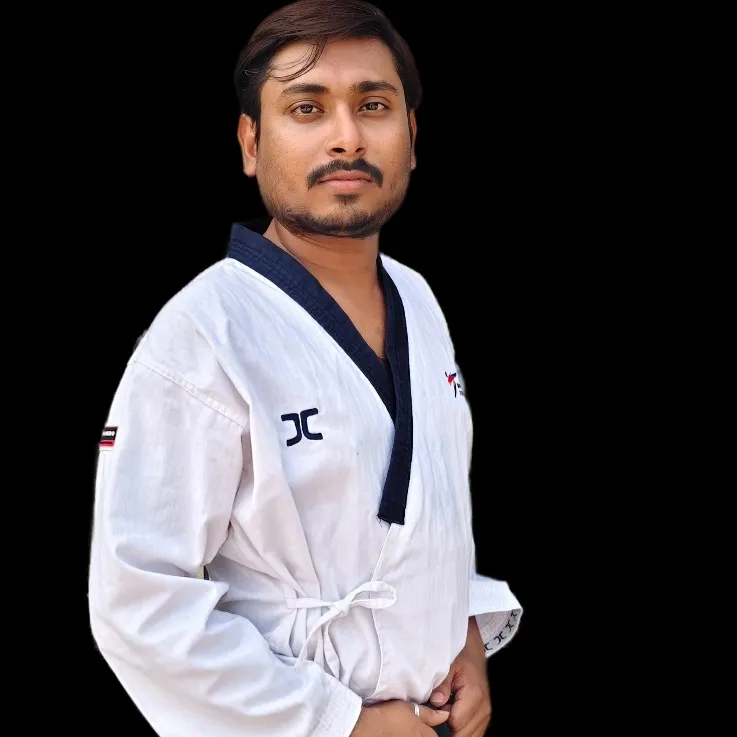
Taekwondo and Fitness Conditioning Program by Sandip Chakraborty
12 Yrs
Skills: Taekwondo, Fitness Trainner, Posture Correction, Pilates instructor



Compare online taekwondo tutors across India for kids, teens, and adults — from white-belt basics to poomsae and sparring drills. Browse verified coach profiles by style and belt lineage, then book a trial class.
Browse qualified tutors, compare profiles, and connect directly.

Join thousands of tutors who are sharing their knowledge and helping students succeed.


We'll match you with tutors based on your goals, budget, and schedule.
Chat With UsIf you've searched for online taekwondo tutors, you've probably already hit the obvious question: can you really learn a striking martial art through a video call? The honest answer is partly. This page helps you compare verified taekwondo coaches teaching live over video, understand what genuinely transfers to an online format and what doesn't, and book a trial session before committing to a batch.
Online taekwondo has grown fast in Indian cities over the last few years, mostly because commute-heavy schedules make a 6 PM dojang class hard to keep, and because a lot of parents are looking for structured, screen-free activity time for kids that doesn't require driving across town. It works well for certain goals and poorly for others — the trick is knowing which one you're signing up for before you pay for a month of classes.
A camera can watch your stance, count your reps, and correct your form in real time. It cannot catch you if you fall, hold a kicking pad steady, or absorb a sparring strike. That distinction should shape what you expect from an online class.
Poomsae (forms) practice. A tutor can watch your sequence, freeze-frame your stance, and correct hip rotation or hand position just as well over video as in a room — this is where online taekwondo is closest to in-person quality.
Flexibility, footwork, and conditioning drills. Kicking mechanics, balance work, and the strength training that supports higher kicks translate fine to a webcam.
Basic self-defence patterns and shadow sparring. Solo drills — blocks, combinations, reaction training against an imaginary opponent — work without a partner in the room.
Theory and belt-syllabus knowledge. Terminology, grading requirements, and the "why" behind techniques are easy to teach remotely.
Live sparring (kyorugi). You need a real opponent and protective gear in the same room. Online tutors typically substitute pad work or shadow drills instead.
Partner-based self-defence and throws. Anything requiring grip, resistance, or a falling partner needs an in-person session.
Hands-on correction. A coach adjusting your hip angle by physically touching it is faster than talking you through it — this matters more for advanced technique than for beginner basics.
A realistic way to think about it: online taekwondo is strong for forms, fitness, discipline, and grading-track progress up to a point, and weaker for full-contact sparring and belt levels that require partner work.
Profile photos and star ratings tell you very little. A few things actually worth checking:
Which style they teach. Most Indian taekwondo instruction follows either the WT (World Taekwondo) / Kukkiwon curriculum — the Olympic sport version, taught through numbered gup belts and Taegeuk poomsae — or ITF-style taekwondo, which uses different patterns (tuls) and terminology. These aren't interchangeable; ask which one a tutor teaches before assuming your existing belt maps across.
Their own certifying body and dan grade. Ask whether the coach's black belt is affiliated with Kukkiwon, an ITF-recognised federation, or a state taekwondo association, and how long they've held it. A coach with a physical dojang affiliation usually means clearer answers when it's time to grade.
Experience with your specific age group. Coaching a 6-year-old's attention span through a screen is a different skill from coaching an adult beginner or a competitive teen. Ask what a typical class for your child's age actually looks like.
A trial or intro session. Most tutors on FindMyGuru offer one. Use it to check whether the coach actually watches your form closely or just demonstrates and moves on — the difference matters a lot in a striking art.
Group online batches suit kids and beginners who mainly want structure, discipline, and a fixed schedule — a coach running a batch of 8–10 can still correct individual form reasonably well in taekwondo since students move through poomsae one at a time rather than all together. They're the more affordable option and usually run on a fixed weekly timetable.
Personal (1:1) online classes make more sense for adults preparing for a specific belt test, athletes training for competition, or anyone who wants faster correction on a technique they're stuck on. You pay more per session, but the coach's full attention is on your kicking angle and stance, not managing a group.
This is the question most pages skip, and it's usually the real reason someone is searching. Short version: you can train toward a grading online, but the test itself is often still conducted in person or with a physical affiliation.
A tutor teaching Kukkiwon-curriculum taekwondo can prepare you through the lower gup (colour belt) levels entirely over video — poomsae, terminology, and basic technique are gradeable through recorded submission or live video assessment by many coaches. Higher gup levels and any dan (black belt) grading, however, typically require either travelling to a physical grading event or the tutor being affiliated with a registered dojang that can submit your grading to Kukkiwon or the relevant federation. Ask this directly before enrolling if belt progression — not just fitness — is your goal: "Which belt can I actually reach fully online, and what happens after that?" A tutor who gives you a clear, specific answer (rather than a vague "yes, all belts") is usually the more reliable one.
Online taekwondo classes need less space than most people assume, but not zero. A rough baseline:
Floor space roughly the width of your outstretched arms in each direction, ideally on a non-slip surface — a yoga mat or two works for younger kids.
A dobok (uniform), which most tutors will tell you to buy separately once you commit past a trial.
A kicking target or paddle for anyone progressing past basic forms — many tutors suggest budget-friendly options rather than gym-grade pads for home use.
Stable internet and a side-angle camera view, since the coach needs to see your full stance, not just your face.
Pricing varies by city, coach experience, and whether it's a group or personal format, so treat these as indicative ranges rather than fixed numbers. Group online batches for kids commonly fall somewhere in the ₹800–₹2,000 a month range for 8–12 sessions. Personal (1:1) coaching runs higher — often in the ₹400–₹900 per-session range — since you're paying for individual correction rather than a shared slot. Coaches actively preparing students for dan grading or competition typically price at the upper end of these ranges given the additional attention involved.
FindMyGuru lists taekwondo tutors and institutes teaching online across India, with profiles showing years of experience, specialisation, and available time slots so you can compare before reaching out. You contact tutors directly — there's no commission charged to learners, and no obligation beyond a trial class. If you teach taekwondo and want to reach students beyond your local dojang, you can list your profile and set your own schedule and rates.
Looking for something adjacent? You can also browse online karate tutors if you're comparing martial arts styles, online yoga tutors or online Zumba tutors for general fitness alongside taekwondo, or in-person options through Online Tutors if you'd rather train offline on some days.
Whether your child needs a structured after-school routine or you're an adult working toward your black belt, the fastest way to know if a coach is right for you is a trial class — not another week of comparing profiles. Search online taekwondo tutors on FindMyGuru and message a couple of them today.
Yes, for a meaningful part of it. Poomsae (forms), footwork, flexibility, conditioning, and solo self-defence drills transfer well to live video coaching. Full-contact sparring and partner-based throws don't, since they need a real opponent in the room, so most online programmes focus on the former and supplement sparring with pad or shadow drills.
It works well for building discipline, focus, and basic technique, especially for younger kids who benefit from structure and short, camera-friendly drills. Look for a coach with specific experience teaching children online, since holding a young child's attention through a screen takes a different approach than coaching adults.
You can train toward it online, but the actual dan grading is usually conducted in person or requires your tutor to be affiliated with a registered dojang or federation. Ask your coach directly which belt levels are gradeable fully online and what the path looks like once you go past that.
At minimum, a non-slip patch of floor about arm's-width in each direction, a stable camera angled to show your full body, and a dobok (uniform) once you move past a trial class. A kicking paddle or target is useful once you're past basic forms.
Group online batches for kids typically run roughly ₹800–₹2,000 a month for 8–12 sessions, while personal 1:1 coaching is usually priced per session, often in the ₹400–₹900 range. Coaches preparing students for grading or competition tend to price toward the higher end.
WT/Kukkiwon is the Olympic sport style, using numbered gup belts and Taegeuk poomsae, and is the more common curriculum taught in Indian dojangs. ITF-style taekwondo uses different patterns (tuls) and terminology and isn't directly interchangeable with a Kukkiwon belt. Confirm which style a tutor teaches before assuming your current belt or grading history carries over.
Group batches are usually enough for beginners who mainly want structure and a fixed schedule, and they're more affordable. Personal 1:1 classes make more sense if you're preparing for a specific grading, competing, or want faster correction on a technique you're stuck on.
Ask which style they teach, their own dan grade and certifying body (Kukkiwon, an ITF federation, or a state association), and how long they've held it. A short trial class is the fastest way to judge whether they actually watch and correct your form closely rather than just demonstrating and moving on.