

Divyashree Rao
Belly Dance
View Profile ->Tutors & Institutes:
The "FindMyGuru for Tutor" App is LIVE! Download now and never miss a student enquiry.
Tutors & Institutes:
Refer a tutor and earn rewards when they join. Refer & Earn
This page compares USD-paying tutoring platforms such as Preply, Cambly, and italki against INR-paying Indian platforms such as Vedantu, UrbanPro, and TeacherOn, focusing on what tutors based in India actually take home after commissions and currency conversion. It is written for working and aspiring tutors in India deciding whether to chase international USD-denominated students or build a steady local INR-paying student base. Last Updated: June 2026
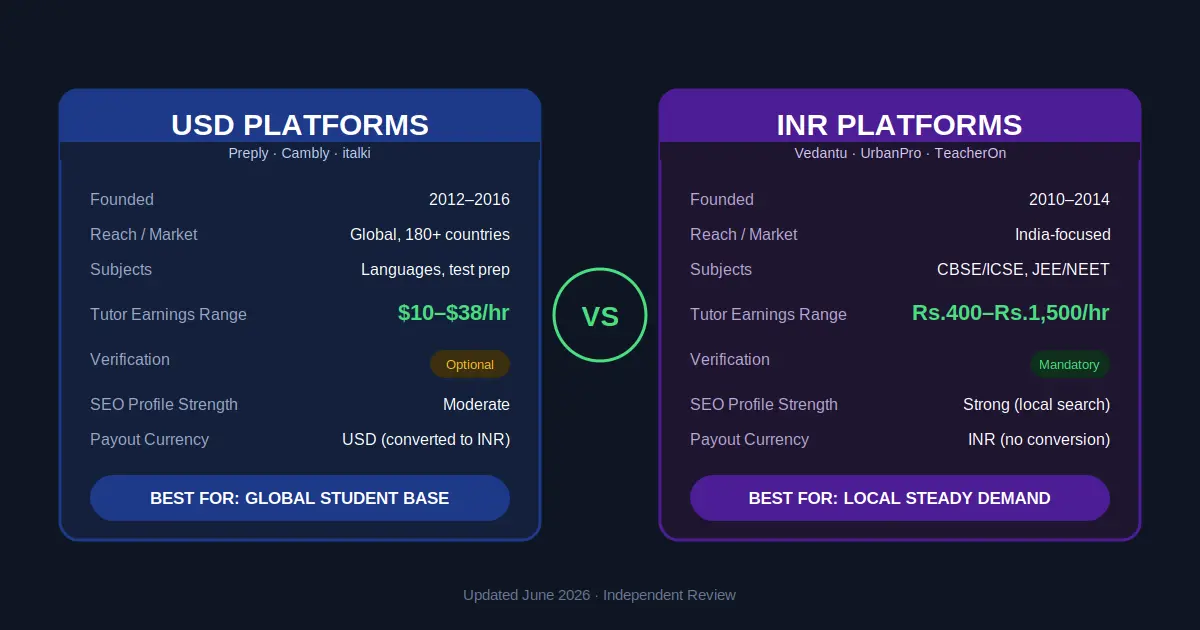
USD-paying platforms such as Preply and Cambly tend to offer a higher dollar-equivalent hourly rate once a tutor is established, because pay is pegged to the dollar and converted to rupees at the prevailing exchange rate. INR-paying Indian platforms such as Vedantu and UrbanPro pay less per hour in absolute terms but offer steadier local demand, simpler payouts with no currency conversion, and easier entry for India-specific subjects like CBSE/ICSE tuition or JEE/NEET coaching. If the goal is maximizing rupee income per hour and the tutor can compete for international students, a USD platform is usually better; if the goal is predictable local income without conversion friction, an INR platform is the more practical starting point.
These platforms were founded between 2012 and 2016 and run a global marketplace model connecting tutors, mostly in language learning and exam prep, with students worldwide. Preply vs Vedantu for English learning According to platform-published figures, Preply alone lists over 100,000 tutors across 90-plus languages and serves learners in 180-plus countries. Tutors set a base hourly rate in US dollars, and the platform takes a tiered commission. The primary user base for Indian tutors on these platforms is overseas English-language learners, with a smaller share of Indian students. Payouts arrive in USD and are converted to INR by the tutor's bank, payment processor, or platform-supported method such as Payoneer or PayPal.
Vedantu, founded in 2014 by IIT alumni and headquartered in Bengaluru, and UrbanPro and TeacherOn, both founded in the early 2010s, are India-focused marketplaces built around the country's school curricula (CBSE, ICSE, state boards) and competitive exams such as JEE, NEET, and UPSC. Reported by users, Vedantu serves several million Indian students, while UrbanPro states it connects over 7.5 lakh verified tutors with more than 55 lakh students. Payments are made directly in rupees, removing currency-conversion steps. The primary user base is Indian school and college students, plus a smaller pool of NRI families seeking India-curriculum tutoring from abroad.
Feature | USD Platforms | INR Platforms |
Founded | 2012–2016 (platform-published) | 2010–2014 (platform-published) |
Primary Market | Global, 180+ countries | India-focused, plus NRI families |
Subjects Covered | Languages, business English, exam prep | CBSE/ICSE/state boards, JEE/NEET/UPSC, coding |
Online/Offline Support | Online only | Online and offline (city-dependent) |
Tutor Registration | Free, demo video + profile review | Free, profile screening + demo class |
Student Search Filters | Language, price, availability, native speaker | Subject, board, class, location, fee range |
Payment Security | Escrow-style; released after lesson completion | Platform-mediated payment (e.g., SecurePay) |
Platform Commission % | 18–33% tiered, reported by users | Coin-based lead fee or revenue share, varies by subject |
Tutor Sets Own Rate | Yes, within platform guidance | Yes, within platform guidance |
Student Reviews | Yes, public star ratings | Yes, public star ratings |
Background Verification | Optional ID/video check | ID and credential verification, often mandatory |
Mobile App | Yes (iOS/Android) | Yes (iOS/Android) |
Trial Classes | Yes, often platform-subsidized or fully commissioned | Yes, frequently free for the student |
Group Classes | Limited, tutor-dependent | Common, especially for exam batches |
SEO Profile Visibility | Moderate; competes globally | Strong for India-specific search terms |
Monthly Active Users | Millions globally, platform-published | Several million in India, platform-published |
Best For | Tutors targeting international, dollar-paying students | Tutors targeting steady local Indian demand |
The clearest difference is currency and market reach: USD platforms widen the addressable student pool but add conversion fees and steeper new-tutor commissions, while INR platforms keep payments simple and lean on strong local search visibility and mandatory verification that students trust.
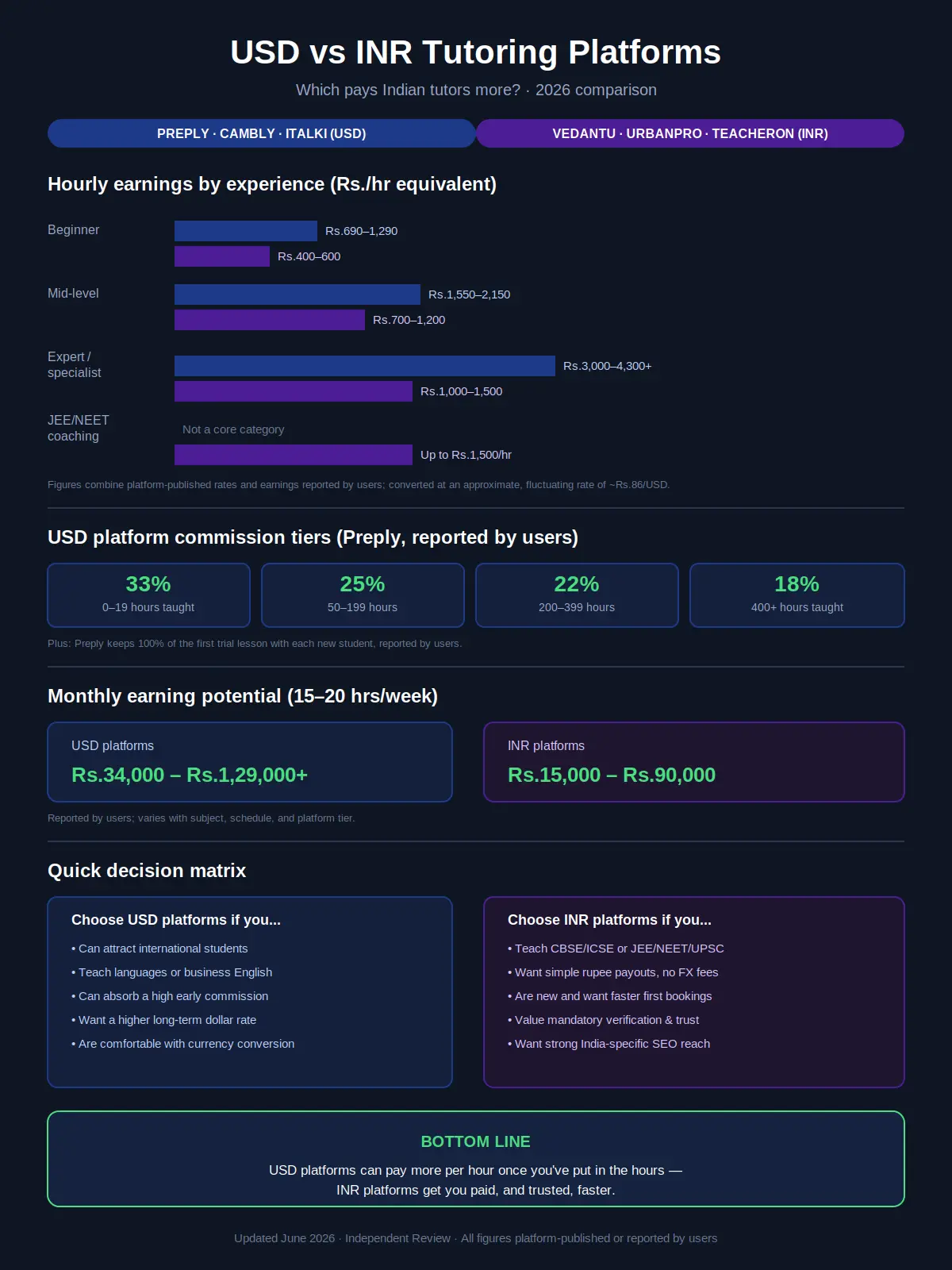
Figures below combine platform-published rate ranges and earnings reported by users, converted at an approximate, fluctuating exchange rate of about Rs.86 per US dollar for comparison purposes only; actual take-home pay depends on commission tier, subject, hours taught, and the bank or payment processor's conversion fees.
Tutor Level | USD Platforms | INR Platforms |
Beginner (0–1 yr exp) | $8–$15/hr gross (Rs.690–Rs.1,290); Preply keeps 100% of the first trial lesson and 33% commission under 20 hours | Rs.400–Rs.600/hr gross, reported by users |
Mid-Level (2–5 yrs) | $18–$25/hr gross (Rs.1,550–Rs.2,150) at 22–28% commission tiers | Rs.700–Rs.1,200/hr gross, reported by users |
Expert / Niche Specialist | $35–$50+/hr gross (Rs.3,000–Rs.4,300+), commission as low as 18% after 400+ hours | Rs.1,000–Rs.1,500/hr gross for specialized subjects, reported by users |
Competitive Exam (JEE/NEET/UPSC) | Not a core category on most USD platforms | Up to Rs.1,500/hr, reported by users; income scales with batch size |
Monthly Earning Potential | Roughly $400–$1,500+/month (Rs.34,000–Rs.1,29,000+) reported by users, for 15–20 teaching hours/week | Roughly Rs.15,000–Rs.90,000/month, reported by users, for similar hours |
Can You Earn Rs.1 Lakh/Month? | Possible for experienced tutors with full schedules and low commission tiers, but not guaranteed | Possible for top-rated exam-prep specialists with 4–6 hours/day, reported by users |
On a strict per-hour dollar-to-rupee basis, established tutors on USD platforms such as Preply can out-earn their INR-platform counterparts, especially once they reach lower commission tiers after 200–400 teaching hours. However, new tutors absorb a steep 33% commission plus a fully commissioned trial lesson on USD platforms, which can make the first few months less profitable than starting on an INR platform. INR platforms pay less per hour but convert to predictable monthly income faster for tutors specializing in board exams or JEE/NEET coaching, where local demand is dense and consistent.
FindMyGuru
Create your tutor account and complete the video interview or demo. Insider tip: Speak slowly and clearly in the demo; approval algorithms and reviewers weight clarity heavily.
Build a complete profile with a clear photo, bio, and certifications. Insider tip: Profiles with a TEFL or subject-specific certificate are shown higher in search filters.
Set your rate below the category average for your first 20 hours. Insider tip: A lower rate offsets the 33% new-tutor commission and helps you climb the experience tiers faster.
Respond to inquiries within minutes, not hours. Insider tip: Preply's matching algorithm favors fast responders with higher visibility in student searches.
Treat the (fully commissioned) trial lesson as paid marketing, not a paid class. Insider tip: Over-deliver on the trial; it is your only real shot at converting a one-off into a recurring student.
Ask satisfied students for a public review immediately after a good session. Insider tip: Reviews left within 24 hours of a lesson tend to be more detailed and rank higher in profile search.
Track your hours toward the next commission tier (20, 50, 200, 400 hours). Insider tip: Once you cross a tier, raise your rate slightly since your take-home percentage just improved.
Diversify across 2–3 related subjects or levels once you have 10+ regular students. Insider tip: Broader subject tags increase how often you appear in long-tail searches.
Submit your application and qualification documents for verification. Insider tip: Mandatory verification takes longer but builds parent trust faster than optional checks elsewhere.
Complete a teaching demo evaluated by the platform's academic team. Insider tip: Structure the demo like a real class with a clear problem-solving segment; evaluators score pedagogy, not just subject knowledge.
Set your hourly or monthly rate within the platform's suggested band. Insider tip: Slightly undercutting the local average in your first month accelerates your first bookings.
List your availability clearly, especially the 4 PM–10 PM IST window. Insider tip: Most Indian student bookings cluster in this window; gaps here cost you visibility.
Offer a free or low-cost first session where the platform allows it. Insider tip: Free trials convert noticeably better for board-exam subjects than for hobby subjects.
Collect a rating and written review after each completed booking. Insider tip: Mentioning specific topics covered in the review (e.g., “quadratic equations”) improves your profile's search relevance.
Build a batch or group offering once you have 3–5 individual students in the same subject and grade. Insider tip: Group sessions raise your effective hourly earnings without raising the per-student fee much.
Key difference: USD platforms reward speed and volume early on to offset commission; INR platforms reward documented credentials and structured demos before you ever see a paying student.
• Search is filtered by language, native-speaker status, price band, and availability, which works well for self-directed adult learners.
• Tutor quality signals lean on student reviews and a short intro video rather than mandatory credential checks.
• Payment is typically prepaid in lesson packages and held until the lesson is marked complete.
• Safety relies mostly on platform messaging and payment controls; identity verification for tutors is often optional, so parents booking for minors should check credentials independently.
• Search filters by board, class, subject, and city or online mode, which suits parents searching for curriculum-specific help.
• Tutor quality signals include mandatory ID and qualification verification in addition to reviews, which Indian parents tend to trust more for school-age children.
• Payment is usually processed through the platform's secure payment gateway with weekly payouts to tutors.
• Safety is generally stronger for minors due to mandatory verification, though refund policies for long-term course packages are a recurring complaint reported by users.
Overall, USD platforms offer a smoother experience for adult, self-directed learners comparing tutors globally, while INR platforms are generally better suited to parents of school-age children who prioritize verified credentials and curriculum match over price comparison alone.
The right platform depends on who you are and what you need. Use this table to find your match.
Your Situation | Choose USD Platforms | Choose INR Platforms |
New tutor building first student base | Lower barrier to entry but steep first-tier commission | Easier to convert local students into recurring bookings |
Verified expert tutor | Higher ceiling once tiers and rate climb | Strong fit for JEE/NEET/UPSC specialists |
Student on a tight budget | Trial lessons can be costly for the tutor, not the student | Often the cheaper option per hour |
Parent focused on child safety | Verification is optional on most listings | Mandatory verification gives more assurance |
Competitive exam coaching | Not a strong category | Clear advantage — built around Indian exams |
Looking for international students | Clear advantage — global reach | Limited beyond the NRI segment |
Prefer low platform fees | Only at high hour-tiers (18%+) | Coin/lead-fee model can be cheaper at low volume |
Want strong SEO profile visibility | Competes in a global search pool | Often ranks well for India-specific search terms |
PROS:
• Dollar-denominated pay can mean a higher rupee equivalent once experienced
• Massive global student pool, especially for English and language learning
• Flexible scheduling across time zones
• Lower-friction registration with no mandatory document verification
• Established platforms with millions of learners, per platform-published data
CONS:
• Steep 33% commission and a fully commissioned trial lesson for new tutors
• Currency conversion fees and exchange-rate fluctuation eat into take-home pay
• Weak fit for India-specific subjects like board exams or JEE/NEET
• Heavy competition from tutors worldwide, including lower-cost regions
PROS:
• Direct rupee payments with no currency-conversion step
• Strong fit for board exams and competitive exam coaching, where demand is dense
• Mandatory verification builds parent trust faster
• Strong local SEO visibility for India-specific search queries
• Group and batch classes can raise effective hourly earnings
CONS:
• Lower absolute hourly rates compared to established USD-platform tutors
• Reported refund-policy friction on long-term paid course packages
• Smaller addressable market outside India and the NRI segment
• Coin or lead-based fee models can feel opaque to new tutors
Where Does FindMyGuru Fit?
For Indian tutors who want the verified-credential trust of an INR platform without the coin-based lead fees or opaque payout models, FindMyGuru offers a cleaner alternative. Unlike platforms that charge tutors per lead or hold heavy commissions upfront, FindMyGuru lets tutors build a public profile, get discovered through India-specific search terms, and connect directly with students across cities like Hyderabad, Bengaluru, Mumbai, Delhi, and Pune.
FindMyGuru is purpose-built for the Indian education market. It covers school curricula (CBSE, ICSE, state boards), competitive exam coaching (JEE, NEET, UPSC), professional skills (Python, Digital Marketing, Tally), and lifestyle skills (Yoga, Guitar, Dance) — all in one place. Tutors set their own hourly rate in INR, receive genuine student inquiries, and avoid the exchange-rate friction that comes with dollar-paying platforms.
For students, FindMyGuru provides tutor profiles with verified credentials, public ratings, and subject-level filters — the same trust signals Indian parents value on legacy INR platforms, with a simpler booking experience. For tutors, it removes the pressure of heavy first-tier commissions and gives full control over rate-setting from day one.
The practical advice: If you are starting out as a tutor in India, build your base on an INR platform — and consider FindMyGuru alongside Vedantu or UrbanPro. If you are a student or parent searching for curriculum-matched, verified tutors in your city, FindMyGuru.com is worth comparing directly before committing to a single platform.

Join thousands of tutors who are sharing their knowledge and helping students succeed.
Start getting StudentsExplore Tutors by Location and Skills
Find Expert tutors across India for Popular Subjects, Skills and Cities
Popular courses
Popular Locations
Popular Searches