

Preethi
Teaching Skills
View Profile ->Tutors & Institutes:
The "FindMyGuru for Tutor" App is LIVE! Download now and never miss a student enquiry.
Tutors & Institutes:
Refer a tutor and earn rewards when they join. Refer & Earn
This guide compares TeacherOn, a global pay-per-lead tutor marketplace, with Tutor.com, a U.S.-based on-demand tutoring service used by schools, libraries, and the military. It is written for tutors deciding where to apply and for students or parents weighing TeacherOn vs Tutor.com for online tutoring in 2026. Last Updated: June 2026
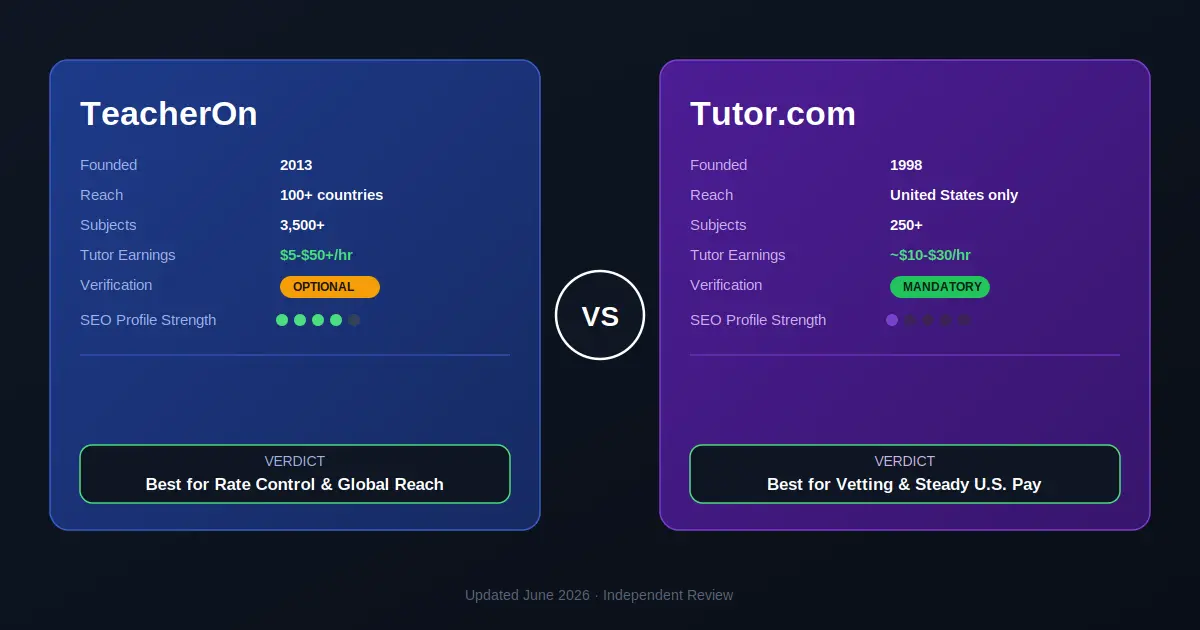
TeacherOn is better for self-employed tutors worldwide who want to set their own rates, because tutors and students negotiate fees directly and TeacherOn takes no cut unless you use its optional payment tool. Tutor.com is better for tutors who want structured, guaranteed (if modest) hourly pay, because Tutor.com sets the rate and pays tutors directly on a fixed schedule — but it is open only to U.S. residents. If your goal is maximum earning control and global reach, choose TeacherOn; if your goal is steady part-time pay without sales effort, choose Tutor.com.
Founded in 2013 and headquartered in Ludhiana, India, TeacherOn is a global tutor-finding marketplace, not a fully managed tutoring company. It connects students and tutors across more than 100 countries in thousands of subjects (platform-published), but the lessons themselves, along with fees and payment terms, are typically arranged directly between the tutor and student. Students post requirements or browse public tutor profiles; tutors spend "coins" to contact promising leads. Because TeacherOn mostly stays out of lesson delivery and vetting, TeacherOn vs Wyzant it functions more like a global classifieds board for tutoring than a school. Its user base includes independent tutors worldwide and students or parents who prefer to choose and negotiate with a tutor directly rather than go through a managed service.
Founded in 1998 by George Cigale and incorporated in 2000, Tutor.com is a U.S.-based on-demand tutoring company headquartered in New York City. It has changed hands several times — from IAC and Match Group, to Korea's ST Unitas in 2017, to Primavera Capital Group in 2022 — and became 100% U.S.-owned and operated again in July 2025. Tutor.com is an affiliate of The Princeton Review and delivers roughly two million tutoring, homework-help, and test-prep sessions a year, with more than 25 million sessions delivered historically (platform-published). It primarily serves K-12 schools, colleges, libraries, employee-benefit programs, and the U.S. Department of Defense, meaning many students access it free through an institution rather than paying directly. Tutors must be U.S. residents who pass an application, a subject-matter exam, and a background check.
Feature | TeacherOn | Tutor.com |
Founded | 2013 | 1998 (incorporated 2000) |
Primary Market | Global (100+ countries) | United States only |
Subjects Covered | Thousands (platform-published) | 250+ (platform-published) |
Online/Offline Support | Both online and in-person/home tutoring | Online only |
Tutor Registration | Free profile; about 54% of applicants approved (platform-published) | Free application; only a small fraction of ~200,000 yearly applicants selected (platform-published) |
Student Search Filters | Search/post requirements or browse public tutor profiles | No tutor browsing; matched automatically on demand or by schedule |
Payment Security | Optional in-house payment tool; most deals handled off-platform | All payments processed and scheduled centrally by Tutor.com |
Platform Commission % | 0% off-platform; 10-15% if paid via TeacherOn's tool (platform-published) | Not applicable — tutors are paid a set wage, not charged commission |
Tutor Sets Own Rate | Yes, negotiated directly with each student | No, Tutor.com sets the hourly pay rate |
Student Reviews | Yes, public tutor ratings and reviews | Session ratings used internally for quality scoring |
Background Verification | Profile review only; ID/credential checks optional | Mandatory third-party background check (platform-published) |
Mobile App | Limited; primarily web-based | Web-based online classroom; no major mobile app emphasis |
Trial Classes | Negotiated directly between tutor and student | Built into many Princeton Review consumer packages |
Group Classes | Possible if negotiated directly | Primarily 1:1 sessions |
SEO Profile Visibility | Public, searchable tutor profiles | No public tutor profiles |
Monthly Active Users | Not publicly disclosed | ~2 million sessions delivered per year (platform-published) |
Best For | Independent tutors wanting global reach and rate control | U.S. students and tutors wanting a vetted, institutionally backed service |
Table Summary: The core difference is structural: TeacherOn is an open, global marketplace where tutors set prices and TeacherOn rarely touches the money, while Tutor.com is a closed, U.S.-only service that vets every tutor, sets the pay rate, and handles all payments itself. That makes TeacherOn more flexible and global, but less standardized and verified than Tutor.com.
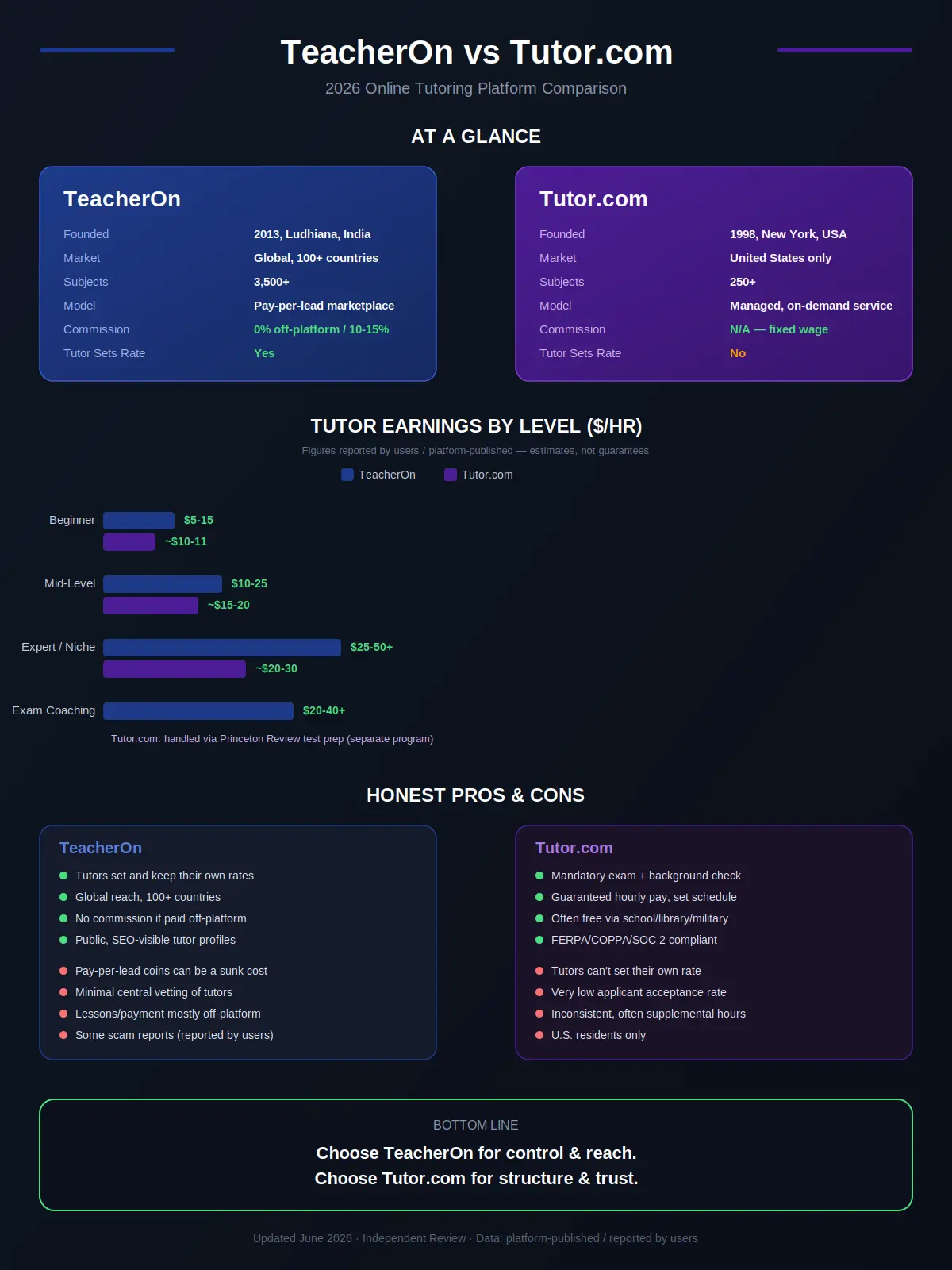
Earnings on these two platforms work very differently. On TeacherOn, pay is whatever a tutor negotiates directly with each student, so it scales with reputation, subject demand, and marketing effort. On Tutor.com, pay is a fixed hourly rate set by the company based on subject and tutor level, paid on a regular schedule regardless of how a tutor markets themselves. Figures below are reported by users on review sites such as Glassdoor, Indeed, and ZipRecruiter, plus TeacherOn's own published fee structure, and should be treated as estimates rather than guarantees.
Tutor Level | TeacherOn Rate | Tutor.com Rate |
Beginner (0-1 yr exp) | $5-$15/hr, negotiated directly (reported by users) | About $10-$11/hr starting rate (reported by users) |
Mid-Level (2-5 yrs) | $10-$25/hr, negotiated directly (reported by users) | About $15-$20/hr (reported by users) |
Expert / Niche Specialist | $25-$50+/hr, negotiated directly (reported by users) | About $20-$30/hr for high-demand subjects (reported by users) |
Competitive Exam Coaching | $20-$40+/hr for exam-focused tutoring (reported by users) | Handled mainly via Princeton Review test prep, billed separately from on-demand tutoring |
Monthly Earning Potential | Highly variable; depends on leads won and hours billed directly | Often $400-$800/month part-time, capped by available hours (reported by users) |
Can You Earn $1,000+/Month? | Possible for established tutors with a steady roster of paying students | Uncommon; widely described as supplemental rather than primary income (reported by users) |
Earnings Verdict: TeacherOn has the higher ceiling because tutors set and keep their own rates, with no fixed cap beyond an optional payment-processing fee. Tutor.com pays a lower but steadier wage, reported by users to start around $10-11 an hour and rise with tenure and subject difficulty. Tutors who can market themselves and build a loyal student base will generally earn more on TeacherOn over time, while Tutor.com suits those who want predictable, if modest, pay without doing their own sales.
Create a free tutor profile listing your subjects, qualifications, and a sample rate. Insider tip: profiles with a clear photo and a detailed bio tend to get more student replies.
Complete the application carefully; only about 54% of applicants are approved (platform-published). Insider tip: list specific, verifiable credentials rather than vague claims of expertise.
Browse the requirements board for active student posts in your subject area. Insider tip: respond quickly, since lower-coin leads tend to attract competing tutors fast.
Spend coins to contact a promising lead, or wait for free leads when a post has had little response. Insider tip: free leads usually appear once a student post has gone unanswered for a while.
Negotiate the rate, format, and schedule directly with the student. Insider tip: confirm payment terms in writing before the first session, since TeacherOn is not a party to this agreement.
Offer a discounted or free trial session to convert the lead into a regular student. Insider tip: use the trial to set expectations on pace and homework, which reduces early drop-off.
Ask satisfied students to leave a public review on your profile. Insider tip: reviews are the main trust signal new students will see before contacting you.
Reinvest part of your early earnings into more coins to keep contacting leads and grow your roster. Insider tip: track which lead types convert best for you, and focus your coin spend there.
Confirm eligibility: U.S. residency, college sophomore status or higher (or a four-year degree), and strong subject knowledge (platform-published). Insider tip: gather your transcript or degree details before applying, since the process checks this.
Submit the online application and pass a subject-matter exam in your chosen area. Insider tip: the process typically takes one to three weeks (platform-published), so apply well before you need the income.
Complete the mandatory background check. Insider tip: respond quickly to any document requests, since this step is a common source of delay.
Set your weekly availability for at least five hours, the minimum required to stay active (platform-published). Insider tip: demand is reportedly highest between 4 p.m. and 11 p.m. on school days.
Log in and accept floating session alerts within about ten seconds, or build a fixed weekly schedule. Insider tip: scheduled hours generally pay more reliably than floating wait time.
Deliver the session inside Tutor.com's online classroom using chat or voice tools. Insider tip: every session is rated by the student, and ratings affect future opportunities.
Get paid on Tutor.com's set schedule via direct deposit, at the hourly rate assigned to your subject and level. Insider tip: pay starts modest and is reported to rise with tenure and quality scores.
Track your hours against the weekly minimum to avoid account deactivation for low activity. Insider tip: less-competitive subject areas, such as advanced STEM, reportedly come with more available hours.
Key difference: TeacherOn's onboarding is about marketing yourself to win leads; Tutor.com's onboarding is about clearing a formal hiring bar (exam, background check) before you're given any pay rate at all.
FindMyGuru
Teaching Skills
View Profile ->Teaching Skills
View Profile ->Teaching Skills
View Profile ->Teaching Skills
View Profile ->Teaching Skills
View Profile ->Teaching Skills
View Profile ->Teaching Skills
View Profile ->Teaching Skills
View Profile ->Teaching Skills
View Profile ->Teaching Skills
View Profile ->• Search is open and self-directed: students post a requirement or browse public tutor profiles and contact tutors directly.
• Filters cover subject, level, location or online preference, and budget, but there is no centralized vetting beyond what each tutor discloses.
• Quality signals come mainly from public reviews and ratings, so newer tutors may have few or none yet.
• Payment and lesson terms are agreed directly with the tutor; TeacherOn's optional in-house payment tool is not mandatory.
• Safety depends heavily on the student's own diligence; review sites show both strong recommendations and warnings about unverified tutors, so parents should check credentials and references before booking (reported by users).
• There is no public tutor browsing; the system matches students to an available, subject-qualified tutor on demand or by schedule.
• Filters are limited to subject and session type rather than tutor selection, since matching is handled centrally.
• Every tutor passes a subject exam and background check before joining, a stronger upfront quality gate than self-reported profiles (platform-published).
• Payment is centralized through Tutor.com, and many students access it free through a school, library, or military partnership.
• Strict data-privacy compliance (FERPA, COPPA, SOC 2 Type II) and mandatory vetting make it a safer default for parents who prioritize verification over picking a specific tutor (platform-published).
Overall, TeacherOn gives students more control and potentially lower prices through direct negotiation, but with thinner safety nets. Tutor.com trades that flexibility for a vetted, standardized, and often institutionally funded experience, which suits risk-averse parents and students who just need fast, reliable homework help over choosing a favorite tutor.
The right platform depends on who you are and what you need. Use this table to find your match.
Your Situation | Choose TeacherOn | Choose Tutor.com |
New tutor building first student base | Yes — open marketplace, no institutional gatekeeping | No — extremely selective; only a small share of applicants are accepted (platform-published) |
Verified expert tutor | Yes — set premium rates directly with students | Yes — higher subject tiers pay more, but the rate is platform-set |
Student on a tight budget | Yes — negotiate rate directly, no built-in markup | Often yes — many users access it free via school, library, or military partnership |
Parent focused on child safety | No — limited central vetting of tutors | Yes — mandatory background checks and FERPA/COPPA compliance (platform-published) |
Competitive exam coaching | Yes — specialized exam-focused tutors are common | Partial — available mainly via the Princeton Review test-prep brand |
Looking for international students | Yes — reaches 100+ countries (platform-published) | No — U.S. residents and students only |
Prefer low platform fees | Yes — 0% if paid off-platform, 10-15% only via TeacherOn's own tool | Not applicable — tutors receive a wage, not a commission-based payout |
Want strong SEO profile visibility | Yes — public, searchable tutor profiles | No — no public tutor profiles exist |
PROS:
• Global reach across 100+ countries and thousands of subjects (platform-published)
• Tutors set and keep full control of their own rates
• No platform commission if payment is arranged off-platform
• Open registration lets new and niche-subject tutors get listed quickly
• Public reviews and searchable profiles help build long-term tutor visibility
CONS:
• The pay-per-lead coin system means tutors can spend money on contacts that never convert
• Minimal central vetting of tutors beyond self-reported profile information
• Lessons and payments largely happen off-platform, so disputes aren't TeacherOn's responsibility
• Some reviews report scam concerns from both tutors and students (reported by users)
PROS:
• Mandatory subject exam and background check for every tutor (platform-published)
• Guaranteed hourly pay on a fixed schedule, paid via direct deposit
• Free access for many students through school, library, and U.S. military partnerships
• Backed by The Princeton Review's long-standing test-prep reputation
• Strong data-privacy compliance, including FERPA, COPPA, and SOC 2 Type II (platform-published)
CONS:
• Tutors don't set their own rate; starting pay is reported as low as $10-11/hr (reported by users)
• The acceptance rate for new tutor applicants is extremely low (platform-published)
• Available hours are inconsistent; many reviewers describe the income as supplemental rather than reliable (reported by users)
• Open only to U.S. residents, limiting both the tutor and student pool
TeacherOn suits self-driven, often international tutors who want full control over pricing. It also helps students worldwide find a tutor directly, with no U.S.-residency restriction. Tutor.com suits U.S.-based students and institutions that need a vetted, centrally managed service. Tutors who prefer a guaranteed hourly wage over running their own tutoring business will find Tutor.com more comfortable.
For tutors, TeacherOn wins on earning ceiling. Rates are not capped by the platform, and experienced tutors report $25–$50+ per hour in niche subjects. Tutor.com wins on earning certainty, with fixed, scheduled pay via direct deposit. For students, TeacherOn wins on selection and price control. Tutor.com wins on tutor vetting and data-privacy compliance.
Indian tutors and students will find neither platform purpose-built for the Indian market. TeacherOn lists Indian tutors, but the platform does not offer INR billing or India-specific exam support as a core feature. Tutor.com does not accept tutors outside the United States at all.
FindMyGuru fills this gap directly. It is India's dedicated online tutoring marketplace, built for CBSE, ICSE, JEE, NEET, and competitive exam coaching across cities like Hyderabad, Bangalore, Delhi, Mumbai, and Chennai. Tutors set their own fees in INR. Students browse verified profiles, read real reviews, and book sessions in their preferred language. There are no coin-based lead fees and no U.S.-only restrictions.
If you are an Indian student or tutor comparing TeacherOn vs Tutor.com, the most relevant alternative is closer to home. Explore verified tutors on FindMyGuru and find the right match today.

Join thousands of tutors who are sharing their knowledge and helping students succeed.
Start getting StudentsExplore Tutors by Location and Skills
Find Expert tutors across India for Popular Subjects, Skills and Cities
Popular courses
Popular Locations
Popular Searches