TeacherOn vs Chegg Tutors (2026): Which Platform Pays Indian Tutors More?
This page compares TeacherOn and Chegg Tutors on tutor pay, commission structure, subject coverage, and earning potential for Indian tutors in 2026. It is written for tutors based in India who are deciding between a domestic marketplace and a USD-paying global platform. The TeacherOn vs Chegg Tutors comparison reveals two very different income models — one optimised for rupee-based local demand, the other for dollar-based international students.
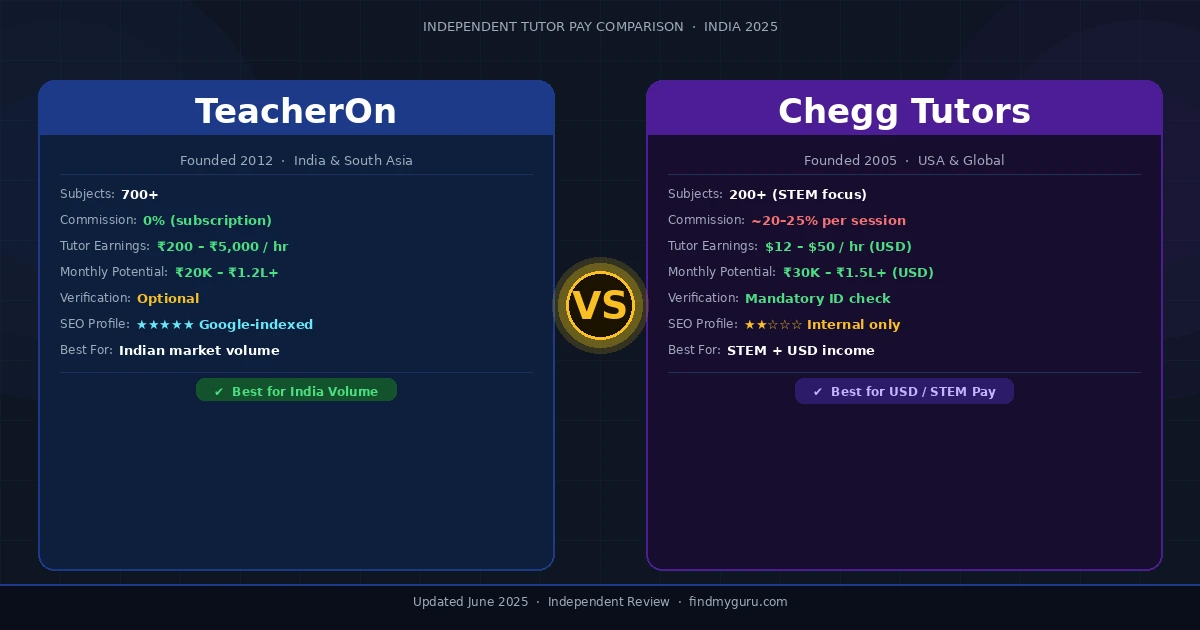
TeacherOn is better for Indian tutors who want zero platform commission, Indian student access, and control over their own rates in INR. Chegg Tutors is better for STEM-specialist tutors who want USD-denominated income from a global student base, with higher per-hour absolute earnings. If your goal is maximum monthly income as an experienced tutor in India, Chegg Tutors currently offers higher per-session pay — but TeacherOn offers higher volume potential for exam coaching and vernacular subjects.
Platform Overview
TeacherOn
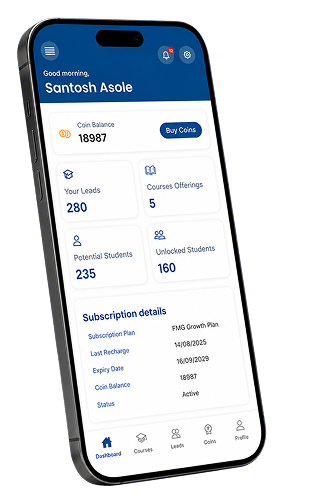
TeacherOn was founded in 2012 and is headquartered in India, making it one of the country's largest online tutor marketplaces. The platform connects students with tutors across 700-plus subjects, covering academic coaching, competitive exam preparation, language learning, music, arts, and professional skills. TeacherOn operates on a subscription model — tutors pay a monthly or annual fee to access contact details of interested students, and the platform charges zero commission on earnings. Platform-reported figures cite over 5 million registered users and tutors across India, Bangladesh, Pakistan, and the Middle East. Its primary user base is Indian students from Class 1 to postgraduate level, along with working professionals seeking skill upgrades.
Chegg Tutors
Chegg Inc. was founded in 2005 and is headquartered in Santa Clara, California, USA. Originally a textbook rental company, Chegg expanded into online tutoring services targeting US college and high school students, with its Chegg Tutors (formerly InstaEdu) division processing thousands of on-demand sessions per day. Chegg's tutoring model focuses on STEM subjects — mathematics, physics, chemistry, biology, engineering, and computer science — and pays tutors in US dollars via direct deposit. Tutors must pass a subject screening test and identity verification before being approved. Platform-reported data indicates over 7 million student users globally, with the majority located in North America. Chegg Tutors does not cater directly to Indian curriculum exams such as JEE, NEET, or UPSC.
TeacherOn vs Chegg Tutors: Full Feature Comparison
Feature | TeacherOn | Chegg Tutors |
Founded | 2012 (India) | 2005 (USA) |
Primary Market | India, South Asia | USA, Global |
Subjects Covered | 700+ subjects | 200+ STEM-focused subjects |
Online / Offline | Both supported | Online only |
Tutor Registration | Free, self-service | Application + screening test |
Student Search Filters | Subject, location, budget, rating | Subject, topic, rating |
Payment Security | Escrow / milestone system | Weekly direct deposit (USD) |
Platform Commission % | 0% (subscription model) | ~20–25% of session fee |
Tutor Sets Own Rate | Yes (full control) | Partially (Chegg sets base rate) |
Student Reviews | Yes, verified reviews | Yes, quality score system |
Background Verification | Optional / self-declared | Identity verification required |
Mobile App | Yes (iOS + Android) | Yes (iOS + Android) |
Trial Classes | Yes | No formal trial system |
Group Classes | Yes | No (1-on-1 only) |
SEO Profile Visibility | High (Google-indexed profiles) | Low (internal search only) |
Monthly Active Users | ~5 million+ (platform-reported) | ~7 million+ (platform-reported) |
Best For | Indian tutors building local + online base | Tutors seeking USD income on STEM topics |
Table Summary: The most critical difference is the fee structure — TeacherOn charges tutors a flat subscription with zero per-session commission, while Chegg deducts approximately 20 to 25 percent from each session. Chegg's dollar-denominated rates can exceed TeacherOn's INR rates in absolute value for STEM tutors, but TeacherOn offers broader subject coverage and higher volume potential within the Indian market.
Tutor Earnings: How Much Can You Make?
Tutor earnings on both platforms depend on subject, experience level, and student demand. On TeacherOn, tutors set their own rates in INR and keep 100 percent of session fees, paying only a platform subscription (approximately ₹800 to ₹1,500 per month, platform-reported). Preply vs TeacherOn On Chegg Tutors, the platform sets a base hourly rate in USD, with top tutors able to increase earnings through quality bonuses — though Chegg deducts its commission before payout. The following table uses a mix of platform-published rates and rates reported by active tutors on public forums as of 2026.
Tutor Level | TeacherOn Rate | Chegg Tutors Rate |
Beginner (0–1 yr exp) | ₹200 – ₹500/hr | USD $12 – $18/hr (~₹1,000 – ₹1,500) |
Mid-Level (2–5 yrs) | ₹500 – ₹1,200/hr | USD $18 – $30/hr (~₹1,500 – ₹2,500) |
Expert / Niche Specialist | ₹1,200 – ₹3,000/hr | USD $30 – $50/hr (~₹2,500 – ₹4,200) |
Competitive Exam (JEE/NEET/UPSC) | ₹1,500 – ₹5,000/hr | Not a primary category |
Monthly Earning Potential | ₹20,000 – ₹1,20,000+ | ₹30,000 – ₹1,50,000+ (USD income) |
Can You Earn ₹1 Lakh/Month? | Yes — at expert/exam level | Yes — at mid-level+ with USD rates |
Earnings Verdict: For raw per-hour pay, Chegg Tutors pays more to STEM tutors due to USD exchange rates — a mid-level Chegg tutor earning USD 25 per hour receives approximately ₹2,100 at current rates, compared to a typical ₹800 to ₹1,200 on TeacherOn for the same subject. However, TeacherOn tutors who specialise in high-demand Indian exam coaching (JEE, NEET, UPSC) and build a repeat student base frequently report monthly earnings of ₹80,000 to ₹1,20,000 — figures reported by tutors in community forums. For Indian tutors who are not STEM specialists, TeacherOn's volume and zero-commission model can deliver comparable or higher net monthly income.
How to Get Your First Student: Step-by-Step Guide
On TeacherOn — Step-by-Step
1. Register at teacheron.com and select your subjects and teaching mode (online, home, or both). Use your real name and a professional photo — profiles with photos receive 3 times more student inquiries, per tutor community reports.
2. Set your hourly rate based on your experience level. Beginners should start at ₹300 to ₹500 per hour and increase rates after collecting five-plus reviews.
3. Choose a subscription plan to unlock student contact details. The monthly plan suits new tutors testing the platform; the annual plan reduces cost per lead by roughly 40 percent.
4. Write a detailed profile bio of 150-plus words covering your qualifications, teaching method, and results achieved. Mention specific exam names such as JEE or CBSE to match student search filters.
5. Respond to student inquiries within one hour. Early response time is a key ranking factor on TeacherOn's internal search algorithm, per tutor community discussions.
6. Offer a 30-minute free or discounted demo class to convert initial inquiries into paid bookings. Tutors who offer demos convert at a significantly higher rate than those who do not, per user-reported data.
7. After each session, politely ask students to leave a verified review. Reviews are the primary trust signal on TeacherOn and directly influence profile ranking.
8. Scale by listing in multiple cities and updating your availability regularly. TeacherOn's algorithm surfaces recently active profiles in search results.
On Chegg Tutors — Step-by-Step
9. Apply at Chegg.com/tutors and select the subjects you want to teach. Unlike TeacherOn, Chegg requires passing a subject knowledge screening test — prepare by reviewing undergraduate-level problem sets before applying.
10. Complete identity verification with a government-issued ID. This step is mandatory and usually takes 24 to 48 hours to process.
11. Set up your payout via direct deposit to a bank account. Chegg pays in USD weekly, so Indian tutors need a bank account that accepts international wire transfers or a multi-currency account.
12. Build your profile with academic credentials, university degrees, and subject specialisations. Chegg students are primarily US college students, so emphasise relevant coursework at undergraduate level and above.
13. Accept your first on-demand session request quickly. Chegg's session matching rewards tutors with fast response times by surfacing their profiles more frequently.
14. Maintain a high quality score by completing sessions fully and receiving positive student ratings. Chegg's quality score system affects both your visibility and eligibility for rate increases.
15. After 20-plus sessions, you may be eligible to apply for a higher base rate. Track your performance metrics in the Chegg tutor dashboard to know when to apply.
Student Experience: Finding a Tutor, Safety and Payment
On TeacherOn
• Students can search by subject, location, budget range, teaching mode, and rating — making it easy to shortlist five to ten tutors in under two minutes.
• Tutor quality signals include verified reviews, teaching experience in years, qualification badges, and response time — all visible on the public profile page.
• Payment is handled directly between student and tutor in most cases, with TeacherOn offering an optional escrow system for added security. This flexibility suits budget-conscious students but may feel less secure to first-time users.
• Background verification is optional and self-declared, which parents of school-age children may find inadequate. TeacherOn does not conduct criminal background checks as standard.
• The mobile app (iOS and Android) is rated positively for ease of browsing and messaging tutors, though some users report that payment integration within the app could be improved.
On Chegg Tutors
• Students submit a question or topic and are matched with an available tutor in real time — the on-demand model suits US college students who need instant help during exam season.
• Tutor quality is indicated by the number of completed sessions, subject expertise level, and student ratings visible on the tutor card.
• Payment is processed fully within the Chegg platform by card or Chegg account credits — students never pay tutors directly, which provides strong payment security and easy refund handling.
• Chegg conducts mandatory identity verification for all tutors, giving parents and students a higher baseline level of trust compared to TeacherOn.
• The on-demand model means students cannot book a specific tutor in advance for a recurring weekly session easily — this limits the platform for students seeking long-term coaching relationships.
Overall, students in India seeking long-term coaching, vernacular-language support, or exam-specific tutoring will find TeacherOn's search and booking experience better suited to their needs. Students in the US or those seeking immediate STEM help will find Chegg's on-demand system more convenient. Chegg edges ahead on payment security and tutor verification; TeacherOn leads on tutor variety and subject breadth.
Which Platform Should YOU Choose?
The right platform depends on who you are and what you need. Use this table to find your match.
Your Situation | Choose TeacherOn | Choose Chegg Tutors |
New tutor building first student base | ✅ TeacherOn — free signup, faster first student | ❌ Chegg screening test can delay start |
Verified expert tutor | ✅ Leverage premium rates in India | ✅ Chegg pays USD — higher absolute value |
Student on a tight budget | ✅ TeacherOn — rates start ₹150/hr | ❌ Chegg is USD-priced, costly for Indian students |
Parent focused on child safety | ⚠️ TeacherOn — optional verification | ✅ Chegg — mandatory identity check |
Competitive exam coaching | ✅ TeacherOn — JEE/NEET/UPSC specialists listed | ❌ Chegg does not specialise in Indian exams |
Looking for international students | ❌ Primarily India-focused platform | ✅ Chegg — global student base (US majority) |
Prefer low platform fees | ✅ TeacherOn — zero commission model | ❌ Chegg takes ~20–25% per session |
Want strong SEO profile visibility | ✅ TeacherOn — Google-indexed public profiles | ❌ Chegg profiles internal only |
Honest Pros and Cons
TeacherOn — Pros and Cons
PROS:
• Zero commission model — tutors keep 100 percent of session earnings after the subscription fee.
• Widest subject coverage in India, including vernacular languages, arts, yoga, and competitive exam coaching.
• Google-indexed public profiles give tutors organic SEO visibility outside the platform.
• Flexible teaching modes — online, home visits, and group classes all supported.
• Free registration to browse and list your profile before committing to a paid plan.
CONS:
• Tutor verification is optional and not independently conducted — safety risk for students booking in-person sessions.
• High tutor supply in popular subjects means new tutors must compete aggressively on price to win first students.
• INR-based earnings limit income ceiling compared to USD-paying platforms when converted to absolute rupee value for STEM topics.
• Subscription fee is a fixed cost regardless of how many students a tutor books in a given month.
Chegg Tutors — Pros and Cons
PROS:
• USD-denominated pay delivers higher per-session income for STEM tutors at current exchange rates.
• Mandatory identity verification builds stronger trust with students and parents.
• Established global brand with a large US student base — steady demand for core STEM subjects.
• Weekly direct deposit ensures consistent, predictable cash flow for active tutors.
• Quality bonus system rewards high-performing tutors with rate increases over time.
CONS:
• Platform commission of approximately 20 to 25 percent reduces effective hourly earnings significantly.
• Subject range is narrow — arts, languages, vernacular subjects, and Indian exam coaching are largely absent.
• Screening test and verification process can delay new tutors from earning for one to three weeks.
• On-demand model makes it difficult to build a loyal, recurring student base on the platform.
Final Verdict: TeacherOn or Chegg Tutors?
Both TeacherOn and Chegg Tutors serve distinct learner needs, but neither fully delivers the personalized, relationship-driven learning experience that today's students increasingly demand.
TeacherOn works well for students seeking a wide range of tutors across global locations, particularly for STEM subjects and languages. Its free-to-contact model lowers the entry barrier, but inconsistent tutor profile completion and a coin-based system can make the experience feel fragmented. Chegg Tutors, on the other hand, has largely pivoted away from live one-on-one tutoring since 2022, now focusing primarily on asynchronous homework help and textbook solutions — making it a better resource tool than a true tutoring platform.
If you're an Indian student looking for consistent, verified, and personalized tutoring, FindMyGuru is the smarter alternative. Unlike TeacherOn's global-first approach or Chegg's homework-centric model, FindMyGuru is purpose-built for Indian learners — covering academics, competitive exams like JEE and NEET, language learning, and skill-based courses. Every tutor on the platform is verified for qualifications and experience, and students can compare profiles, read reviews, and connect directly without any intermediary or coin-based barriers.
Most importantly, FindMyGuru lets tutors keep 100% of their earnings, which attracts genuinely motivated educators — and that directly benefits you as a learner.
Whether you need a home tutor in Hyderabad, an online NEET coach, or a coding mentor, FindMyGuru offers transparency, quality, and flexibility in one place.
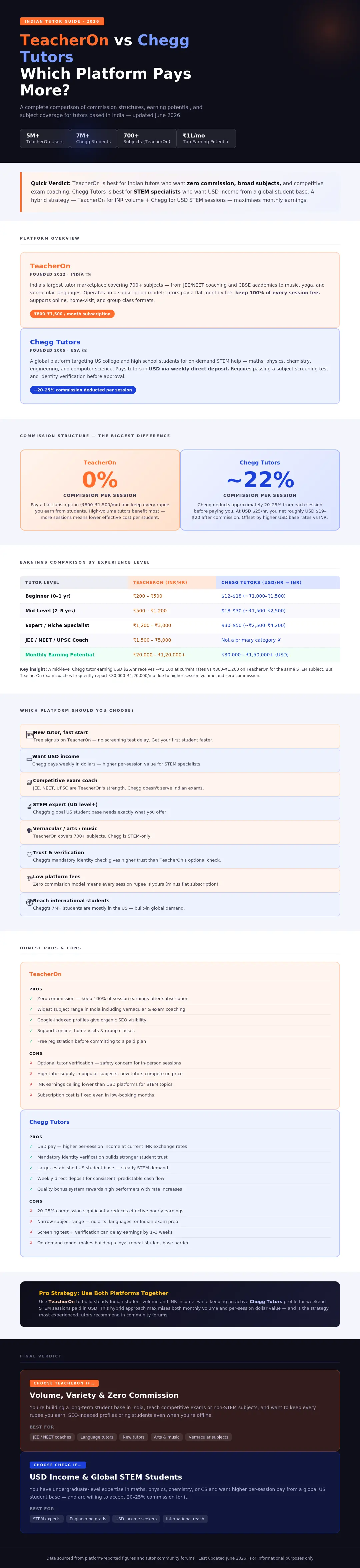
TeacherOn vs Chegg Tutors (2026): Which Platform Pays Indian Tutors More?: infographic
Frequently Asked Questions
