PhysicsWallah vs Vedantu (2026): Which IIT-JEE Coaching Platform Is Better?
This page compares PhysicsWallah and Vedantu specifically for IIT-JEE Main and Advanced preparation, covering pricing, faculty, teaching format, student outcomes, and educator opportunities. It is written for JEE aspirants and parents deciding where to enroll, as well as for educators evaluating where to teach. All figures are drawn from platform-published pricing pages and third-party review sources current as of mid-2026, and are marked accordingly throughout. Last Updated: June 2026
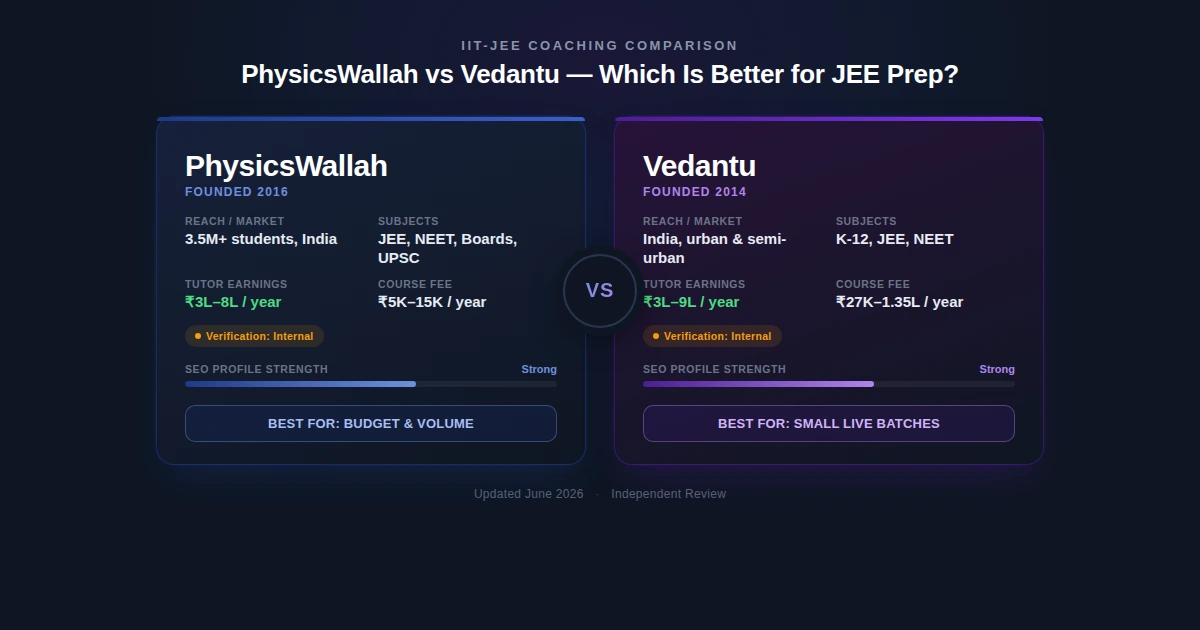
PhysicsWallah is the stronger choice for JEE aspirants who want low-cost, high-volume video-based coaching, with full-year online JEE courses reported in the ₹5,000–₹15,000 range (platform-published). Vedantu is better suited to students who want smaller live batches with more direct teacher interaction, though its full-year JEE/NEET courses cost roughly ₹27,000–₹1,35,000 depending on tier (platform-published). If your priority is affordability and volume of practice material, choose PhysicsWallah; if your priority is structured live mentorship at a higher price point, choose Vedantu.
Platform Overview
PhysicsWallah
PhysicsWallah (PW) began in 2016 as a YouTube channel run by educator Alakh Pandey before formally incorporating as an edtech company. It focuses primarily on the Indian market, targeting JEE, NEET, and school-board students, with additional verticals for UPSC and skill-based courses under PW Skills. The platform reports over 35 lakh (3.5 million) registered students (platform-published) and has expanded into offline "Vidyapeeth" and hybrid "Pathshala" centers across multiple Indian cities. PW's core business model is built on keeping online course fees low — its founder has publicly stated that flagship online batches will stay under ₹5,000 — while monetizing through scale, offline centers, and adjacent skill courses. Its primary user base is budget-conscious students, including many from smaller towns who could not otherwise afford structured JEE coaching.
Vedantu
Vedantu was founded in 2014 by four IIT alumni — Vamsi Krishna, Anand Prakash, Pulkit Jain, and Saurabh Saxena — and built its early reputation on live, interactive online classes delivered through its proprietary WAVE virtual classroom technology. The platform serves K-12 students across CBSE, ICSE, and state boards, alongside dedicated JEE and NEET preparation tracks, and reports a network of several hundred teachers (platform-published). Vedantu's business model centers on tiered subscription packages — Lite, Classic, and Pro/Plus — priced higher than PhysicsWallah's flagship offering, positioning itself as a more premium, mentorship-driven alternative. Its primary user base includes urban and semi-urban families willing to pay more for smaller batches, one-on-one doubt support, and closer teacher contact, though the platform has faced public scrutiny over its financial position and independent review scores in recent years.
PhysicsWallah vs Vedantu: Full Feature Comparison
Feature | PhysicsWallah | Vedantu |
Founded | 2016 | 2014 |
Primary Market | India (Tier 2/3 strong) | India (urban/semi-urban) |
Subjects Covered | JEE, NEET, boards, UPSC, skills | K-12 boards, JEE, NEET |
Online/Offline Support | Both (Vidyapeeth, Pathshala) | Primarily online (WAVE platform) |
Tutor Registration | Recruitment via careers page | Recruitment via careers page |
Student Search Filters | Batch/course selection, not 1:1 marketplace | Batch + 1:1 tutoring option |
Payment Security | In-app/website gateway (platform-published) | In-app/website gateway (platform-published) |
Platform Commission % | Not publicly disclosed | Not publicly disclosed |
Tutor Sets Own Rate | No — fixed salary/stipend model | No — fixed salary/stipend model |
Student Reviews | Mixed; strong on YouTube/app store | Reported as inconsistent on independent review sites |
Background Verification | Internal hiring screening (platform-published) | Internal hiring screening (platform-published) |
Mobile App | Yes, high app-store ratings reported | Yes |
Trial Classes | Free YouTube content + sample batches | 7-day free trial (platform-published) |
Group Classes | Yes, large live batches | Yes, smaller live batches |
SEO/Profile Visibility | Strong brand SEO; no individual tutor profiles | Strong brand SEO; no individual tutor profiles |
Monthly Active Users | Not independently verified | Not independently verified |
Best For | Budget-focused JEE aspirants wanting volume | Students wanting smaller live batches, higher price tolerance |
The clearest divide is price versus batch intimacy: PhysicsWallah wins decisively on affordability and content volume, while Vedantu positions itself around live, more personalized teaching at a meaningfully higher price. Neither platform functions as an open tutor marketplace — both hire instructors directly rather than letting tutors set independent rates or build individual SEO-visible profiles.
Tutor Earnings: How Much Can You Make?
Neither PhysicsWallah nor Vedantu operates as a freelance tutor marketplace where individual educators set their own rates per student. Both instead hire teachers as employees or contracted instructors who are paid a fixed salary or stipend to deliver lectures to large or small live batches. This is a fundamentally different earnings model from peer-to-peer tutoring platforms, so figures below reflect employment-style compensation reported by users and industry sources rather than per-student billing.
Tutor Level | PhysicsWallah | Vedantu |
Beginner (0–1 yr exp) | ~₹3–5 LPA (reported by users) | ~₹3–6 LPA (reported by users) |
Mid-Level (2–5 yrs) | ~₹5–8 LPA (reported by users) | ~₹6–9 LPA (reported by users) |
Expert / Niche Specialist | Senior faculty/top educators: higher, undisclosed (platform-published roles only) | Senior faculty: higher, undisclosed (platform-published roles only) |
Competitive Exam (JEE/NEET) Faculty | Entry-level reported at ₹4–8 LPA (reported by users) | Comparable range reported, not independently confirmed |
Monthly Earning Potential | Roughly ₹35,000–₹65,000/month for early-career faculty (reported by users) | Roughly ₹40,000–₹75,000/month for early-career faculty (reported by users) |
Can You Earn ₹1 Lakh/Month? | Possible only for senior/star educators; not typical for new hires | Possible only for senior/star educators; not typical for new hires |
Earnings Verdict:
Based on user-reported compensation data, Vedantu's reported pay bands run slightly higher than PhysicsWallah's at the entry and mid-career level, which may reflect its more premium course pricing. However, neither platform discloses exact compensation structures, and actual pay varies widely by subject, seniority, and whether the role is full-time, contract, or per-lecture. Reaching ₹1 lakh per month on either platform is realistic mainly for established, high-visibility educators — such as those with large personal followings — rather than for new entrants, since both platforms pay fixed salaries rather than allowing tutors to scale earnings by raising their own rates.
How to Get Hired and Build a Teaching Career: Step-by-Step Guide
Because neither platform is a freelance marketplace, the relevant path for educators is getting hired and building internal visibility rather than acquiring individual students. The steps below reflect the general hiring and growth process reported by faculty and described on each platform's careers pages.
On PhysicsWallah — Step-by-Step
1. Apply through PW's official careers page or job postings, typically requiring subject expertise and a teaching demo. Insider tip: candidates with an engineering or science background from a recognized institute, or strong content-creation experience, are reportedly prioritized.
2. Record or deliver a sample teaching segment as part of the screening process. Insider tip: PW's hiring reportedly weighs clarity of explanation and on-camera presence heavily, since much content is video-first.
3. Complete any internal training or onboarding modules offered to new educators. Insider tip: familiarize yourself with PW's JEE/NEET batch structure (e.g., Lakshya, Arjuna, Prayas) before onboarding so you understand which student segment you'll teach.
4. Get assigned to a live batch, recorded course, or doubt-solving rotation. Insider tip: doubt-solving and DPP (Daily Practice Problem) review assignments are a common starting point for newer faculty.
5. Build a teaching track record within assigned batches. Insider tip: consistency and strong batch completion rates are reportedly considered in performance reviews.
6. Seek opportunities to host bonus sessions, webinars, or YouTube content. Insider tip: visibility on PW's YouTube channel can meaningfully raise an educator's internal profile and negotiating power.
7. Request feedback and performance reviews to identify paths to senior or lead faculty roles. Insider tip: senior educators with strong student outcomes are sometimes given expanded batches or marketing involvement.
8. Negotiate compensation or role changes based on demonstrated outcomes. Insider tip: educators who can point to specific student results (ranks, score improvements) reportedly have stronger negotiating leverage.
On Vedantu — Step-by-Step
9. Apply via Vedantu's careers page, generally requiring subject mastery and prior teaching or tutoring experience. Insider tip: Vedantu has historically emphasized hiring IIT/NIT alumni and postgraduate subject experts for JEE faculty roles.
10. Undergo a teaching demo using Vedantu's WAVE virtual classroom tool. Insider tip: comfort with interactive digital tools (whiteboards, live polls, quizzes) is reportedly assessed directly, since Vedantu's format leans heavily on real-time interactivity.
11. Complete platform-specific onboarding on the WAVE technology and lesson-delivery standards. Insider tip: Vedantu's smaller batch sizes mean individual teaching style and rapport are reportedly weighted more than in high-volume formats.
12. Get assigned to live batches across Lite, Classic, or Pro/Plus tiers. Insider tip: higher-tier batches are smaller, and educators report these allow more direct student interaction and feedback.
13. Build a consistent teaching history and gather internal performance feedback. Insider tip: student engagement metrics within live sessions (quiz participation, doubt resolution speed) are reportedly tracked by the platform.
14. Take on master classes or guest sessions to build visibility within Vedantu's broader student base. Insider tip: master classes are a common way newer-to-platform educators get exposure to larger student pools.
15. Pursue senior or lead faculty status based on tenure and outcomes. Insider tip: as with PW, documented student results are reportedly the strongest lever for career progression.
The key difference in onboarding: PhysicsWallah's hiring and training process leans toward video-content delivery skills given its YouTube-rooted model, while Vedantu's process places more emphasis on live, interactive small-batch teaching technique using its proprietary WAVE platform.
Student Experience: Choosing a Batch, Safety & Payment
On PhysicsWallah
• Course discovery is straightforward: students select a batch (e.g., Lakshya, Arjuna) by class and goal rather than searching individual tutor profiles.
• Filtering is limited to course/batch type rather than granular tutor-level filters, since PW does not operate a marketplace of individual educators.
• Quality signals come primarily from instructor reputation (notably founder Alakh Pandey and other named faculty) and large YouTube subscriber bases, rather than per-tutor review scores.
• Payment is handled through PW's website or app checkout for course fees; refund policies are platform-specific and should be checked at enrollment.
• Safety and trust are supported by PW's scale and public brand visibility, though students should independently verify current centre operations before enrolling in offline batches.
On Vedantu
• Course discovery happens through Vedantu's category pages (JEE, NEET, boards) with tier selection (Lite/Classic/Pro), plus a 7-day free trial reported on the platform's pricing pages.
• Filtering allows some choice between live group batches and one-on-one tutoring, offering more format flexibility than PhysicsWallah.
• Quality signals are mixed: Vedantu emphasizes IIT-alumni faculty credentials, but independent review aggregators have reported comparatively low audience review scores in recent years, which prospective students should weigh.
• Payment is processed via Vedantu's website/app, with EMI options reported for higher-tier annual packages.
• Safety and trust considerations include verifying Vedantu's current financial and operational stability, given public reporting on the broader Indian edtech sector's volatility, before committing to a long multi-year package.
Overall, PhysicsWallah offers a simpler, lower-stakes entry point — free YouTube content plus inexpensive paid batches — while Vedantu offers more format flexibility (live small batches, 1:1 options) at meaningfully higher price points, with student experience quality varying more by individual batch and review source.
Which Platform Should YOU Choose?
The right platform depends on who you are and what you need for JEE preparation. Use this table to find your match.
Your Situation | Choose PhysicsWallah | Choose Vedantu |
New JEE aspirant on a tight budget | Yes — flagship online courses reported under ₹5,000–₹15,000 | Less ideal — full-year courses start around ₹27,000+ |
Wants small live batches with more 1:1 access | Less ideal — batches can be very large | Yes — smaller batch and 1:1 tutoring options available |
Dropper/repeater needing intensive structure | Yes — dedicated dropper/Prayas-style batches available | Yes — dedicated full-year JEE/NEET tracks also available |
Parent prioritizing brand longevity/track record | Moderate — younger company, fast-growing | Moderate — older company, but recent scrutiny over financial stability |
Student who wants free supplementary content first | Yes — extensive free YouTube lecture library | Limited — mostly trial-based, less free long-form content |
Looking for offline/in-person centre options | Yes — Vidyapeeth and Pathshala physical centres | Limited — primarily online delivery |
Prefers EMI/flexible payment plans | Available on higher-tier offline programs | Available, reported on annual Pro/Plus packages |
Educator seeking a content-creation-style teaching role | Yes — YouTube-rooted model rewards on-camera teaching | Less emphasis — model is live small-batch focused |
Honest Pros and Cons
PhysicsWallah — Pros & Cons
PROS:
• Significantly lower course fees, with flagship online JEE batches reported under ₹5,000–₹15,000
• Large free YouTube content library covering full JEE syllabus
• Strong brand recognition built specifically around Physics/Chemistry/Math instruction for JEE and NEET
• Growing offline centre network (Vidyapeeth, Pathshala) for students who want in-person classes
• Reports thousands of IIT qualifiers among its student base (platform-published)
CONS:
• Very large batch sizes can limit individual teacher attention, as noted in user reviews
• Some lecture sessions reported as overly long (2+ hours), which can affect focus
• No marketplace-style tutor profiles or independent rate-setting for educators
• Detailed compensation and commission structures are not publicly disclosed
Vedantu — Pros & Cons
PROS:
• Live, interactive WAVE classroom technology with real-time quizzes and leaderboards
• Smaller batch tiers and 1:1 tutoring options for students wanting closer interaction
• Faculty credentialed with IIT/postgraduate backgrounds (platform-published)
• 7-day free trial before committing to a paid plan (platform-published)
CONS:
• Meaningfully higher course fees than PhysicsWallah for comparable JEE preparation
• Independent review aggregators have reported inconsistent or comparatively low audience ratings in recent periods
• Public reporting on broader edtech-sector financial pressure has raised questions some users factor into long-term enrollment decisions
• Less free long-form content available compared to PhysicsWallah's YouTube library
Final Verdict: PhysicsWallah or Vedantu for IIT-JEE?
PhysicsWallah is best for cost-conscious JEE aspirants who want extensive practice material, a large free content library, and the option of low-cost offline centres. Vedantu is best for students who specifically want smaller live batches, more interactive real-time teaching tools, and are willing to pay a substantially higher price for that format. For tutors and educators, PhysicsWallah's model rewards strong on-camera, content-style teaching at scale, while Vedantu's model rewards live small-group facilitation skill. A hybrid strategy many JEE aspirants reportedly use is starting with PhysicsWallah's free YouTube content to build fundamentals, then supplementing with a paid batch on either platform — or a smaller live-format option like Vedantu — closer to exam time for structured test-series practice and faster doubt resolution. Bottom line: choose PhysicsWallah for affordability and volume, choose Vedantu for smaller, more interactive live batches — and verify current pricing and platform stability directly before enrolling in either.
More Comparisons:
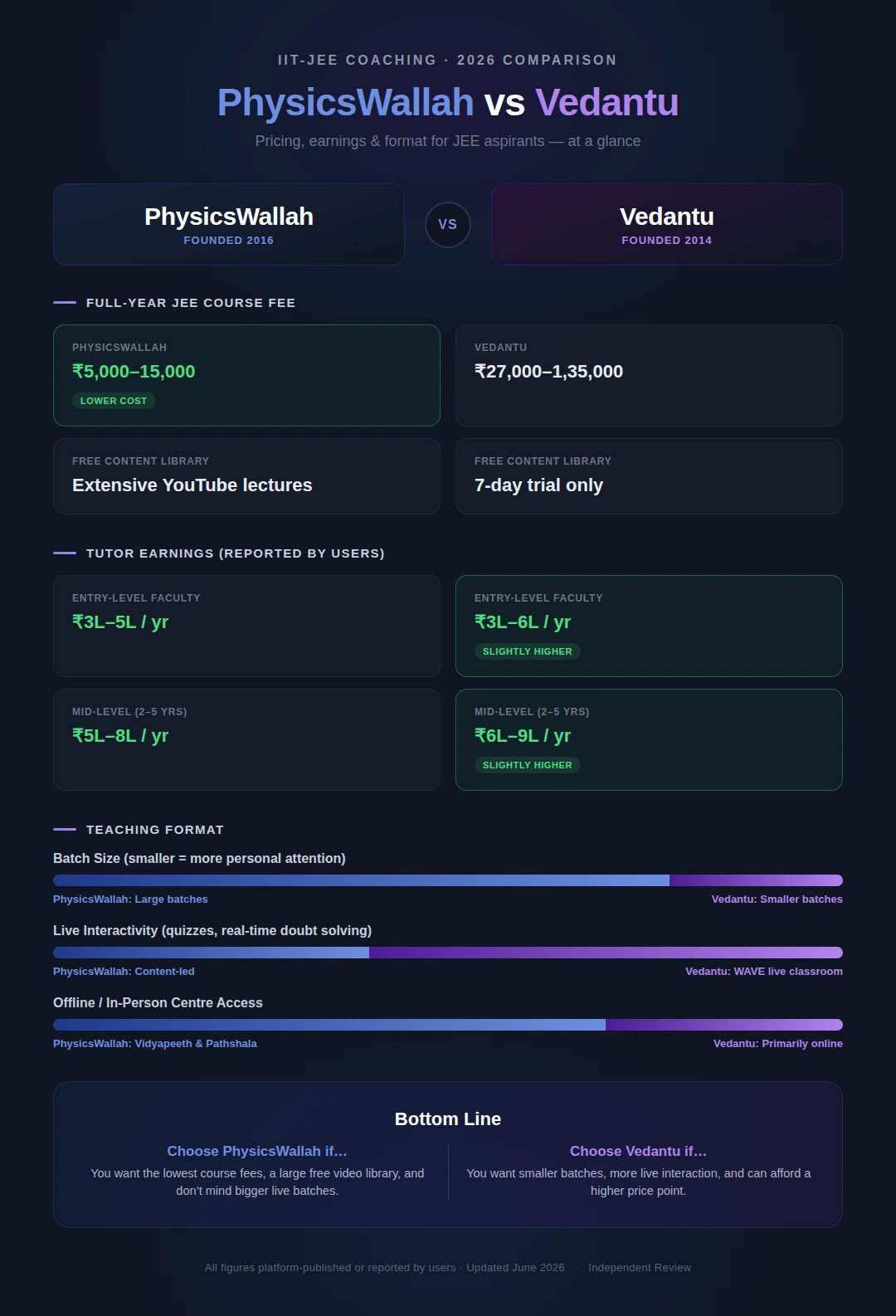
PhysicsWallah vs Vedantu (2026): Which IIT-JEE Coaching Platform Is Better?:infographic
Frequently Asked Questions
