Chegg vs Vedantu (2026): Which Platform Is Best for Indian Tutors?
This page compares Chegg and Vedantu across tutor earnings, platform model, student experience, and fees — covering everything Indian tutors and students need to decide between the two in 2026. Chegg vs Vedantu is one of the most searched comparisons in Indian edtech, and this independent review cuts through marketing claims to give you verified, sourced data. Last Updated: June 2026
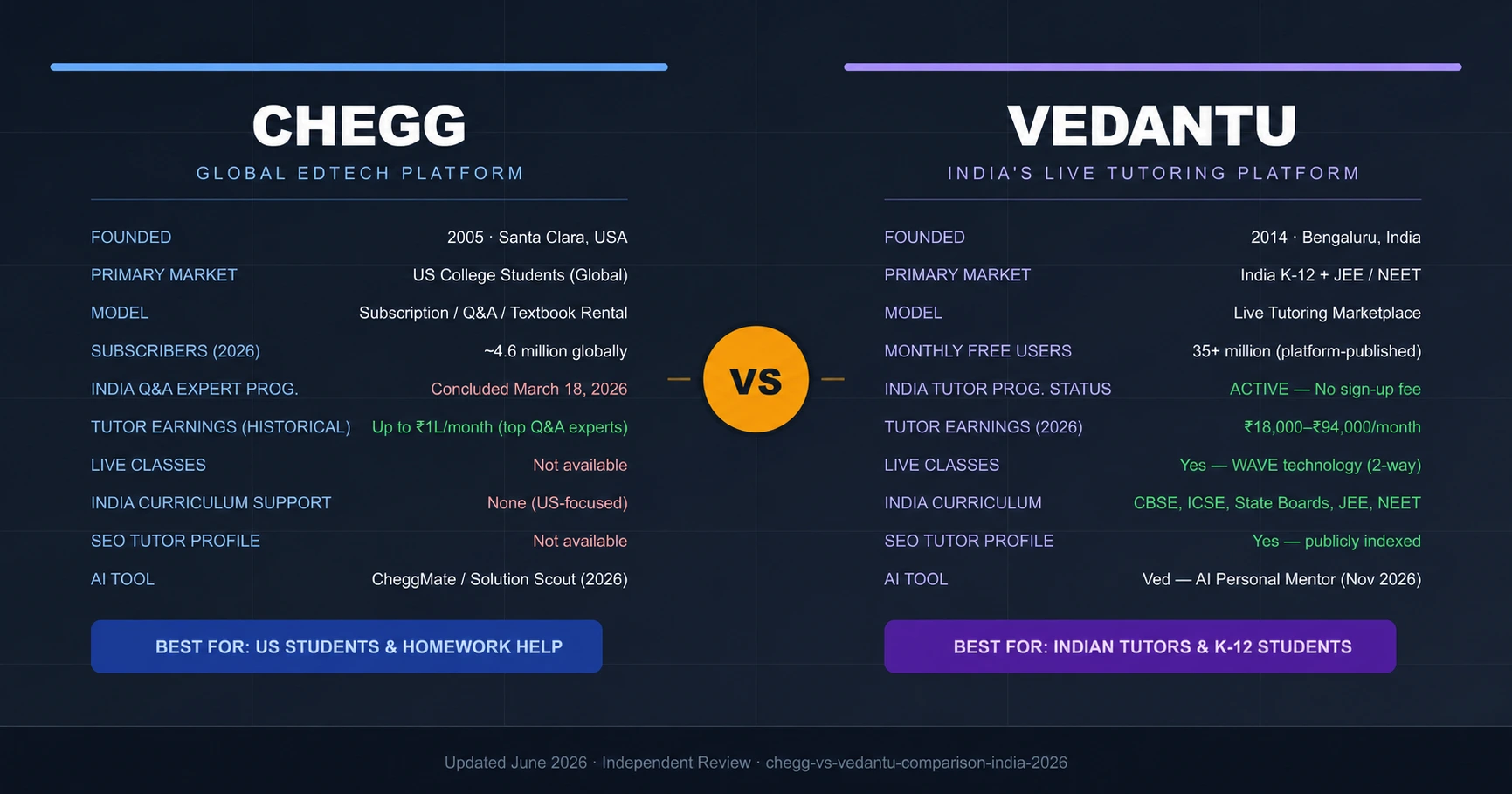
Vedantu is the stronger choice for Indian tutors who want live, sustained teaching income, offering ₹18,000–₹94,000/month (per Glassdoor data) through structured live classes with their own rate-setting. Chegg historically offered a flexible Q&A-based income for subject matter experts in India, but its India Q&A Expert operations concluded on March 18, 2026, making it unavailable as a tutor income source as of mid-2026 onwards. For students, Vedantu provides live interactive classes and competitive exam coaching, while Chegg (via its global platform) remains a subscription-based homework-help and textbook service primarily serving US/international students. If you are an Indian tutor looking to earn through online teaching in 2026, Vedantu is the operational choice.
Platform Overview
Chegg — Overview
Chegg, Inc. was founded in 2005 by Aayush Phumbhra and Osman Rashid at Iowa State University, initially as a textbook rental service modelled on Netflix. The company went public in 2013, raising US$187.5 million, and is headquartered in Santa Clara, California. Chegg's core global business model is a subscription service (around US$15.95/month for Chegg Study; US$19.95/month for the Study Pack), giving students access to expert Q&A, step-by-step textbook solutions, math solvers, and writing tools. At its peak, Chegg had approximately 7.7 million subscribers globally; by 2026 this had declined to around 4.6 million, largely as a result of competition from free AI tools such as ChatGPT. Chegg India operated a separate Q&A Expert programme that hired Indian subject matter experts to answer student questions on a per-answer basis, but this India-specific programme concluded on March 18, 2026. Chegg's global revenue was US$375 million in 2026 (platform-published financials). Its primary user base is US-based high school and college students.
Vedantu — Overview
Vedantu was founded in 2011 and launched as an online tutoring platform in 2014 by IIT alumni Vamsi Krishna, Pulkit Jain, Anand Prakash, and Saurabh Saxena, who had previously co-founded Lakshya (acquired by MT Educare in 2012). Headquartered in Bengaluru, Karnataka, Which tutoring platform has lowest fees India Vedantu is India's first live interactive online tutoring platform and achieved unicorn status in September 2021 at a valuation of US$1 billion. The platform serves students in grades 4 to 12 across CBSE, ICSE, and state board curricula, as well as competitive exam aspirants for JEE, NEET, NTSE, and Olympiads. Vedantu uses its proprietary WAVE (White Board Audio Video Environment) technology for two-way live classes. As of 2026, monthly active users on Vedantu's free content channels exceed 35 million; its YouTube channel records 65 million views monthly in the K-12 segment. The platform reached its first profitable quarter in March 2026 and has raised a total of US$337 million in funding. Tutors set their own hourly rates within platform guidelines and are paid monthly.
Chegg vs Vedantu — Full Feature Comparison
Feature | Chegg | Vedantu |
Founded | 2005 (Chegg India: 2012) | 2011/2014 (India launch) |
Headquarters | Santa Clara, California, USA | Bengaluru, Karnataka, India |
Primary Market | USA / global (India Q&A ended Mar 2026) | India (K-12 & competitive exams) |
Business Model | Subscription (students); per-answer pay (experts) | Live tutoring marketplace; subscription courses |
Subjects Covered | STEM, humanities, business (college-level focus) | STEM, languages, social sciences, coding (K-12 focus) |
Teaching Format | Asynchronous Q&A / homework help; no live classes | Live interactive classes (1-on-1 and group via WAVE) |
Tutor / Expert Registration | Subject test + document verification (India ops closed) | Application + demo class + document verification |
Student Search / Matching | AI/platform-matched Q&A (no direct student search) | Students browse tutor profiles and book sessions |
Tutor Sets Own Rate | No (platform sets per-answer pay rate) | Yes (within platform guidelines) |
Platform Commission % | Not publicly disclosed; per-answer model | Not publicly disclosed; hourly pay model |
Payment Security | Monthly NEFT payout (India, now concluded) | Monthly payout by 5th of each month |
Student Reviews for Tutors | No direct public tutor review system | Yes — tutor ratings visible to students |
Background / Academic Verification | Yes — degree + ID verification for experts | Yes — profile screening + teaching demo required |
Mobile App | Yes (Chegg Study app — primarily for US students) | Yes (Vedantu app — iOS and Android, India-focused) |
Live / Trial Classes | No live classes; Q&A is asynchronous | Yes — demo/trial sessions available |
Group Classes | No | Yes (group and 1-on-1) |
Competitive Exam Coaching | Limited (college-level exam prep in the US) | Strong — JEE, NEET, NTSE, Olympiads |
AI Tools | CheggMate (AI study assistant, in development 2026) | Ved — AI-powered personal mentor (launched Nov 2026) |
SEO Profile Visibility | No public tutor profile page | Yes — tutor profiles indexed publicly |
Monthly Active Users | ~4.6 million subscribers globally (2026) | 35+ million monthly free users; millions of paid students |
Offline Centres | No | Yes — 20+ cities for JEE/NEET prep |
Best For | US-based students needing homework/textbook help | Indian K-12 students and competitive exam aspirants |
The two platforms serve fundamentally different use cases. Chegg is a global subscription service built for US college students, with its India Q&A expert programme now closed. Vedantu is a live-tutoring marketplace squarely focused on India's K-12 and competitive exam market. For Indian tutors and students in 2026, these are not interchangeable alternatives — Vedantu is the operational choice.
Tutor Earnings — How Much Can You Make?
Understanding tutor earnings on both platforms requires looking at their fundamentally different models. Chegg paid Indian experts on a per-answer basis, with earnings dependent on answer volume and quality scores. Vedantu pays tutors on an hourly basis for live classes, with tutors setting their own rates within platform guidelines. The table below uses platform-published figures and user-reported data aggregated from Glassdoor, Indeed, and third-party review sources — all figures are estimates and not guaranteed income.
Tutor / Expert Level | Chegg India (Historical — ops ended Mar 2026) | Vedantu (Active — 2026) |
Beginner (0–1 yr exp) | ₹12,000–₹18,000/month (4–5 hrs/week, Q&A) | ₹15,000–₹25,000/month (2–3 hrs/day live classes) |
Mid-Level (2–5 yrs) | ₹20,000–₹40,000/month (higher answer volume) | ₹25,000–₹50,000/month (strong ratings, 4+ hrs/day) |
Expert / Niche Specialist | ₹40,000–₹80,000/month (STEM, Finance subjects) | ₹50,000–₹94,000/month (premium subjects, full-time) |
Competitive Exam (JEE/NEET) | Not applicable (Chegg focused on US college level) | ₹50,000–₹94,000/month (highest demand category) |
Monthly Earning Potential | Up to ~₹1 lakh reported (top Q&A experts) | ₹18,000–₹94,000 per Glassdoor (platform-published range) |
Can You Earn ₹1 Lakh/Month? | Reported by select experts (now historical only) | Possible for full-time tutors in high-demand subjects |
Hourly Rate | ₹80–₹200/answer equivalent (reported by users) | ₹150–₹1,500/hour (subject and grade dependent) |
Payment Method | NEFT bank transfer by 15th of month (concluded) | Direct bank transfer by 5th of each month |
Registration Fee | None (platform-published) | None (platform-published) |
Earnings Verdict:Vedantu offers clearer, verifiable earning potential for Indian tutors in 2026 because its live-class model is currently operational, its hourly pay structure is transparent, and tutors set their own rates. Platform-published data indicates tutors earn between ₹18,000 and ₹94,000 per month, with JEE/NEET specialists at the higher end. Chegg India's Q&A expert programme, which at its peak offered up to ₹1 lakh/month for top experts in STEM subjects, is no longer available following the March 2026 shutdown. For any tutor evaluating these two platforms today, Vedantu is the only active option.
How to Get Your First Student — Step-by-Step Guide
On Vedantu — Step-by-Step
1. Visit vedantu.com/become-a-teacher and submit the registration form. Fill in your academic background, subject specialisation, and preferred teaching hours.
Tip: Tutors with IIT/NIT/top-university backgrounds or postgraduate degrees in their subject are prioritised in profile screening.
2. Prepare for the profile screening call. Vedantu's academic team reviews your profile for qualification match before inviting you to a demo.
Tip: Have a clear teaching philosophy ready — Vedantu values tutors who see themselves as end-to-end learning partners, not just content deliverers.
3. Deliver a teaching demo on a topic of your choice. You will teach a short session demonstrating your communication style, use of the digital whiteboard, and student engagement.
Tip: Choose a conceptually rich topic at Class 10–12 or JEE level — this signals readiness for Vedantu's core demand.
4. Complete onboarding documentation and training. Submit your degree certificates, government ID, and bank details.
Tip: Complete the Vedantu teacher training modules in full — tutors who finish them receive better profile placement in the first 90 days.
5. Set your hourly rate within platform guidelines. Vedantu allows tutors to price their sessions and update rates periodically. Tip: Start slightly below the market rate for your subject to build student reviews quickly in the first month.
6. Accept your first student booking and conduct a thorough session. Use the WAVE whiteboard actively — students and parents rate sessions partly on visual explanation quality.
Tip: Send a session summary to the student/parent after every class; this dramatically improves your rating and rebooking rate.
7. Collect reviews and build your profile reputation. After each session, encourage students to rate you.
Tip: A profile with 10+ verified reviews appears significantly higher in student search results.
8. Scale by adding more session slots and offering group classes. Once you have consistent bookings, expand from 1-on-1 sessions to group batches to multiply your hourly output.
Tip: Group classes for JEE/NEET subjects are in the highest demand on Vedantu and command premium per-student rates.
On Chegg — Step-by-Step (Historical Reference — India Operations Concluded March 2026)
Note: The Chegg India Q&A Expert programme is no longer accepting new sign-ups for Indian experts as of March 18, 2026. The steps below are documented for reference purposes — for example, understanding old payment slips or evaluating historical data. Tutors seeking active income should refer to the Vedantu guide above.
9. Visit cheggindia.com and click 'Become an Expert'. Register with basic details and select your subject. Tip: Chegg India did not charge any registration fee — any third party asking for payment claimed false affiliation.
10. Take the subject-specific expertise test. The test assessed your ability to provide accurate, well-structured answers in your field. Tip: Chegg's July 2026 authoring guidelines required new hires to submit at least 3 solutions with an average QC score of 4.5 or higher.
11. Submit academic documents and ID verification. Aadhaar Card or PAN Card and degree certificates were required. Tip: Mismatches between name on ID and bank account caused the most payment delays reported by users.
12. Complete the mandatory Practice Site phase. Answer sample questions under evaluation before gaining access to Live Q&A. Tip: The 100-question skip limit was enforced — skipping too many questions before completing 3 high-quality answers could reset your progress.
13. Access Live Q&A and answer student questions. Questions came from US and global college-level students, predominantly in STEM. Tip: High-demand STEM and Finance questions commanded better per-answer rates than general humanities.
14. Monitor your Quality Control (QC) score. Chegg used AI and human evaluators to rate your answers. Tip: Step-by-step structured answers with clear explanations consistently scored higher than brief responses, even for correct answers.
15. Receive monthly payout via NEFT by the 15th. India payouts covered valid responses submitted in the previous month. Tip: Maintaining consistent answer quality was more important than answer volume for sustained earnings.
Student Experience — Finding a Tutor, Safety & Payment
Chegg — Student Experience
• Search & Access: Students access Chegg through a monthly subscription (around US$15.95/month for Chegg Study), gaining access to a library of step-by-step solutions and the ability to submit up to 20 questions per month to experts. There is no direct tutor-browsing experience — the platform matches questions to experts.
• Content Quality: Chegg Study covers a vast library of textbook solutions, predominantly US-aligned curricula. The Expert Q&A feature provides human-verified answers, which students report as more reliable than AI-generated responses for complex STEM problems.
• Payment & Pricing: The student-facing model is subscription-only (no per-session fees). Chegg also offers textbook rentals that can be up to 90% cheaper than buying, which is a significant draw for US college students. India students pay from ₹299/month for the India service tier.
• Safety & Trust: Chegg requires expert verification and uses AI moderation on answer quality. However, the platform has faced documented criticism regarding academic integrity — some universities explicitly prohibit Chegg use, and Australia's Tertiary Education Quality and Standards Agency sued Chegg in 2024 for alleged violations.
• AI Tools: Chegg's Solution Scout (launched 2026) lets students compare responses from ChatGPT, Google Gemini, and Claude alongside Chegg's expert content, providing a multi-source verification layer for answers.
Vedantu — Student Experience
• Search & Booking: Students browse tutor profiles directly on Vedantu, filter by subject, grade, price, and availability, and book live sessions. The platform's AI recommendation engine also surfaces tutors based on learning history and performance data.
• Live Interaction Quality: Sessions run through the WAVE platform — a proprietary two-way whiteboard and video environment. Students report average session ratings of 4.8/5, and each student spends an average of 50 hours on the platform per month (platform-published, YourStory).
• Payment & Pricing: Students pay per course or per session directly to Vedantu, which handles tutor payouts separately. Long-term course fees are non-refundable under standard Vedantu policy — the most frequently cited complaint on consumer review platforms (MouthShut rating: 1.37/5 from 2,180 votes as of January 2026) relates to refund denials, not teaching quality.
• Safety & Trust: All Vedantu tutors pass document verification and a mandatory teaching demo. Student and parent ratings are publicly displayed on tutor profiles. Vedantu is a legitimate operating company backed by institutional investors — not a scam — but parents should review refund policies carefully before committing to long-term courses.
• Competitive Exam Support: Vedantu's JEE Main 2026 results (750+ students above 90th percentile; 8 students at 99.9 percentile in JEE 2024) indicate strong teaching quality in its top exam preparation batches, particularly for Physics and Mathematics.
Overall Student Experience: Chegg delivers more value for US-based college students who need on-demand homework help, textbook access, and asynchronous Q&A. Vedantu delivers more value for Indian K-12 students and competitive exam aspirants who benefit from live, interactive, teacher-led sessions. For Indian students, Vedantu is the operationally active and contextually relevant choice in 2026.
Which Platform Should YOU Choose?
The right platform depends on who you are and what you need. Use this table to find your match.
Your Situation | Choose Chegg | Choose Vedantu |
New tutor building first student base | Not available for Indian tutors (India ops closed) | Yes — structured onboarding, demo process, and profile visibility |
Verified expert tutor wanting income | Not available in India from mid-2026 onwards | Yes — set your own rate, monthly payout, scalable to group classes |
Student needing homework / assignment help | Yes — best for US college-level Q&A and textbook solutions | Partial — Vedantu offers doubt-clearing but focuses on live classes |
Indian student preparing for JEE / NEET | No — Chegg does not offer Indian competitive exam coaching | Yes — dedicated JEE, NEET, NTSE, and Olympiad programmes |
Parent focused on child safety and verified teaching | Not applicable for live tutoring | Yes — all tutors are demo-verified and rated by students/parents |
Student on a tight budget | Yes — US$15.95/month Chegg Study subscription is cost-effective for homework help | Partial — Vedantu free content (35M monthly users) is extensive; paid courses are premium priced |
Prefer no platform fees / free registration | No registration fee (historical); now unavailable in India | No registration fee for tutors; no upfront fee for students to browse |
Want strong SEO / public profile visibility | No public tutor profile | Yes — Vedantu tutor profiles are publicly indexed |
Seeking international students | Historically yes via Chegg Q&A (now closed in India) | Primarily Indian students; some international reach via app |
Prefer asynchronous / flexible-schedule work | Yes — Q&A format was fully flexible (now historical) | Partial — some flexibility but minimum 3 hrs/day commitment expected |
Honest Pros and Cons
Chegg — Pros
• Global brand recognition and an established content library of millions of textbook solutions, making it highly useful for US and international college students.
• Subscription pricing (from US$15.95/month) is cost-effective compared to traditional tutoring rates, particularly for students needing quick homework help.
• No live scheduling required — the asynchronous Q&A model allows students to get answers 24/7 without coordinating availability with a tutor.
• Solution Scout (2026) integrates responses from multiple AI models alongside expert-verified content, giving students a useful cross-check tool.
• Strong textbook rental service offers physical and digital textbook access at up to 90% cheaper than buying, a significant financial benefit for US students.
Chegg — Cons
• Chegg India's Q&A Expert income programme concluded on March 18, 2026 — it is no longer a viable tutor income source for Indian professionals.
• The platform has faced significant criticism and legal challenges regarding facilitation of academic dishonesty; some universities explicitly ban its use.
• Subscriber base declined from a peak of ~8 million in 2022 to ~4.6 million in 2026, reflecting structural challenges from free AI competition.
• No live tutoring, no tutor profile visibility, and no India-focused curriculum support — the platform does not serve the core needs of Indian students or tutors in 2026.
Vedantu — Pros
• India's first live online tutoring platform with a decade of operational experience, backed by US$337 million in institutional funding and achieving its first profitable quarter in March 2026.
• Tutors set their own rates and receive a verified, structured payout by the 5th of every month — no registration fee required for either tutors or students to join.
• Proprietary WAVE technology delivers a genuinely interactive two-way classroom, averaging 4.8/5 session ratings and 80% student attendance per month (platform-published).
• Strong competitive exam performance — JEE 2026 data shows 750+ students above the 90th percentile and 8 students at 99.9 percentile, validating teaching quality in top batches.
• AI innovation through the November 2026 launch of 'Ved' — a personalised AI mentor that adapts to each student's learning history without replacing live teachers.
Vedantu — Cons
• Consumer review scores from platforms like MouthShut (1.37/5 from 2,180 votes) and PissedConsumer are consistently low, with refund denials as the most cited complaint — students and parents should review refund policies before committing to long-term paid courses.
• Tutors are expected to commit a minimum of 3 hours daily (4 PM–10 PM IST peak window), which may not suit tutors seeking fully flexible scheduling.
• Earning potential at the beginner level (₹15,000–₹25,000/month) is modest, particularly for tutors in lower-demand subjects or lower grades.
• The platform has undergone significant layoffs (over 1,000 employees in 2022) and financial restructuring, though its March 2026 profitable quarter signals recovery.
Final Verdict — Chegg or Vedantu?
While Vedantu and Chegg dominate the platform comparison headlines, Indian tutors in 2026 are increasingly exploring a third path: independent tutoring through marketplaces like FindMyGuru, where there are no mandatory hourly commitments, no platform-dictated rate caps, and no subject restrictions tied to exam boards.
FindMyGuru operates as a tutor discovery platform — tutors build a public profile, list their subjects, set their own fees, and connect directly with students across India. Unlike Vedantu's structured live-class model (which expects a minimum 3 hours/day peak-hour commitment), FindMyGuru suits tutors who want full scheduling flexibility — whether they teach academic subjects like Mathematics, Science, or English, or skill-based courses like Yoga, Music, Guitar, or Digital Marketing.
For students and parents, FindMyGuru offers verified tutor profiles across subjects and cities — from Hyderabad and Bangalore to Delhi and Chennai — with the ability to compare tutors by experience, location, and subject before booking. This is particularly valuable for parents seeking home tutors or specialised skill instructors rather than standardised exam-prep courses.
The bottom line in 2026: if you are an Indian student preparing for JEE or NEET, Vedantu's live coaching pipeline is hard to beat. If you are a US college student needing quick homework help, Chegg's subscription library still serves that need. But if you are an Indian tutor who wants to teach on your own terms — any subject, any city, any schedule — FindMyGuru gives you the flexibility neither platform offers.
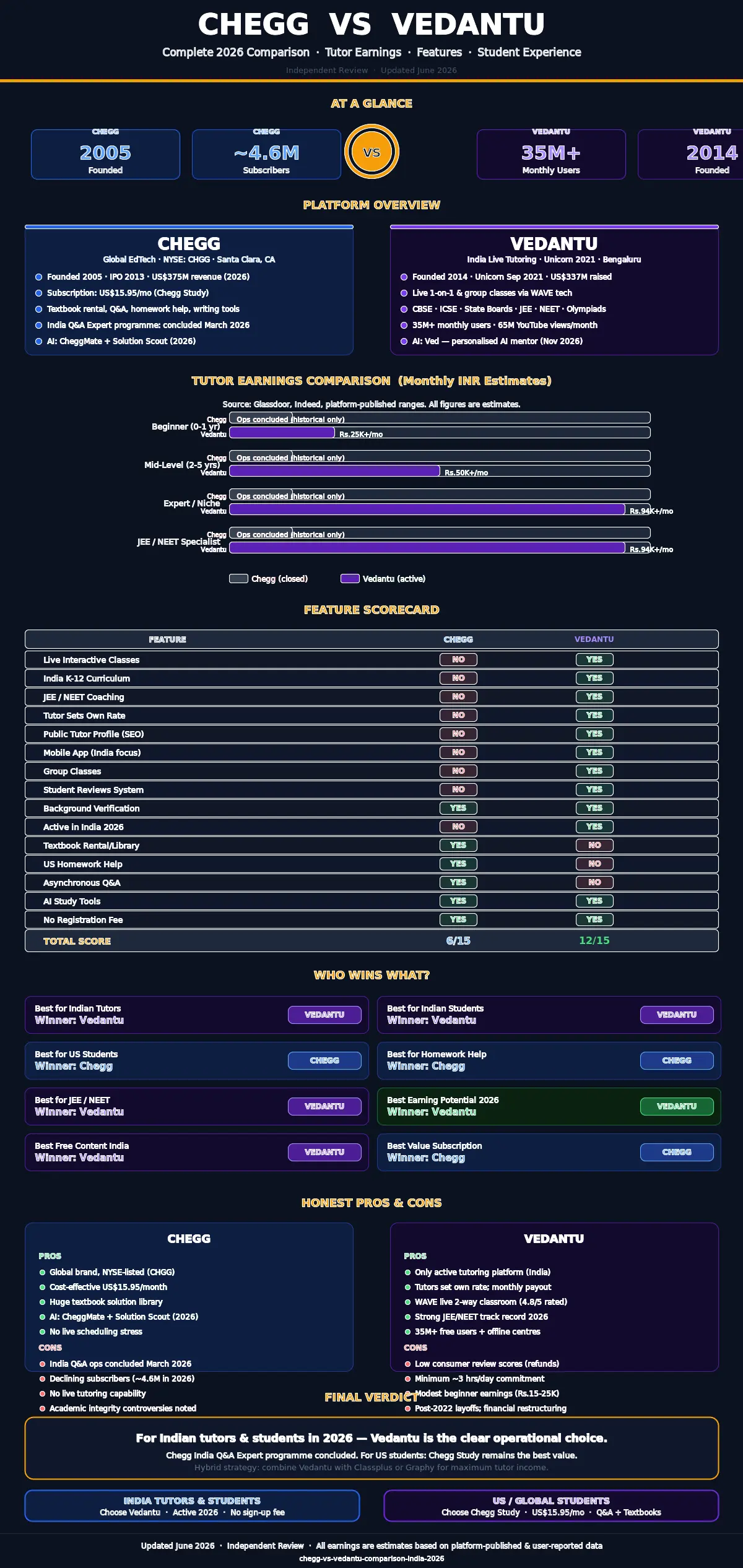
Chegg vs Vedantu (2026): Which Platform Is Best for Indian Tutors?: Infographic
Frequently Asked Questions
